
How to read a Piranesi title
Every plate of Le Vedute di Roma is lettered along the foot with its title, often with a numbered key to the buildings in the view, so the sheet tells you what you are looking at, in Italian. A handful of words covers most titles. Many monuments also had other names in Piranesi’s day: some popular, some ancient, some since corrected by archaeologists. The sections below translate them. What are Piranesi’s Vedute di Roma? explains the series as a whole.
The Colosseum: Anfiteatro Flavio
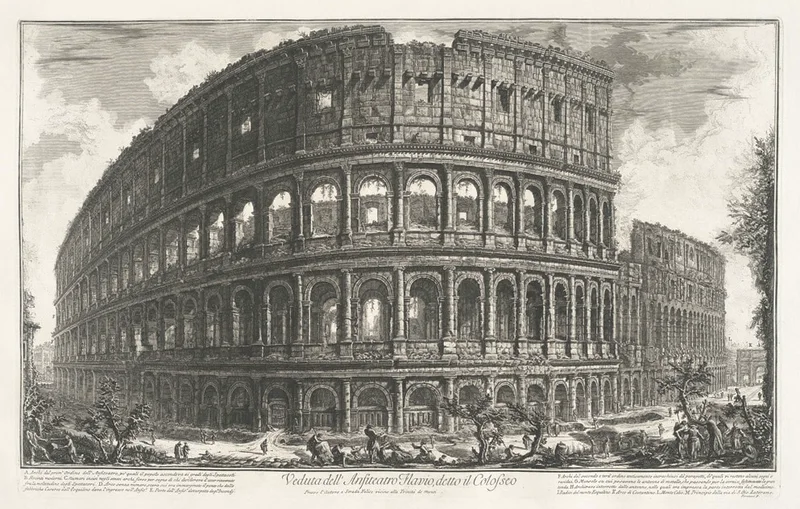
Piranesi calls the Colosseum by its ancient name, the Flavian Amphitheatre, after the emperors who built it in the first century: Anfiteatro Flavio, detto il Colosseo, “the Flavian Amphitheatre, called the Colosseum”. Five plates show it. Two are views of the outside: Veduta dell’Anfiteatro Flavio, detto il Colosseo, seen from a raised point with the broken outer ring at the right, and a second view of the exterior under the same title.
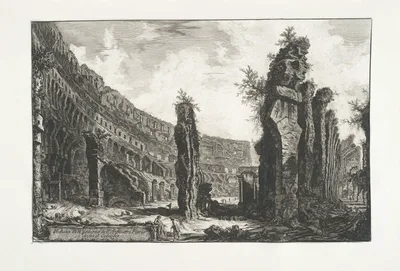
Two go inside: Veduta dell’interno dell’Anfiteatro Flavio, where trees grow from the broken piers and the people are tiny, and Veduta interna del Colosseo. The fifth, Vedute dell’Arco di Costantino e dell’Anfiteatro Flavio, sets the Arch of Constantine beside it.
The Pantheon: Pantheon d’Agrippa and la Rotonda
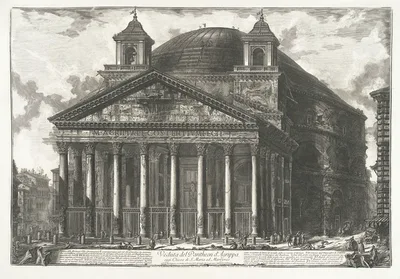
The exterior, Veduta del Pantheon d’Agrippa oggi Chiesa di S. Maria ad Martyres, names the building twice: after Agrippa, whose name is cut in the frieze, M AGRIPPA L F COS TERTIUM FECIT, “Marcus Agrippa, son of Lucius, consul for the third time, made this”; and as the church it had been since the seventh century, Santa Maria ad Martyres. The building itself was rebuilt under Hadrian, who kept Agrippa’s inscription. On Piranesi’s plate the portico still carries two small bell towers, added in the seventeenth century and taken down in 1883.
Three more plates go inside: Veduta interna del Pronao del Pantheon, within the portico, and two views of the domed interior, Veduta interna del Pantheon and Veduta interna del Pantheon volgarmente detto la Rotonda, “commonly called the Rotonda”, the Romans’ own name for it. The square in front is the subject of Veduta della Piazza Rotonda.
The Trevi Fountain: Acqua Vergine
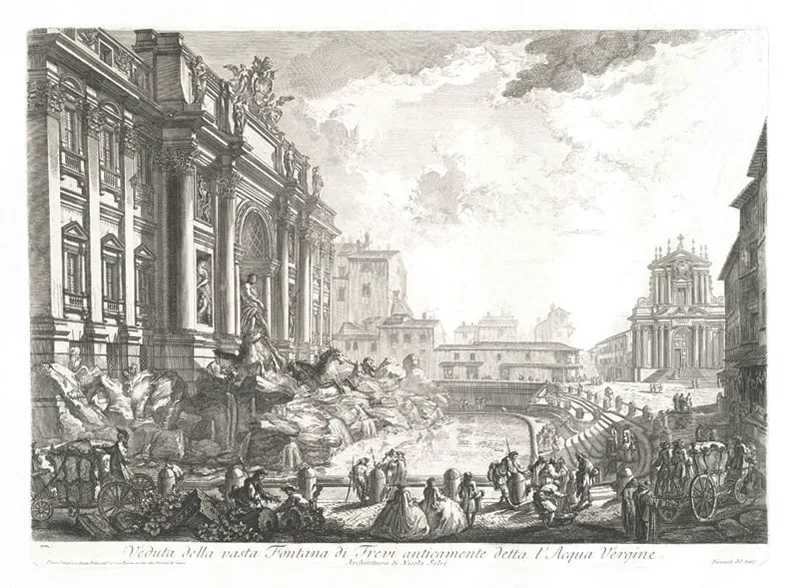
The fountain was new in Piranesi’s day. Nicola Salvi’s design was begun in 1732 and finished in 1762, and both of Piranesi’s plates credit him: Architettura di Nicola Salvi. Both also name the water that feeds it, the Acqua Vergine, the aqueduct Agrippa built in 19 BC and the popes restored, which still runs into the basin today.
Veduta della vasta Fontana di Trevi, whose full lettering adds anticamente detta l’Acqua Vergine, “anciently called the Acqua Vergine”, looks at the fountain from the side, across the basin, with carriages and crowds in the square. Veduta in prospettiva della gran Fontana dell’Acqua Vergine detta di Trevi faces it head on: the whole palace front, Oceanus and his tritons on the rocks below, and the small square opened out like a stage.
St Peter’s: Basilica Vaticana
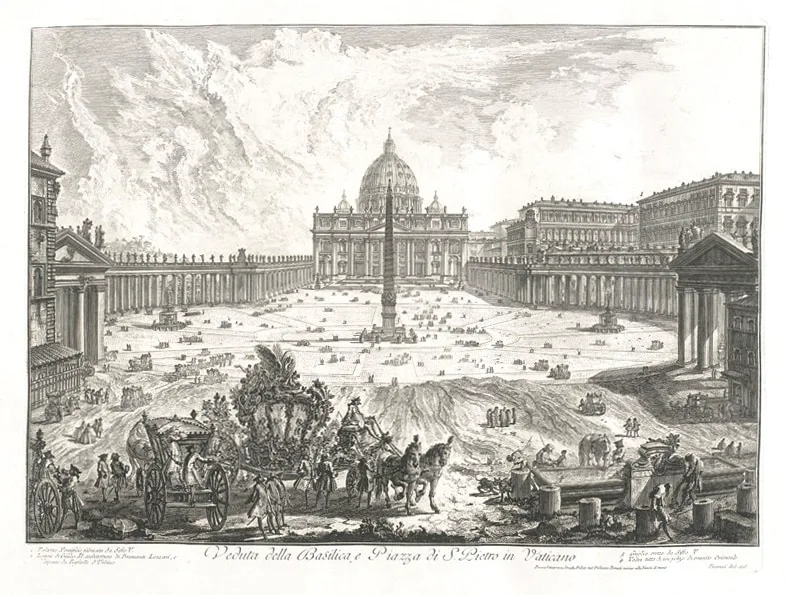
No building in Rome has more plates in our series than St Peter’s: six. Two show the basilica with Bernini’s colonnade and the square in front: Veduta dell’insigne Basilica Vaticana coll’ampio Portico, e Piazza adjacente, “the famous Vatican Basilica with its great portico and the square beside it”, and Veduta della Basilica e Piazza di S. Pietro in Vaticano, with the obelisk at the centre of the square and carriages in the foreground.
Veduta della gran Basilica di S. Pietro and Vedute dell’Esterno della Gran Basilica di S. Pietro in Vaticano show the building itself, and two plates titled Veduta interna della Basilica di S. Pietro in Vaticano, the first and the second, take you inside.
Piazza Navona: Circo Agonale
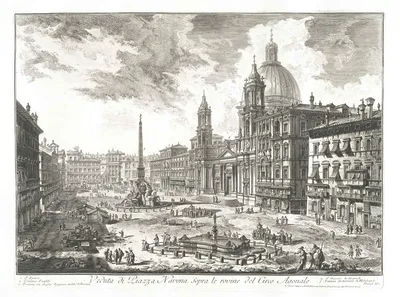
Piazza Navona keeps the long shape of the stadium of Domitian, and Piranesi’s title says so: Veduta di Piazza Navona sopra le rovine del Circo Agonale, “Piazza Navona over the ruins of the Circus Agonalis”. Our series has two plates with this title, the first and the second. In Piranesi’s day the square was also a market; Bernini’s Fountain of the Four Rivers stands at its centre, in front of Borromini’s church of Sant’Agnese in Agone.
Castel Sant’Angelo: Mausoleo d’Elio Adriano
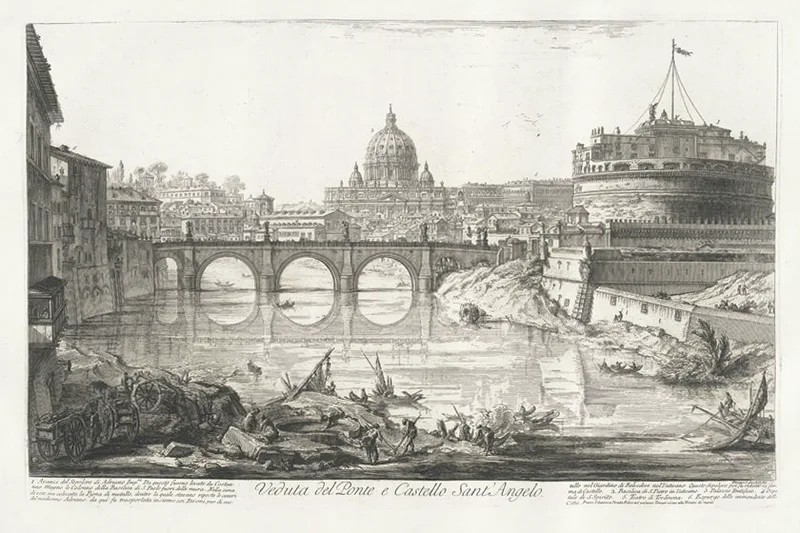
The papal fortress on the Tiber began as the tomb of the emperor Hadrian, Publius Aelius Hadrianus, in the second century, and Piranesi gives it both names, in two plates. Veduta del Ponte e Castello Sant’Angelo shows the castle as Rome knew it, with the bridge and its statues of angels in front and the dome of St Peter’s behind. Veduta del Mausoleo d’Elio Adriano calls it by the name of the ancient tomb.
The Capitol: Campidoglio
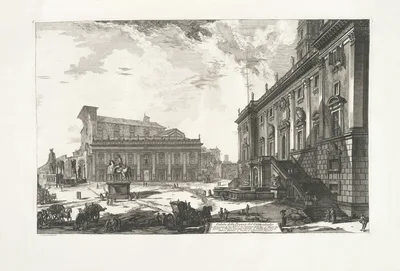
Three plates show the Capitoline Hill. Vedute del Romano Campidoglio con Scalinata che va’ alla Chiesa d’Araceli sets the Capitol beside the long flight of steps up to the church of Santa Maria in Aracoeli. Veduta della Piazza del Campidoglio stands in the square Michelangelo designed, with the bronze horseman of Marcus Aurelius at its centre, named in the key below the view; the statue itself is now indoors in the Capitoline Museums, and a copy stands in its place. Veduta del Campidoglio di fianco shows the Capitol from the side.
The Roman Forum: Campo Vaccino
In Piranesi’s day the Roman Forum lay buried under metres of earth and served as a pasture and cattle market, the Campo Vaccino or “cow field”. Two plates are titled Veduta di Campo Vaccino, the second a different view; the first looks across the field, past the Arch of Septimius Severus standing deep in the ground, to the Colosseum on the horizon. A third, Veduta del Sito, ov’era l’antico Foro Romano, is “a view of the site where the ancient Roman Forum was”.
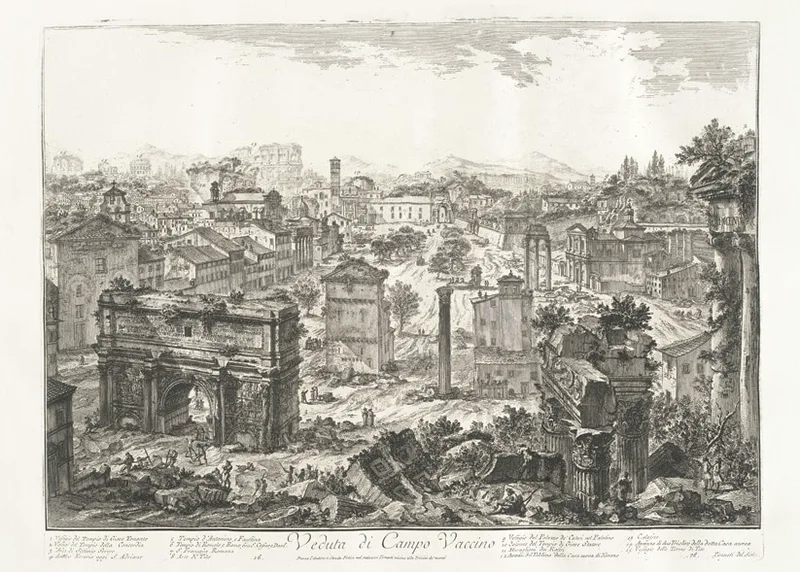
The monuments of the Forum have plates of their own, some under names that have since changed:
- Arco Settimio Severo and Veduta dell’Arco di Settimio Severo: the Arch of Septimius Severus.
- Veduta dell’Arco di Tito and a second view: the Arch of Titus.
- Veduta del Tempio di Antonino e Faustina in Campo Vaccino: the Temple of Antoninus and Faustina, long since the church of San Lorenzo in Miranda.
- Veduta del Tempio di Giove Tonante: the columns Piranesi knew as the Temple of Jupiter the Thunderer, today identified as the Temple of Vespasian.
- Veduta del Tempio detto della Concordia and Altra Veduta degli avanzi del Pronao del Tempio della Concordia: the temple “called” of Concord, today the Temple of Saturn.
- Veduta degli avanzi del Tablino della Casa Aurea di Nerone, detti volgarmente il Tempio della Pace: the great vaults then called the Temple of Peace, today the Basilica of Maxentius.
More of Rome in the series
- Arch of Constantine: Veduta dell’Arco di Costantino.
- Spanish Steps: Veduta di Piazza de Spagna, the square at their foot.
- Piazza del Popolo: Veduta della Piazza del Popolo.
- Trajan’s Column: Colonna Trajana.
- Column of Marcus Aurelius: Colonna Antonina, as Romans call it.
- Baths of Caracalla: Rovine delle Terme Antoniniane.
- Baths of Diocletian: Veduta degli avanzi superiori delle Terme di Diocleziano.
- Pyramid of Cestius: Piramide di C. Cestio.
- Tomb of Caecilia Metella on the Appian Way: Sepolcro di Cecilia Metella.
- Theatre of Marcellus: Teatro di Marcello.
- Tiber Island: Veduta dell’Isola Tiberina.
- St John Lateran: Veduta della Basilica di S. Giovanni in Laterano.
- Santa Maria Maggiore: Veduta della Basilica di Sta Maria Maggiore.
- Outside the city, at Tivoli: Veduta del Tempio della Sibilla in Tivoli and, at Hadrian’s Villa, Avanzi del Tempio del Dio Canopo.
The views at Heritage Prints
Every plate named here is in our series. Each is a facsimile made from the original, at the size of the original sheet, 81 by 55 centimetres (31.9 by 21.7 inches), or the other way up for the few upright plates such as the two columns, with the full margins and Piranesi’s lettering. Re-Art Special Art Productions in Almere photographs each plate and prints it for us on acid-free etching paper of 270 g/m² with archival inks. The edition is 250 of each plate, numbered in pencil, blind embossed and with a certificate of authenticity.
Browse all the views on Le Vedute di Roma. Who was Giovanni Battista Piranesi? tells his story, and Nolli’s map of Rome shows the city the views were made in.
Four monuments to start with
Questions
Which Piranesi etchings show the Colosseum?
Five plates of the Vedute di Roma: two views of the outside titled Veduta dell’Anfiteatro Flavio, detto il Colosseo, two of the interior, and a view of the Arch of Constantine with the Colosseum. Piranesi uses the ancient name, Anfiteatro Flavio.
Did Piranesi make a view of the Trevi Fountain?
Two: a side view, Veduta della vasta Fontana di Trevi, and a frontal one, Veduta in prospettiva della gran Fontana dell’Acqua Vergine detta di Trevi. Both credit the architect, Nicola Salvi.
Which Piranesi views show St Peter’s and the Pantheon?
Six show St Peter’s: two with the square and Bernini’s colonnade, two of the building and two interiors. Four show the Pantheon: the exterior, the portico and two interiors, and a fifth the Piazza della Rotonda in front of it.
Why does Piranesi call the Forum Campo Vaccino?
Because that is what Romans called it in his day: the “cow field”, a half-buried pasture and cattle market among the ruins. Large-scale excavation of the Forum came only in the nineteenth century.