
A book too big for one pair of hands
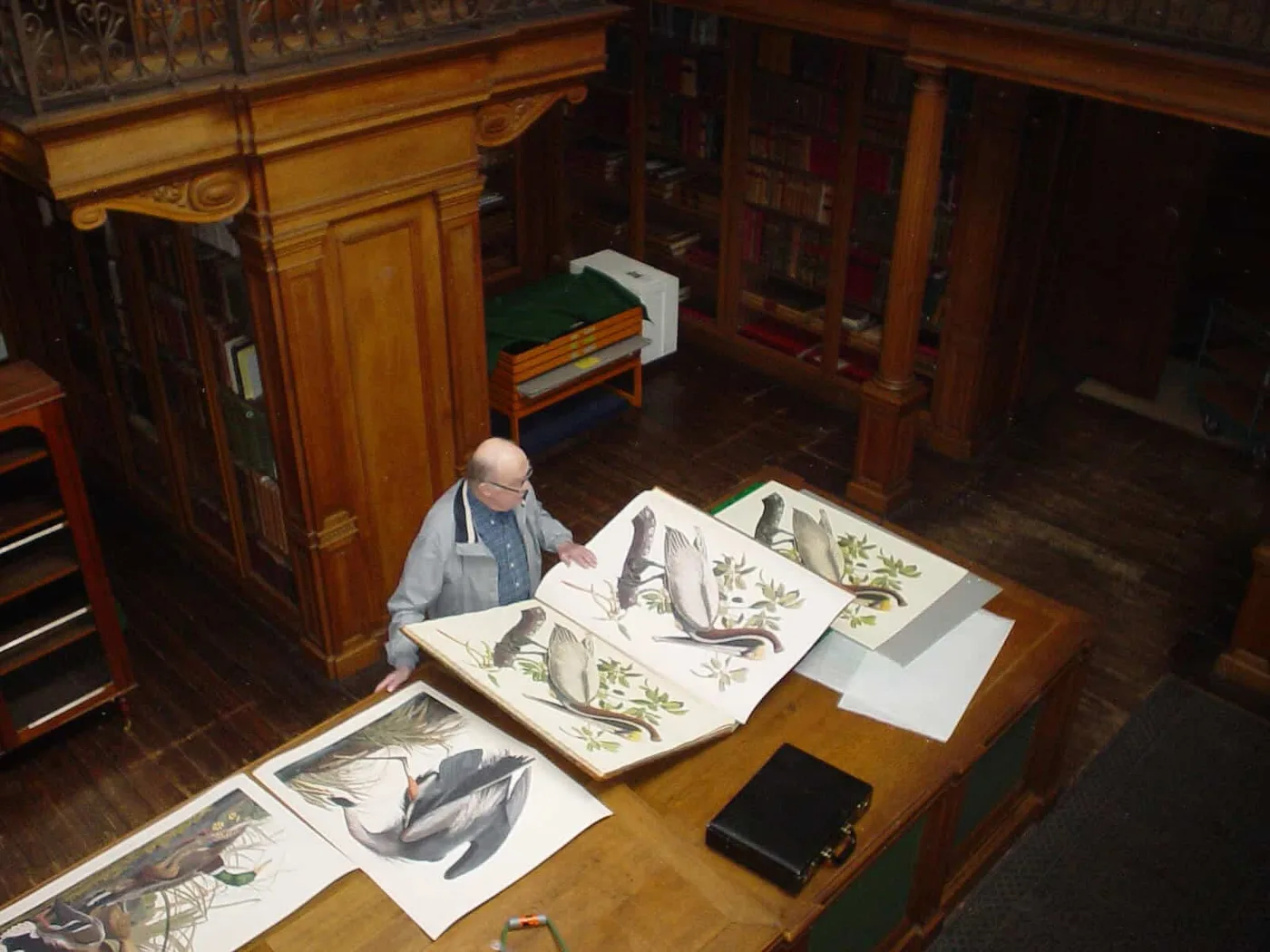
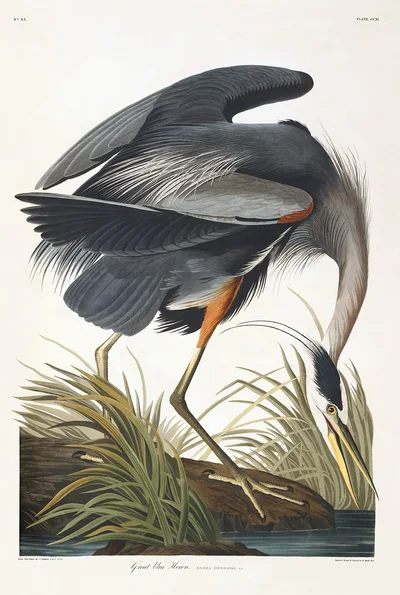
The pages are a metre tall. In the library of the Teylers Museum in Haarlem, a volume of The Birds of America is opened by two people rather than one, and the plate they turn to shows a Great Blue Heron at its full height, neck folded down to fit the paper. Nothing about the book is modest. It is one of the largest books ever printed, one of the most expensive ever sold at auction, and the work that made John James Audubon the most famous bird painter there has been.
This article answers the questions we are asked most often: what the book is, how its plates were made, why it still matters, and how a plate from the copy in Haarlem can hang on your own wall.
The Birds of America in brief
The Birds of America is a collection of 435 hand-coloured engravings of North American birds, drawn by John James Audubon (1785 to 1851) and published in London between 1827 and 1838. Every bird is shown at its real size, which is why the sheets measure about 100 by 67 centimetres (39½ by 26½ inches), a paper size known as double elephant folio. Because the plates were engraved, printed and coloured in the workshop of Robert Havell, this first edition is also called the Havell edition.
It was not sold as a finished book. Subscribers received it in parts over eleven years and had the sheets bound when the last part arrived. The text, Audubon’s Ornithological Biography, was published separately, so the plates carry nothing but the bird, its name and the plate number.
Who was John James Audubon?
Audubon was born in 1785 on his father’s sugar plantation in Saint-Domingue, now Haiti, and raised in France. In 1803 his father sent him to America to keep him out of Napoleon’s army. There he found the obsession of his life. “I felt an intimacy with them bordering on frenzy,” he wrote of birds, and he set himself the task of finding, observing and drawing every species on the continent.
He was self-taught, kept detailed journals of what he saw, described 25 species new to science, and is thought to be the first person in America to ring birds, tying yarn to their legs to prove that they returned to the same nest each spring. He died at his home in northern Manhattan in January 1851. More about Audubon and his work.
Why every bird is life-size
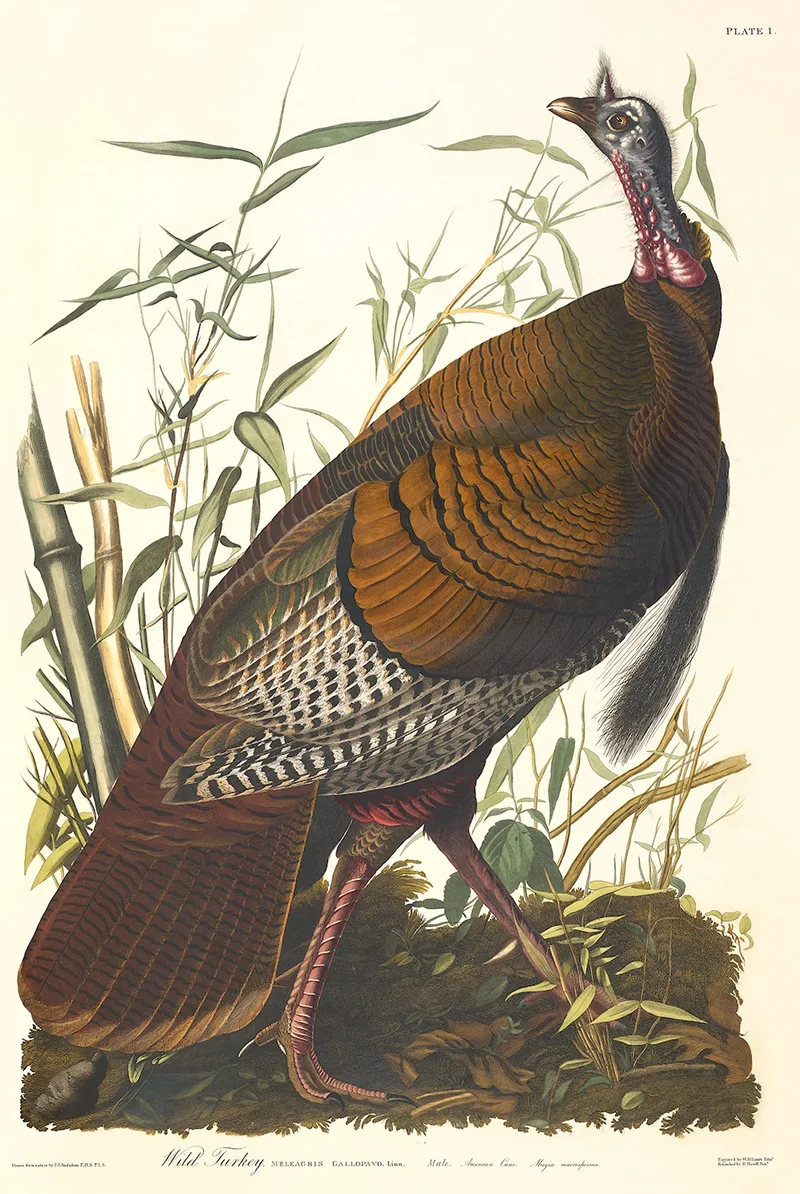
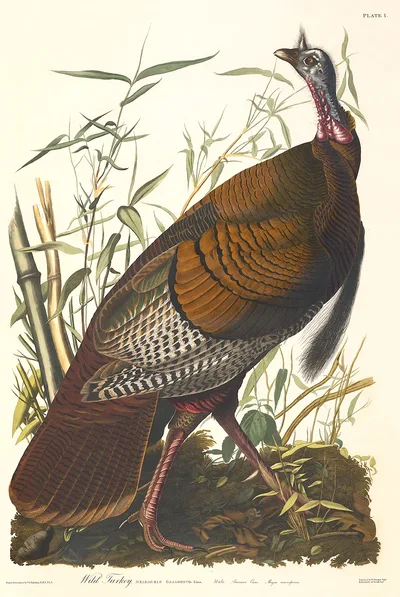
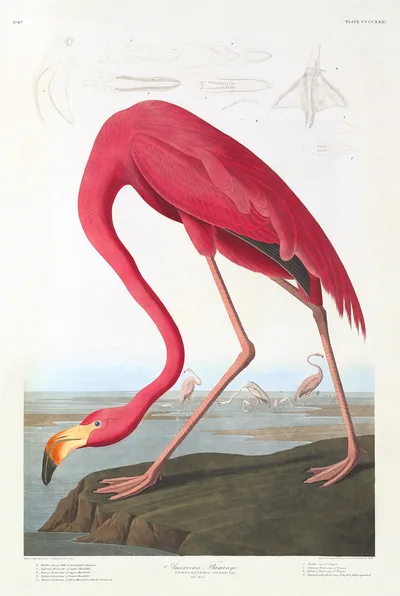
Audubon’s rule was simple and expensive: each bird at its true size, in its own landscape, doing what it does. A goldfinch fits easily on a double elephant sheet. A flamingo, which stands five feet tall, does not. So the flamingo bends to drink, the Great Blue Heron folds its neck as if hunting, and the Wild Turkey of plate 1 walks to the right while looking back over its shoulder, which keeps it inside the page and gives the composition its tension.
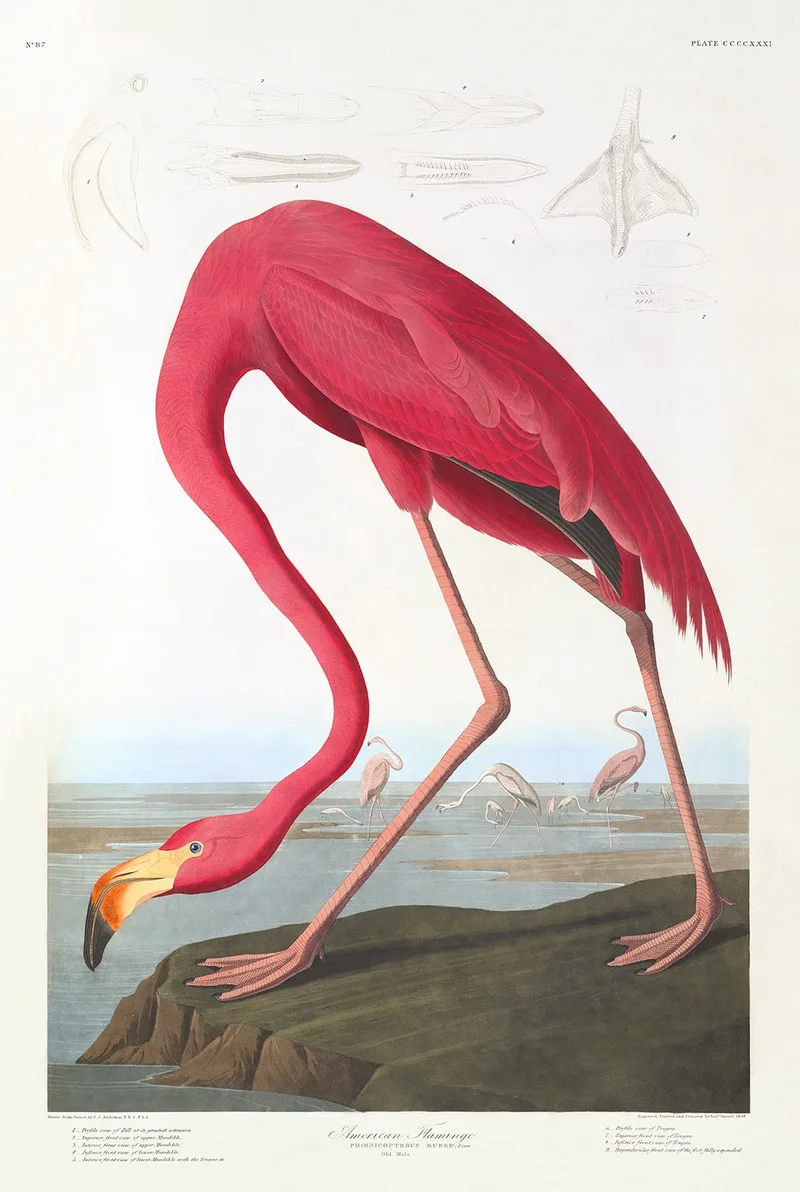
The poses came from the field, but the drawings were made indoors. Audubon shot his specimens, pinned them with wires into lifelike attitudes and drew them at once, before the colours faded. Other artists of his day drew stuffed birds in stiff profile; Audubon drew birds feeding, fighting and flying. He worked in watercolour and graphite, added pastel for the softness of owls and herons, and on three plates (the Wild Turkey, the Mallard and the hummingbirds of plate 47) laid a metallic gold paint under the watercolour. On a large bird such as the White-headed Eagle he could spend four fifteen-hour days.
How the plates were made: Havell, aquatint and hand colouring
No American engraver or publisher would take the project on, so in 1826 Audubon sailed to England with his drawings. The British liked them at once. In London the work went to the engraver Robert Havell Jr., whose name appears below the birds: “Engraved, Printed & Coloured by R. Havell”.
Each drawing was transferred to a copper plate the size of the sheet, using three techniques together. Etching and engraving gave the lines: the outline of the bird, the barbs of the feathers, the lettering. Aquatint, in which fine tone is bitten into the copper through a layer of resin dust, gave the soft shading of sky, water and plumage. The plate was inked and printed on handmade paper, and then the real labour began: every impression was coloured by hand, in watercolour, by a team of colourists working from Audubon’s originals and from bird skins, so that the colours matched.
The arithmetic is daunting. About 200 copies were printed, so one plate meant about 200 sheets to colour, and 435 plates meant something like 87,000 sheets in all. Audubon estimated that some 40 people worked on the engraving and colouring over the eleven years of production.
Published in parts for subscribers, 1827 to 1838
The book was sold by subscription, in 87 parts of five plates each: one large bird, one medium and three small, so that every part held something spectacular and the costly large plates were spread across the years. Part 1 opened with the Wild Turkey. Audubon toured England and Scotland to find subscribers, then returned to America in 1829 to draw the birds he still lacked.
A subscriber who stayed the course received the final part in 1838. Many did not stay the course, and in the years since, copies have been broken up and sold plate by plate, which is why only about 120 complete copies are thought to survive.
Why The Birds of America matters
Three reasons, and the price is the least of them.
It is a record. At least four birds in the book no longer exist: the Passenger Pigeon, the Carolina Parrot, the Great Auk and the Labrador Duck, and the Ivory-billed Woodpecker has not been seen for decades. Audubon drew them while the flocks still darkened the sky, and his journals describe their decline within his own lifetime. For those species his plates are among the best pictures that exist.
It is art and science on one sheet. Audubon drew his birds on the right plants, in the right season, with their prey and their young, and composed them like paintings. Nobody had done both at this scale before, and every bird book since has been measured against it.
And it is one of the most expensive printed books in the world. In March 2000 a complete copy sold at Christie’s for $8.8 million, then a record for a printed book at auction. In 2010 another sold at Sotheby’s in London for £7.3 million, then about $11.5 million, and set the record again.
Where to see a copy: the Teylers Museum in Haarlem
On 26 August 1833, while the book was still being issued, Audubon’s son Victor Gifford Audubon sold a set to the Teylers Museum in Haarlem, the oldest museum in the Netherlands, for 2,243 guilders. The museum still has it, and it is one of the best-preserved copies anywhere. Its colours were never bleached by a century on a wall, because the sheets stayed between their covers.
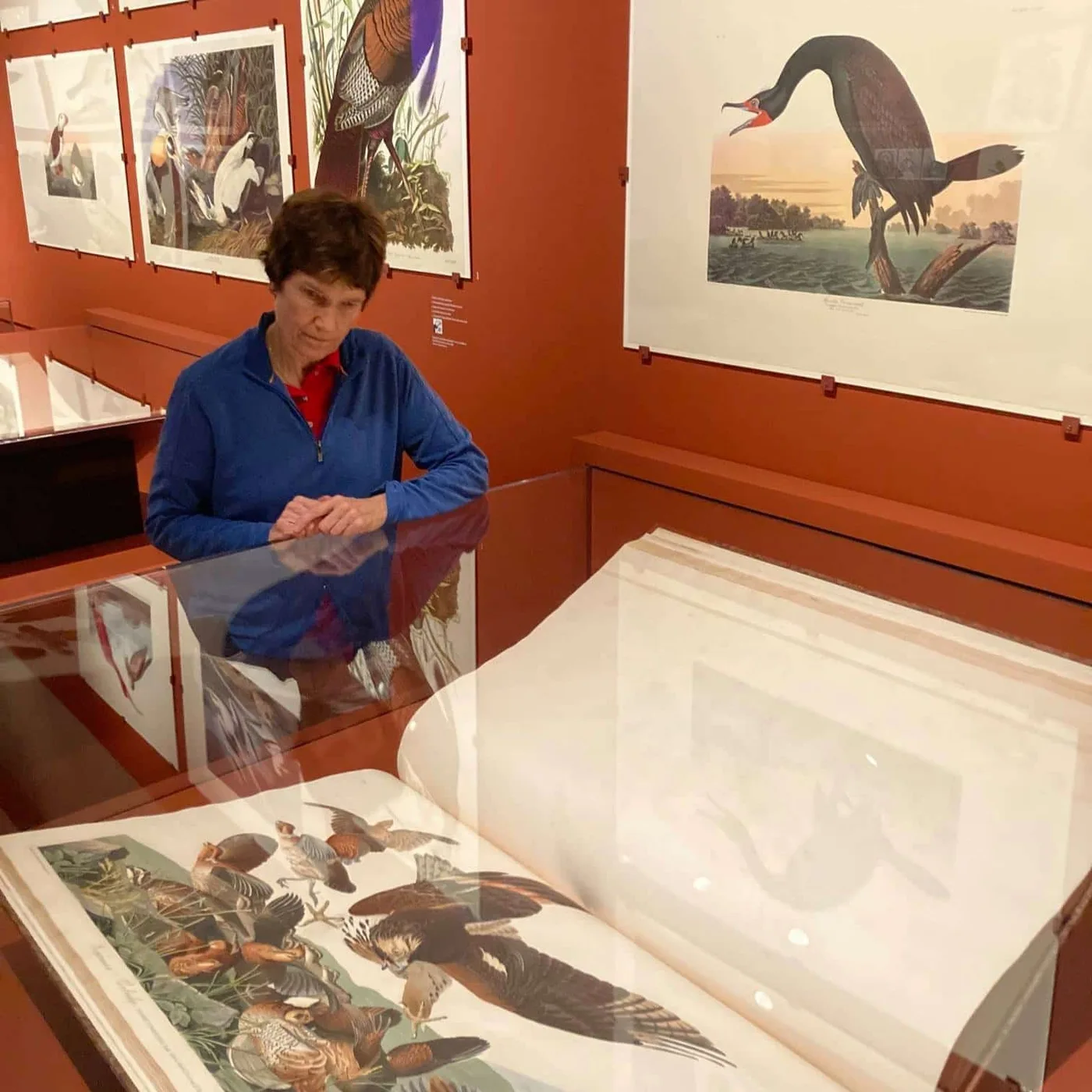
With the museum’s cooperation, this copy was photographed for us plate by plate by Re-Art Special Art Productions, who make our prints. Every Audubon facsimile we sell is made from those photographs, and from no other source.
How to own a plate today
Original plates come to market now and then, usually from copies that were broken up; the large birds are rare and sought after. Most of us will live with a facsimile instead, and the question is then which one. Original, facsimile or reproduction? explains the four kinds you will meet and what to check.
Our Audubon prints are facsimiles of the Teylers sheets. Each plate is photographed at 308 megapixels at the size it will be printed, retouched by hand only where two centuries have left a spot or a crease, proofed against the original under daylight until the colours match, and printed for us by Re-Art Special Art Productions in Almere, on acid-free etching paper of 270 g/m² with archival inks. How a facsimile is made.
Each print is the size of the original sheet, 67 by 100 centimetres, with its margins and its engraved lettering. The edition is 250 of each plate, numbered in pencil, embossed with our blind stamp and accompanied by a certificate of authenticity. Prints ship unframed, rolled in a tube, and they last more than 100 years under good conditions. You can browse the plates by number on The Birds of America.
Four plates to start with
Questions
How many plates are in The Birds of America?
435 hand-coloured plates, issued in 87 parts of five plates each between 1827 and 1838, with the text published separately as the Ornithological Biography.
How big are the plates of The Birds of America?
About 100 by 67 centimetres (39½ by 26½ inches), a size called double elephant folio. Audubon chose it so that every bird, even the flamingo, could be shown at its real size.
Why is The Birds of America so valuable?
Only about 200 copies were printed, every sheet was coloured by hand, and around 120 complete copies survive. A complete copy sold at Sotheby’s in London in 2010 for £7.3 million, then a record for a printed book.
Where can I see an original copy of The Birds of America?
The Teylers Museum in Haarlem, the Netherlands, has held a complete copy since 1833, bought from Audubon’s son Victor. Heritage Prints makes its Audubon facsimiles from this copy.