
One large bird in every part
Every Audubon print we sell is the same size, 67 by 100 centimetres, because every plate of The Birds of America was printed on the same double elephant folio sheet. What changes from plate to plate is how much of that sheet the bird takes up. A warbler sits in a corner of it with a branch; a flamingo, a swan or a wild turkey fills it from margin to margin. Those are the large plates, and this article is about them.
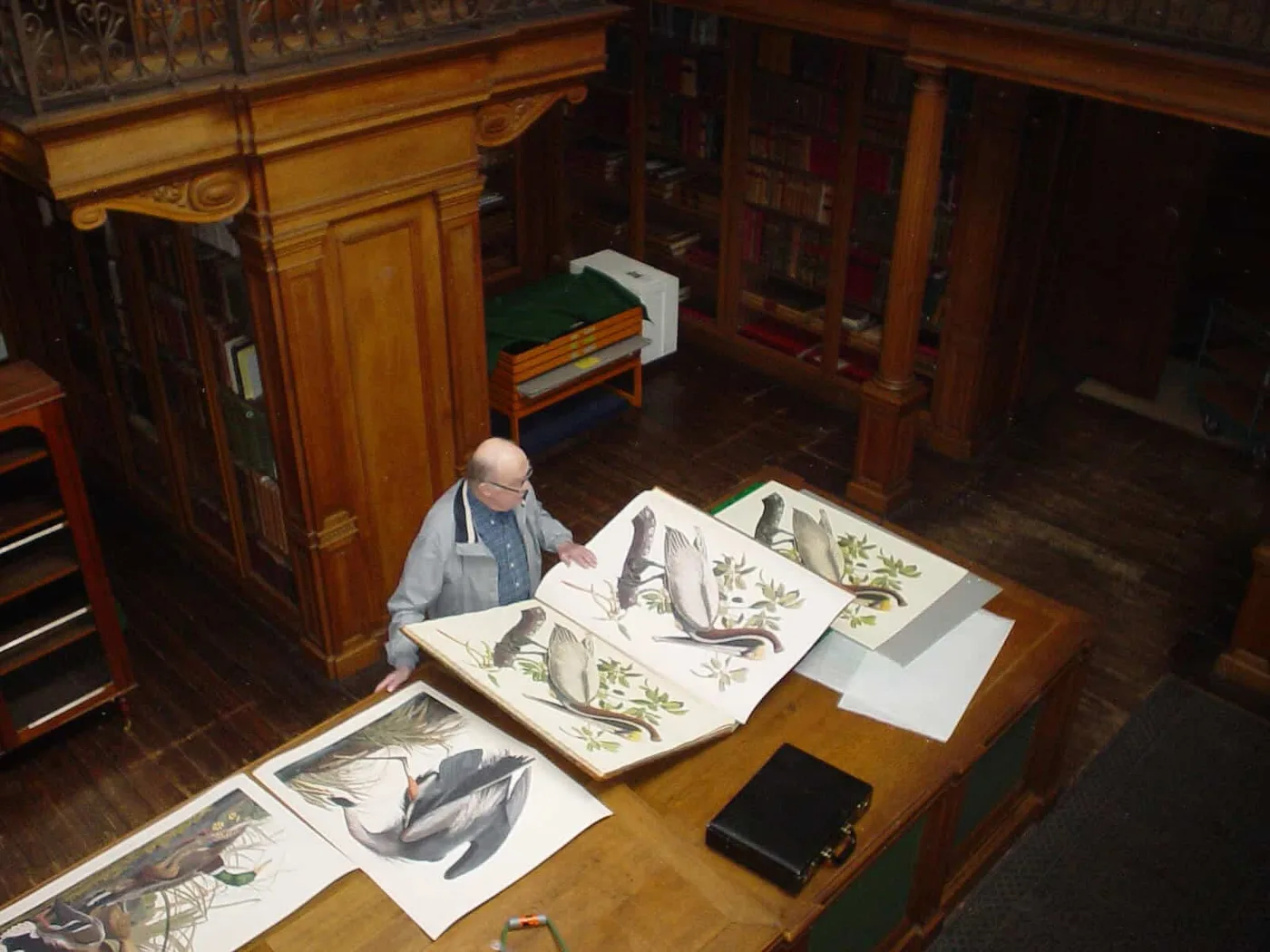
Audubon issued the book in 87 parts of five plates each, between 1827 and 1838, and each part held one large bird, one medium and three small, so that every delivery had something spectacular in it and the costly large plates were spread over eleven years. The 435 plates were later bound into four volumes. What is The Birds of America? tells the whole story.
Why the big birds twist
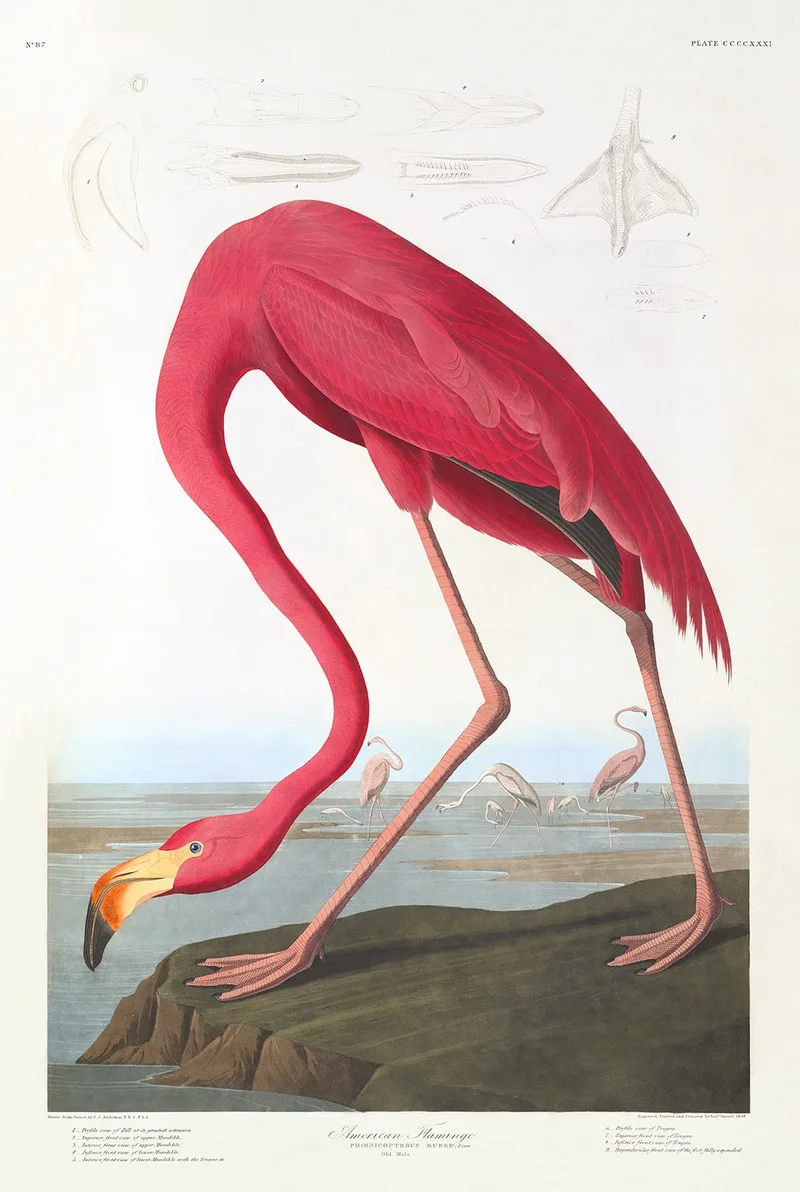
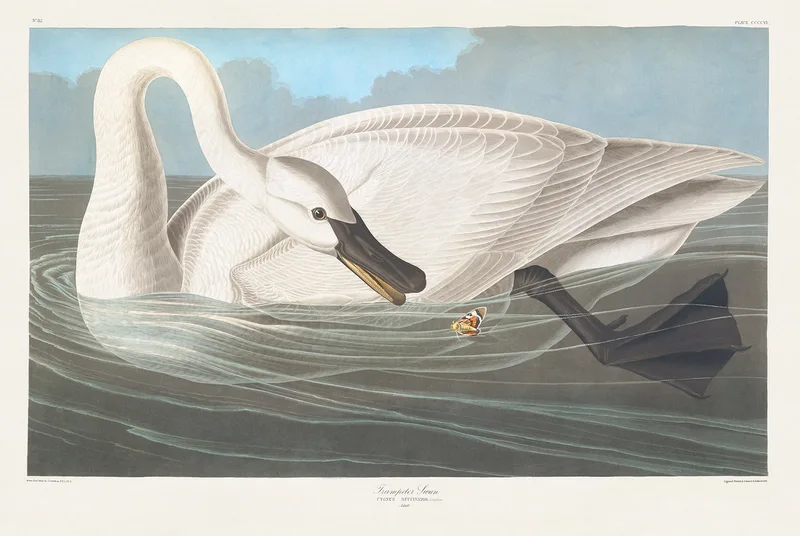
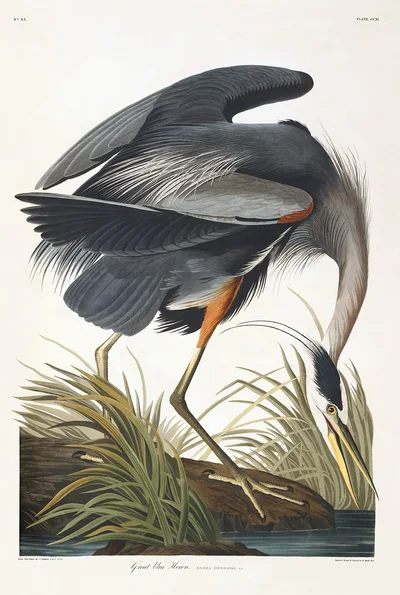
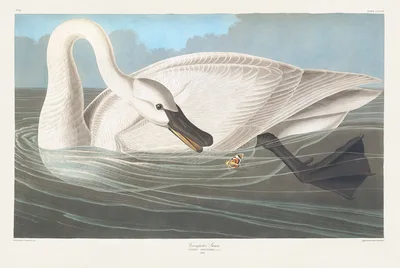
Audubon drew every species at life size, and that is the whole explanation for the contorted poses of his largest birds. A sheet of about 39 by 26 inches is shorter than a standing flamingo, heron or swan, so he gave each bird something to do that bent it into the page. The flamingo lowers its head to feed. The Great Blue Heron folds its neck as if about to strike. The Trumpeter Swan curves its neck down to the water. The Wild Turkey of plate 1 walks to the right but looks back over its shoulder, which keeps it inside the sheet and gives the picture its tension.
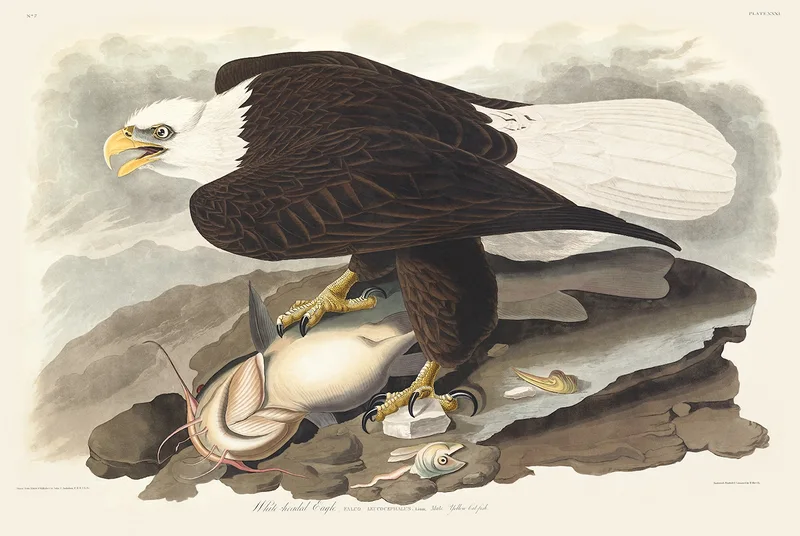
The poses came from the field. Audubon set his birds in their own landscape, drawn from long observation, and on a large specimen he worked hard: on the White-headed Eagle he is said to have spent up to four days of fifteen hours, preparing, studying and drawing. Audubon’s herons looks at the bent necks in more detail.
What he used on the large birds
Early on Audubon worked mainly in watercolour over a graphite sketch. For the big birds he added pastel or coloured chalk, which gave the plumage of herons and owls its softness, laid the watercolour on in several thin layers, and sometimes used gouache for the dense whites. The plates engraved by Robert Havell translate all this into aquatint and hand colouring, and it is those plates, in the copy of the Teylers Museum in Haarlem, that we reproduce.
The large plates, one by one
These are the plates on which the bird fills the sheet, with a line on each. All are facsimiles of the Teylers copy at the size of the original.
- Wild Turkey, plate 1: the cock, walking right and looking back, the plate that opens the book.
- Wild Turkey, Female and Young, plate 6: the hen leads her chicks across a horizontal sheet.
- Bird of Washington, plate 11: the giant eagle that may never have existed, on a rocky outcrop.
- White-headed Eagle, plate 31: the bald eagle with a catfish.
- Barred Owl, plate 46: the owl reaches for a squirrel on a branch.
- Fish Hawk or Osprey, plate 81: rising from the water with a fish.
- White-headed Eagle, plate 126: a second plate of the same bird.
- Great Blue Heron, plate 211: neck folded, about to strike.
- Wood Ibis, plate 216: the stork of the southern swamps.
- Whooping Crane, plate 226: the tallest bird in North America, bent double to fit.
- Brown Pelican, plate 251: the adult bird, perched on a mangrove branch.
- Whooping Crane, plate 261: a second crane, in brown plumage.
- Great White Heron, plate 281: stretched along the sheet, Key West in the distance.
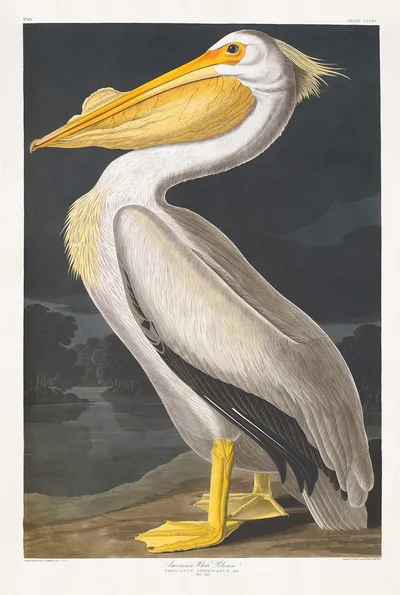
- American White Pelican, plate 311: one of the three plates in our top size group, with the flamingo and the Great Blue Heron.
- Black-bellied Darter, plate 316: the anhinga, drying its wings.
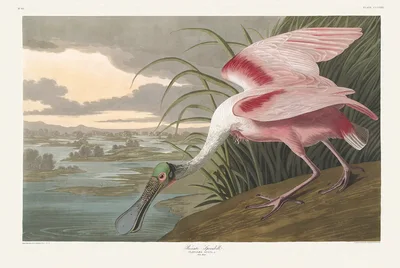
- Roseate Spoonbill, plate 321: pink, feeding on the shore.
- White Heron, plate 386: the great egret in breeding plumes.
- Trumpeter Swan, plate 406: neck curved to the water.
- Common American Swan, plate 411: the tundra swan, swimming.
- Brown Pelican, plate 421: a second pelican, a young bird.
- Californian Vulture, plate 426: the condor, the largest bird in the book.
- American Flamingo, plate 431: bending to drink, the best known of them all.
Hanging a print a metre tall
A large plate needs a wall, not a corner. Every print ships unframed, rolled in a tube, so take it to a framer who works with paper, ask for an acid-free mount and backing, and hang it with the centre about 150 centimetres from the floor, out of direct sunlight and away from damp. Framed like that, it lasts more than 100 years under good conditions. How to frame and hang a giclée print goes through it step by step, and Original, facsimile or reproduction? explains what our facsimiles are.
Four of the big birds
Questions
How big are Audubon’s largest prints?
Every plate of The Birds of America, and every one of our facsimiles, is on the same double elephant folio sheet, 67 by 100 centimetres (26½ by 39¼ inches). On the large plates the bird fills that sheet at life size.
Which Audubon plates show the largest birds?
The American Flamingo (431), the Great Blue Heron (211), the American White Pelican (311), the swans (406 and 411), the Whooping Cranes (226 and 261), the pelicans (251 and 421), the Wild Turkey (1 and 6) and the Californian Vulture (426), among others.
Why are the big birds in such strange poses?
Because Audubon drew them at life size and the sheet was smaller than the bird. Bending to drink, folding the neck or looking back over the shoulder kept each bird inside the page.