
The most delicate of Gould's books
Hummingbirds live only in the Americas, from Alaska to Tierra del Fuego, and in the nineteenth century most Europeans knew them only as skins: dried birds shipped from South America by collectors and dealers, dull until the light caught them. John Gould (1804 to 1881) collected them for most of his life, and in 1849 he began to publish them as A Monograph of the Trochilidae, or Family of Humming-Birds. Trochilidae is the scientific name of the family; the English half of the title says the same thing.
Like all his books, it was sold by subscription, in parts of a few plates each, and subscribers had the parts bound when the work was complete. It was finished in 1861 in five volumes with 360 hand-coloured lithographs. A Supplement of 58 more plates followed from 1880 and was completed after Gould's death. What books did John Gould publish? places the monograph among his other works, and Who was John Gould? tells his story.
These wonderful works of creation… my thoughts are often directed to them in the day, and my night dreams have not infrequently carried me to their native forests in the distant country of America.
Two or three birds, and the throat in the light
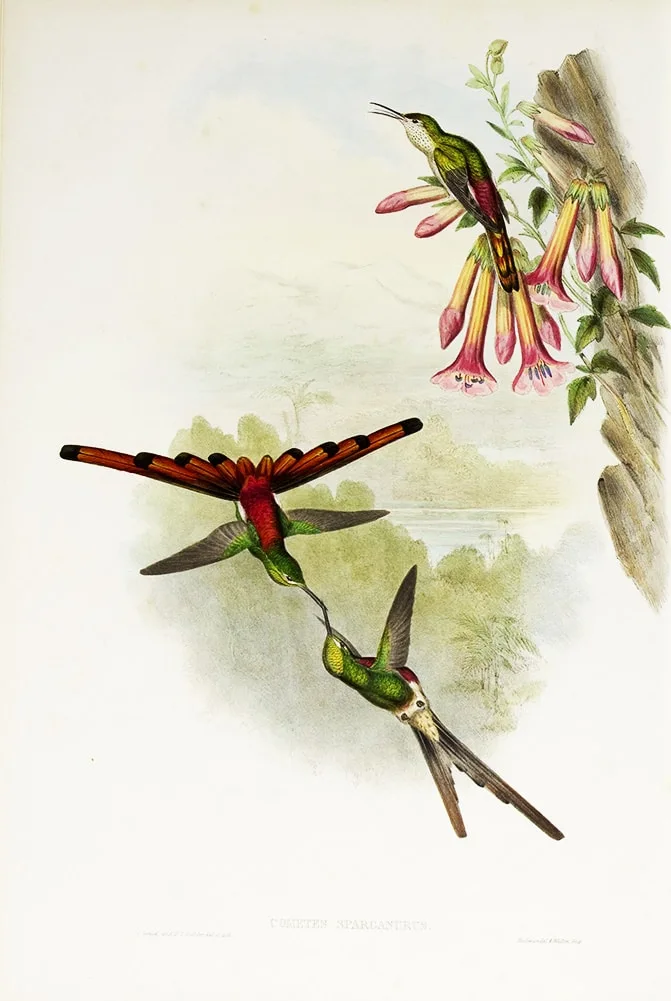
A hummingbird's brightest colours are not pigment. The feathers of the throat and crown are built so that they flash ruby, emerald or violet when the light strikes them at the right angle, and look almost black when it does not. Paint cannot do that, and Gould knew it. He composed most plates with two or three birds, often a male and a female, and turned at least one of them, or showed it in flight, so that the throat faces the viewer and the light.
For those passages the plates were given more than watercolour. Gould's colourists laid gold leaf under transparent colour and varnish, so that the metal glows through the paint, and on the original sheets the throats still shine when the page is tilted. The lithographs themselves were drawn on stone after Gould's sketches, by Gould and Henry Constantine Richter, printed in London and coloured by hand, sheet by sheet.
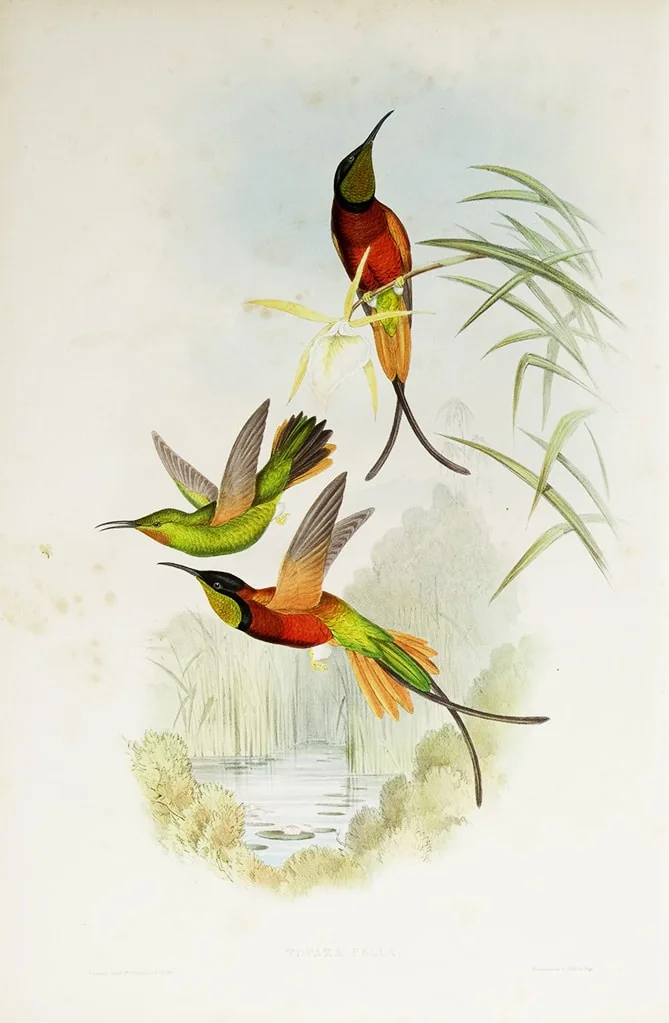
A facsimile is printed in ink, so it shows those passages as the camera recorded them on the original: the colour is there, the shifting metallic glint is not. Everything else, the drawing, the colouring and the tone of the paper, is reproduced at the size of the original sheet.
Five volumes, from the hermits to the puff-legs
Gould arranged the family by groups, and each volume has its own character. The names on the plates are his, from the 1850s, and many of the birds go by other names today.
- Volume 1: sawbills, sicklebills and barbthroats, then a long run of hermits, from the Hairy Hermit to the Pygmy Hermit.
- Volume 2: sabrewings and topazes, the hillstars of the Andes, mangoes, caribs, brilliants, wood nymphs and jacobins, ending with the Snow-cap.
- Volume 3: coquettes, thorntails, woodstars and sheartails, racket-tails, trainbearers, sylphs, comets, sunbeams, helmetcrests and thornbills.
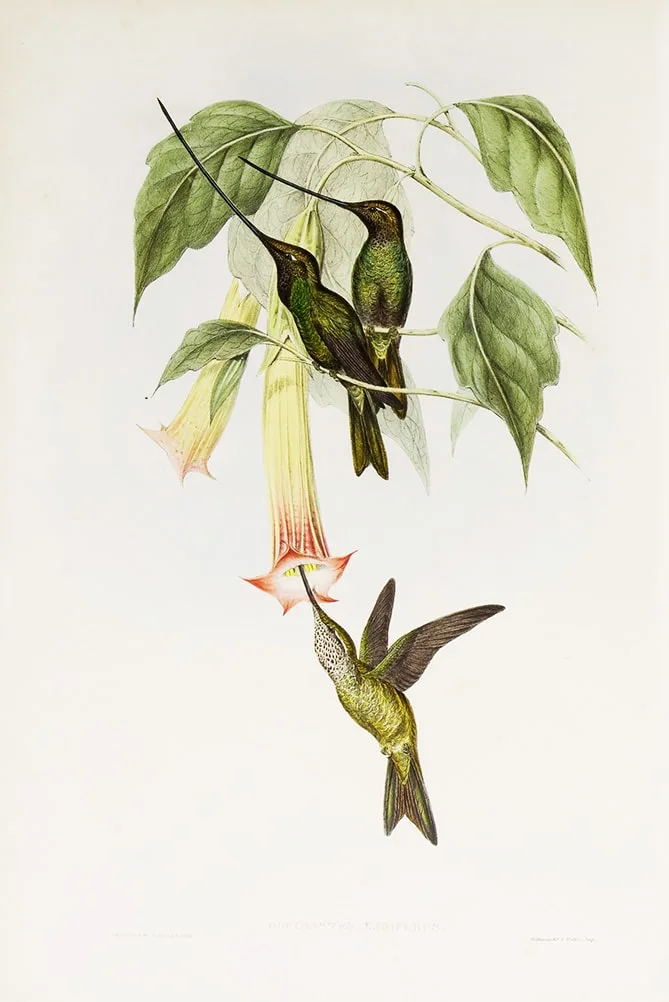
- Volume 4: from the Ruby and Topaz to the puff-legs, by way of plovercrests, fairies, violet-ears, the Giant Hummingbird and the Sword-bill, star-frontlets, sun angels, incas and starthroats.
- Volume 5 completes the family. It is not in our series.
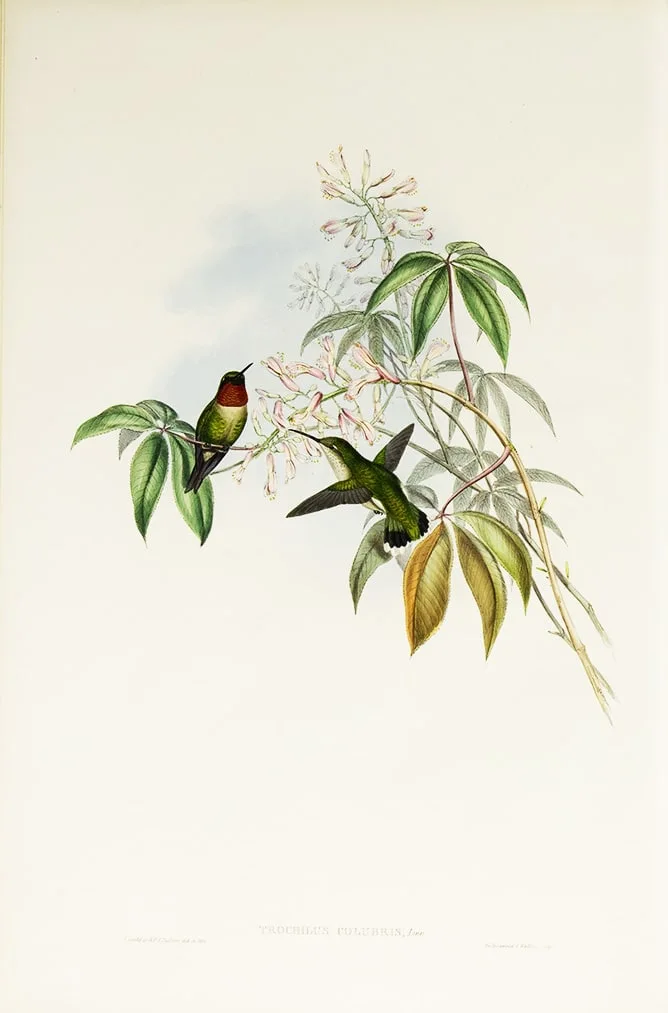
Some plates show birds that North Americans know from their own gardens: the Ruby-throated Hummingbird, Gould's Rufous Flamebearer (today's Rufous Hummingbird) and Anna's Calypte (Anna's Hummingbird) are all in volume 3. Others show birds few people will ever see, such as the Marvellous Hummingbird, today's Marvelous Spatuletail, which lives only in northern Peru.
The hummingbirds in Regent's Park, 1851
In 1851, the year of the Great Exhibition, Gould showed his collection of mounted hummingbirds in a house built for the purpose in the gardens of the Zoological Society in Regent's Park. London came to see them, Queen Victoria among the visitors. It was a show of its own, at the Zoo, and not part of the Great Exhibition in Hyde Park, though it is sometimes described that way.
Gould had drawn his hummingbirds without ever seeing one alive. That changed in 1857, when he travelled to North America and watched his first living hummingbird, a Ruby-throated. He tried to bring live birds home to England; they did not survive for long. By then much of the monograph had been published, drawn, like almost every bird book of the time, from skins.
The Family of Hummingbirds at Heritage Prints
We offer 280 plates from the first four volumes. Each is a facsimile made from the original, at the size of the original sheet, 38 by 56 centimetres (15 by 22 inches), with its margins and lettering. Re-Art Special Art Productions in Almere photographs each plate, retouches it by hand only where the paper has suffered, proofs it against the original and prints it on acid-free etching paper of 270 g/m² with archival inks. The edition is 250 of each plate, numbered in pencil, blind embossed and with a certificate of authenticity.
Browse them all on Family of Hummingbirds, and Gould's other books on John Gould. Audubon drew the Ruby-throated Hummingbird too, at life size, on plate 47 of The Birds of America.
Four plates, four volumes
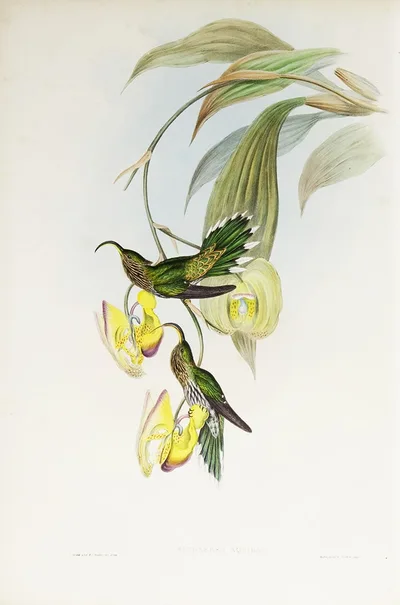
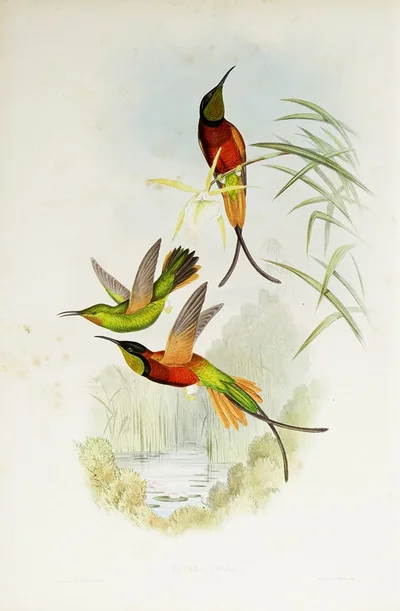
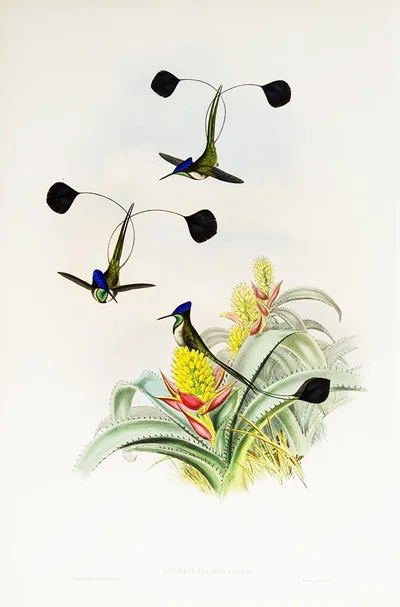
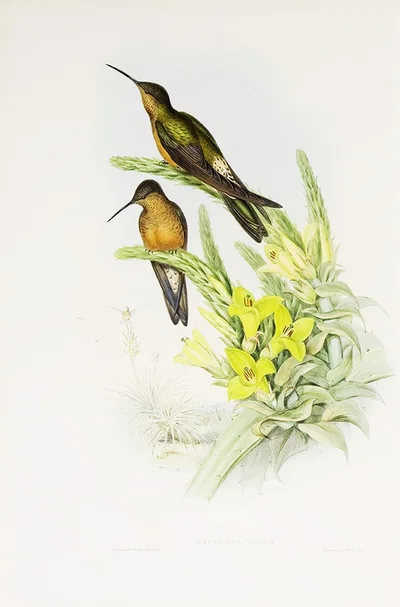
Questions
How many plates are in Gould's Family of Hummingbirds?
360 hand-coloured lithographs in five volumes, published in London between 1849 and 1861, plus 58 in the Supplement of 1880 to 1887, completed after Gould's death. We offer 280 plates from the first four volumes.
What does Trochilidae mean?
It is the scientific name of the hummingbird family. Gould's full title, A Monograph of the Trochilidae, or Family of Humming-Birds, gives the name in Latin and in English.
Did Gould see his hummingbirds alive?
Hardly at all. He worked from skins, like nearly every bird artist of his time, and saw his first living hummingbird, a Ruby-throated, only in 1857, on a visit to North America.
Do the prints shine like the original plates?
No. On the original plates the throats and crowns were laid over gold leaf to imitate the sheen of the feathers. A facsimile is printed in ink: it shows the colour of those passages as photographed from the original, without the metallic glint.