
A publisher first
No publisher would take John Gould's first book, so in 1830 he published it himself, in monthly parts, sold by subscription. He never did it any other way. For fifty years he issued part after part, each with a handful of hand-coloured lithographs, and subscribers had the parts bound into volumes when a work was complete. The result was more than forty volumes with nearly 3,000 plates, and it made Gould, as Who was John Gould? explains, a manager of artists rather than an artist.
The plates were lithographs: drawn with crayon on fine-grained limestone, printed, and coloured by hand. Lithography was cheaper and quicker than the copper engraving Audubon used, and it was new in Britain in 1830. Edward Lear, who was then publishing his own parrots that way, helped Gould's wife Elizabeth to learn it. What is A Century of Birds from the Himalaya Mountains? tells how.
Below, every book in order. For each we give the plates in the original and the number of prints we offer. They are not the same: the site shows the plates we have made so far, and we hold master files of more. Can I order a plate that is not on the site?
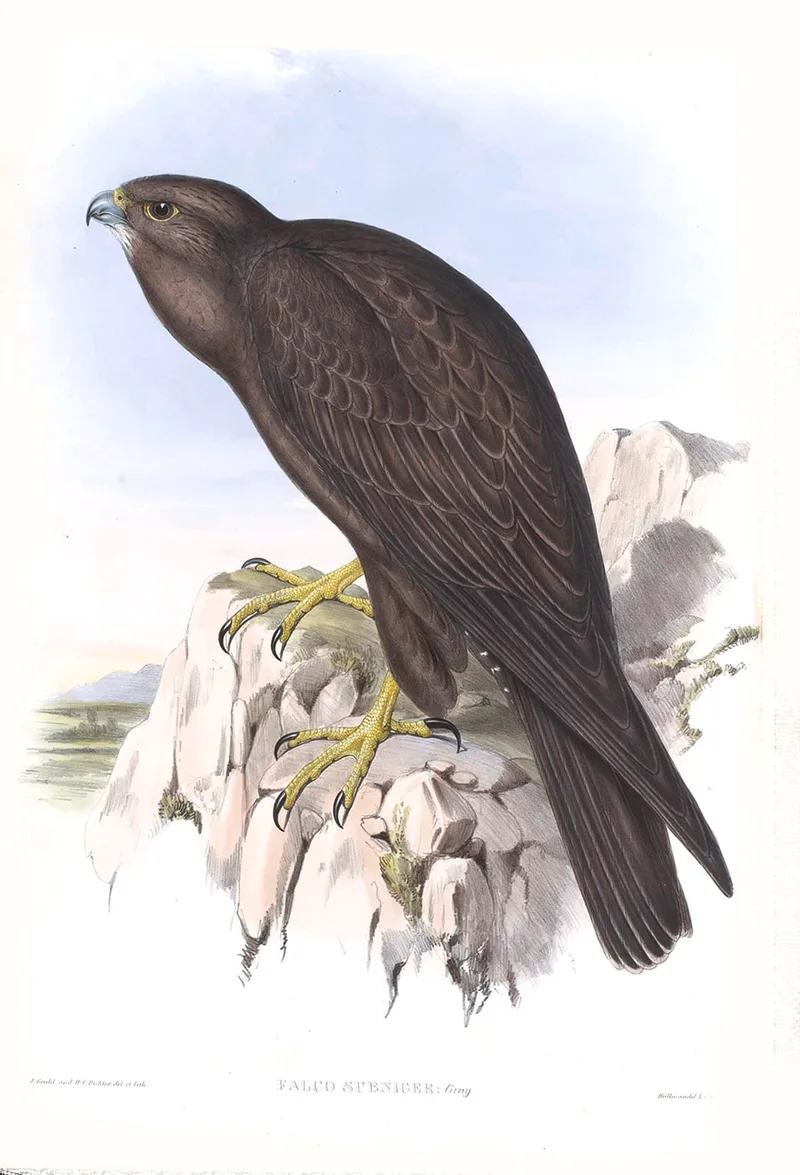
A Century of Birds from the Himalaya Mountains (1830 to 1833)
- Published 1830 to 1833, in 20 monthly parts; one volume.
- 80 hand-coloured lithographs; we offer 79.
- Sketches by John Gould; plates drawn on stone by Elizabeth Gould.
- Original in the Teylers Museum, Haarlem. See the plates.
A parcel of bird skins from the Himalaya, received at the Zoological Society in 1830, gave Gould his first book. It sold at once and paid for what came after. In these early plates the bird is everything and the setting hardly exists; compare them with The Birds of Asia twenty years later, where the foliage fills the sheet.
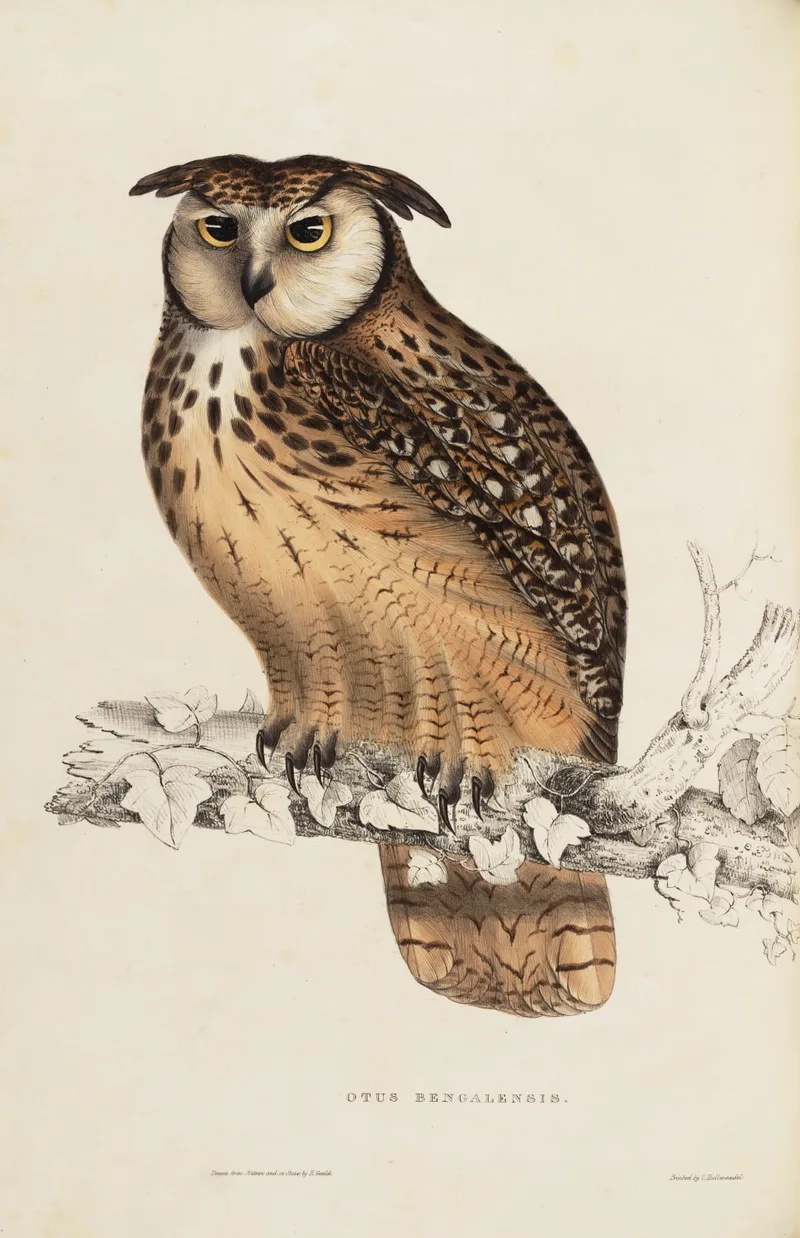
The Birds of Europe (1832 to 1837)
- Published 1832 to 1837; five volumes.
- 448 hand-coloured lithographs, many of them by Edward Lear. Not in our collection.
Gould's second large work covered the birds of his own continent and gave Lear his best plates. We do not print it.
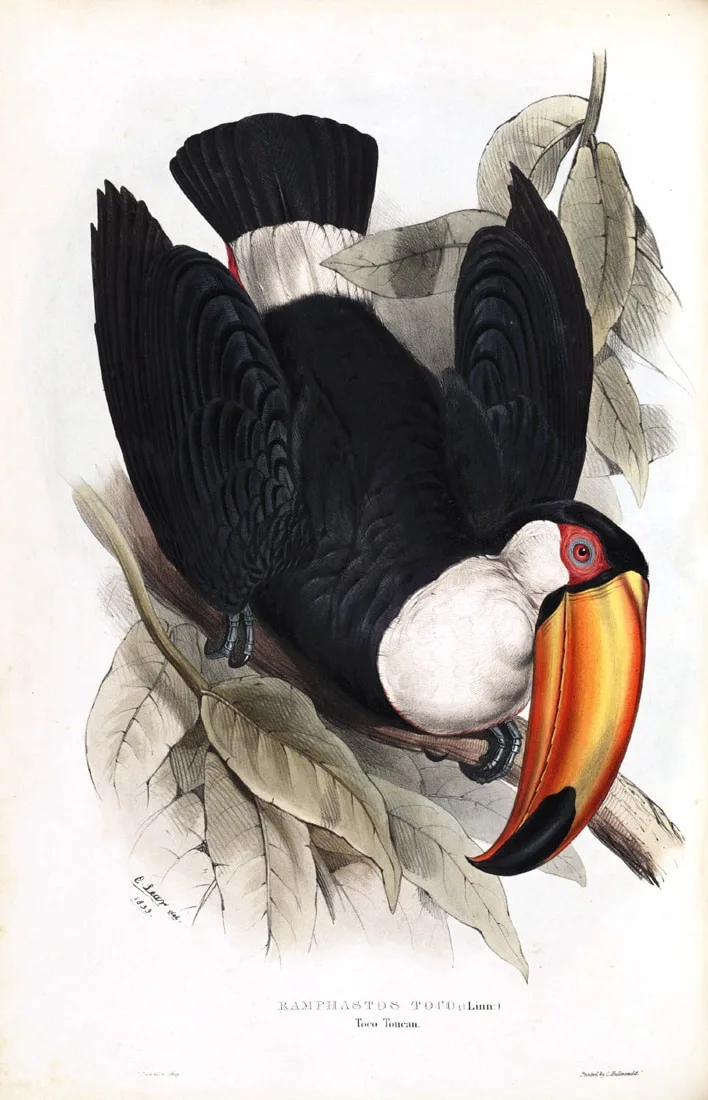
A Monograph of the Ramphastidae, or Family of Toucans (1834; Supplement 1855)
- First edition 1834, in three parts; Supplement 1855; a second, enlarged edition 1852 to 1854.
- Hand-coloured lithographs, several by Edward Lear; we offer 53, from the first edition and the Supplement together.
- See the plates.
The most flamboyant of Gould's books, and one of the earliest: the toucans and araçaris of Mexico, Central and South America, set against plain backgrounds so that the bills carry the plate. Gould took it up after seeing a fellow ornithologist's collection of toucan skins. Lear's plates, with young and adult birds together, are among his best bird work.
The Birds of Australia and the Adjacent Islands (1837 to 1838)
- Published 1837 to 1838, in two parts; 20 plates. Not in our collection.
Gould began a book on Australian birds from skins sent to London, published two parts, and stopped: he decided he had to see the birds himself. The work was begun again on his return.
The Birds of Australia (1840 to 1848) and its Supplement (1851 to 1869)
- Published 1840 to 1848; seven volumes. Supplement 1851 to 1869; one volume.
- 600 hand-coloured lithographs, plus 81 in the Supplement; we offer 140, from volumes 1 and 2.
- Elizabeth Gould drew 84 plates, Henry Constantine Richter most of the rest; one plate each by Edward Lear and Benjamin Waterhouse Hawkins.
- About 250 sets printed. See the plates.
The Goulds sailed for Australia in 1838 and collected there for almost two years. Elizabeth drew 84 plates before her death in 1841; Richter worked the rest up from her drawings and Gould's sketches. It was the first comprehensive survey of the continent's birds, with many species described for the first time, and it earned Gould the title he still holds: the father of bird study in Australia.
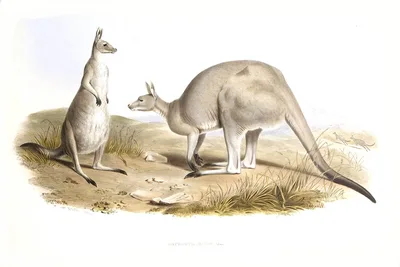
A Monograph of the Macropodidae, or Family of Kangaroos (1841 to 1842)
- Published 1841 to 1842; one volume.
- 30 hand-coloured lithographs; we offer all 30.
- See the set.
It was not until I arrived in the country, and found myself surrounded by objects as strange as if I had been transported to another planet, that I conceived the idea of devoting a portion of my attention to the mammalian class of its extraordinary fauna.
Gould's one departure from birds among the books in our collection: the Great Grey and Great Red Kangaroo, rock wallabies, rat-kangaroos and two tree-kangaroos, drawn in Australia and finished in London. The first time most Europeans saw the animals in any detail.
A Monograph of the Trochilidae, or Family of Hummingbirds (1849 to 1861) and its Supplement (1880 to 1887)
- Published 1849 to 1861; five volumes. Supplement 1880 to 1887, completed after Gould's death.
- 360 hand-coloured lithographs, plus 58 in the Supplement; we offer 283, from the five volumes.
- See the plates.
These wonderful works of creation… my thoughts are often directed to them in the day, and my night dreams have not infrequently carried me to their native forests in the distant country of America.
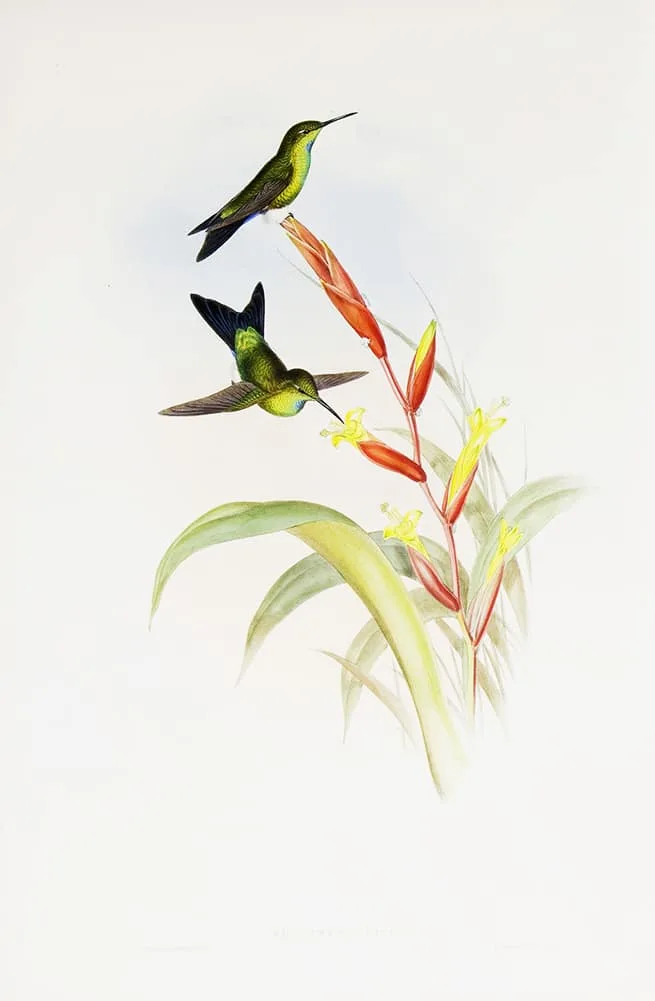
Hummingbirds were Gould's passion, and the monograph is his most delicate book. Most plates show two or three birds among flowers, at least one of them in flight, so that the throat catches the light. Volume 4 alone runs from the Ruby and Topaz to the puff-legs, by way of the Giant Hummingbird and the Sword-bill.
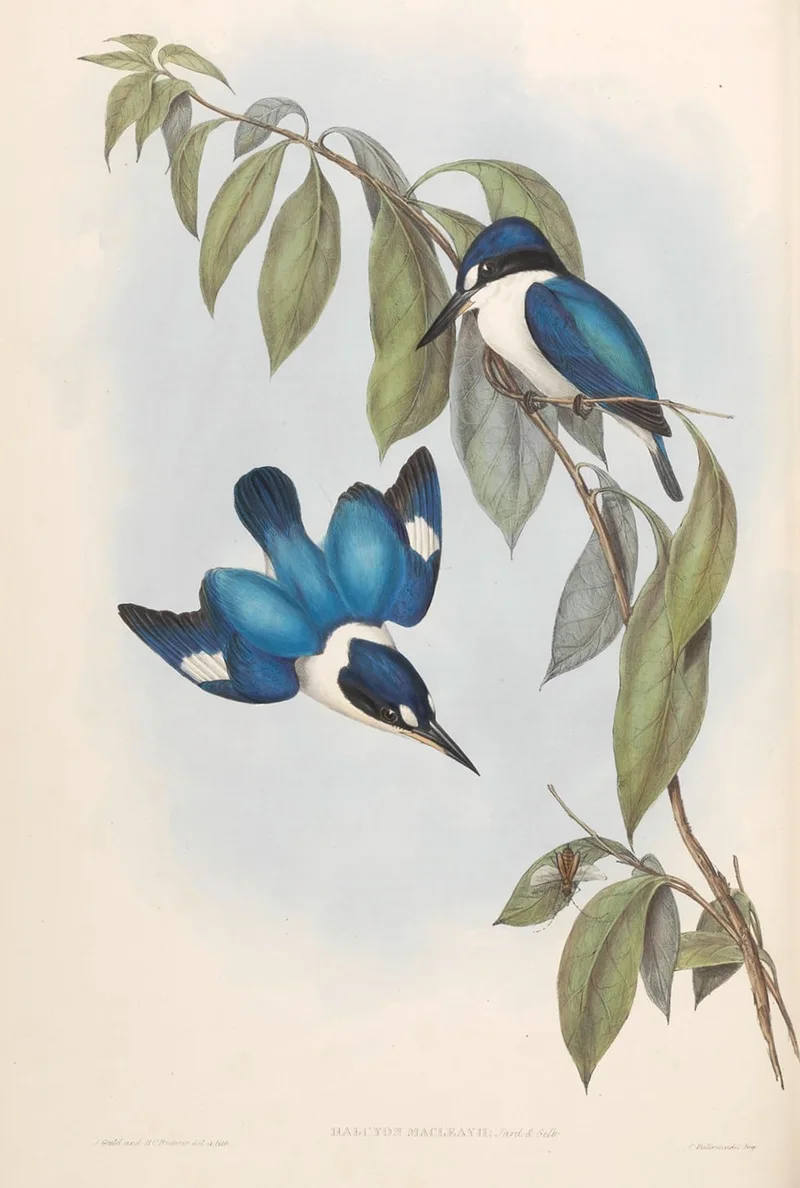
The Birds of Asia (1849 to 1883)
- Published 1849 to 1883, in 35 parts; seven volumes. Finished by Richard Bowdler Sharpe after Gould's death in 1881.
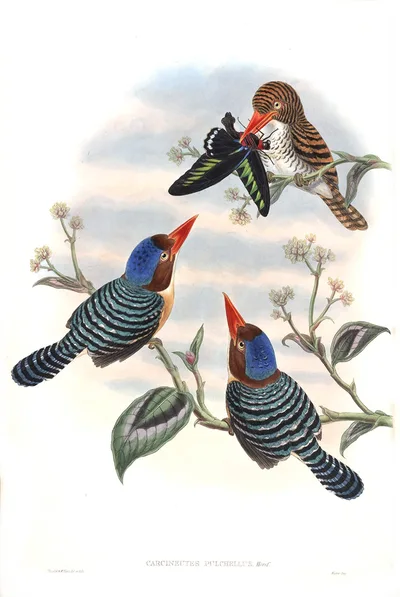
- 530 hand-coloured lithographs by Gould, Joseph Wolf, Henry Constantine Richter and William Matthew Hart; we offer 344.
- Original in the Teylers Museum, Haarlem. See the plates.
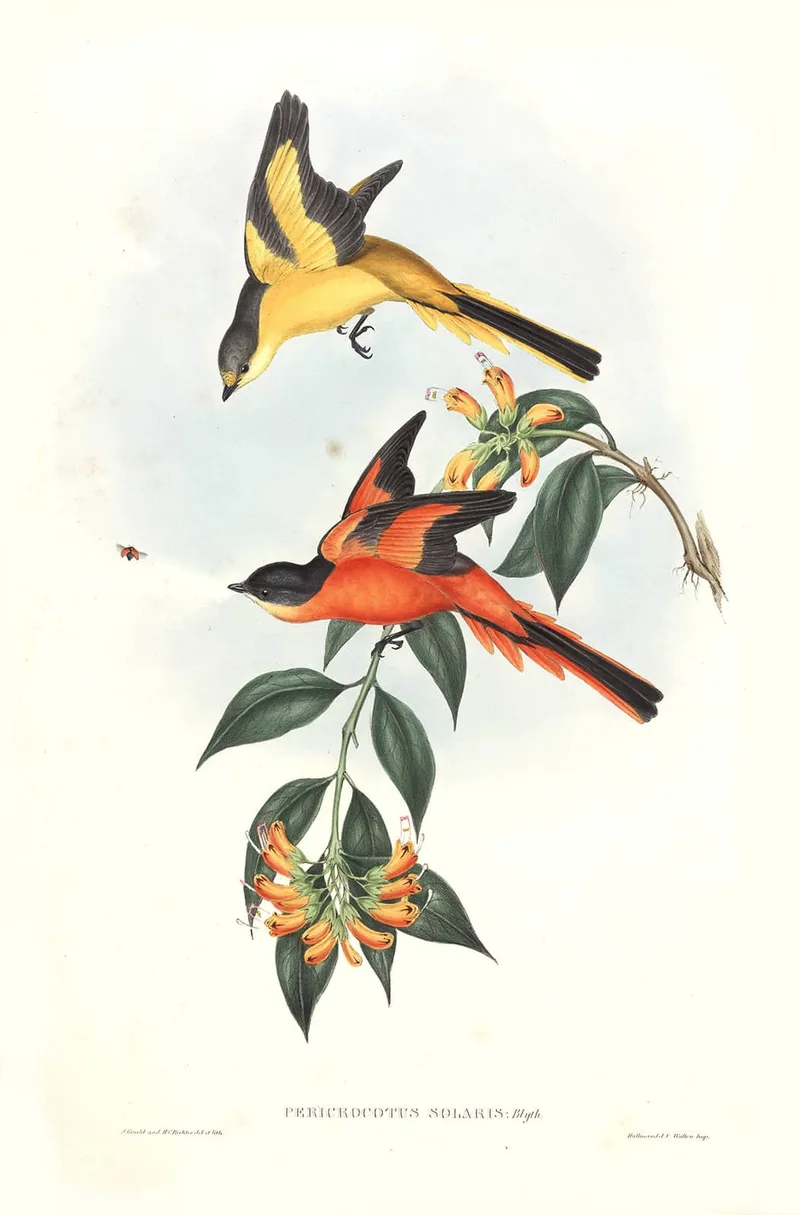
Thirty-four years in production, longer than any other Gould book. Trogons, kingfishers, sunbirds, pittas, pheasants: the birds of Asia were the showiest he had handled, and he gave them the lushest settings of any of his books. Joseph Wolf joined the team with this work. What is The Birds of Asia? goes through the seven volumes.
The Birds of Great Britain (1862 to 1873)
- Published 1862 to 1873, in 25 parts and 750 copies; five volumes.
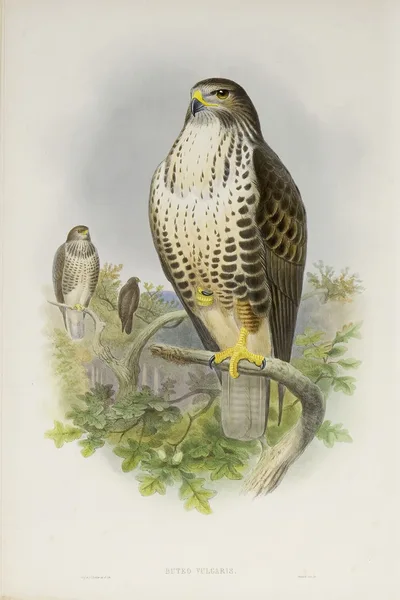
- 367 hand-coloured lithographs after Gould's sketches, by Wolf, Richter and Hart; we offer 223.
- Original in the Teylers Museum, Haarlem. See the plates.
I also felt that there was an opportunity of greatly enriching the work by giving figures of the young of many of the species of various genera.
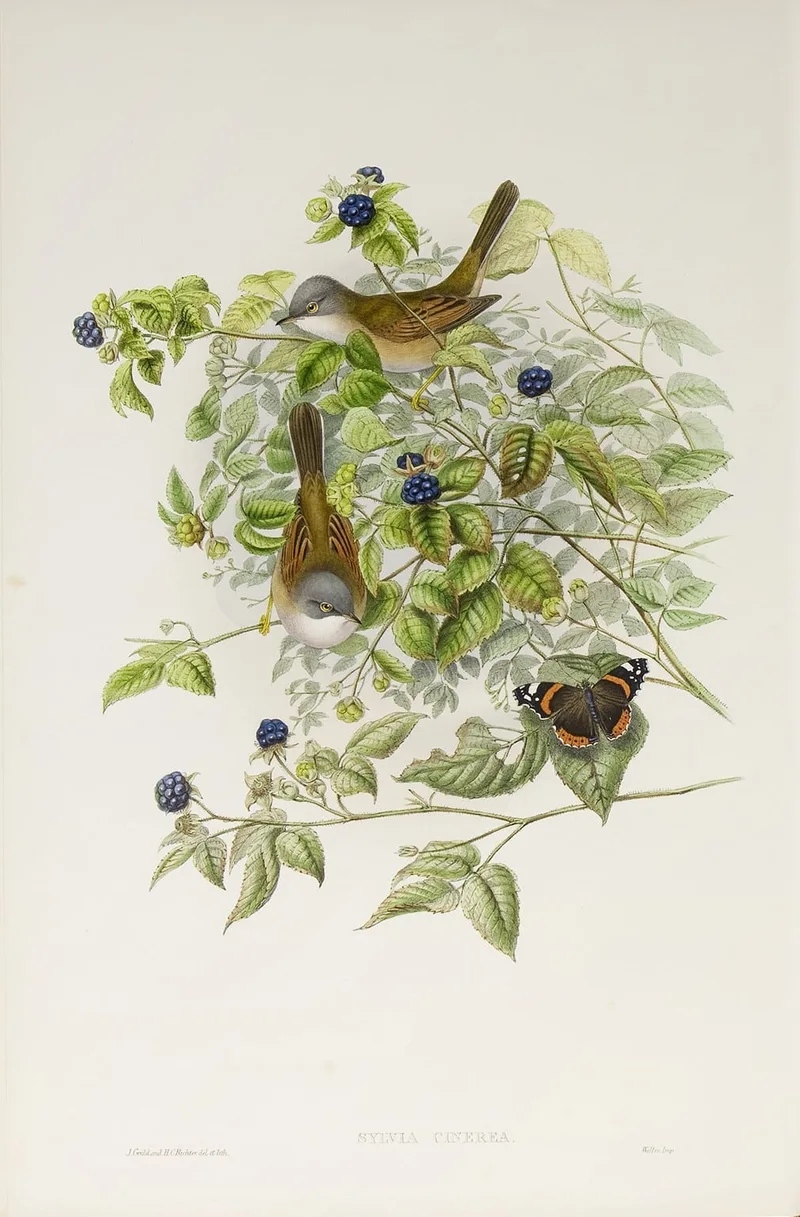
Gould's book on his own birds, and the one where nests, eggs and young appear on a large scale: scenes most bird artists of the day left out. He published it himself, and worked out in the introduction that nearly 280,000 pictures had been coloured by hand. What is The Birds of Great Britain? tells the rest.
The Birds of New Guinea, and the Adjacent Papuan Islands (1875 to 1888)
- Published 1875 to 1888, in 25 parts; five volumes.
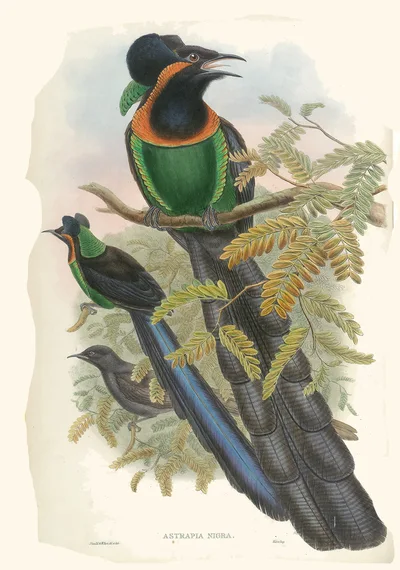
- 320 hand-coloured lithographs; we offer 55, almost all from volume 1.
- Gould completed twelve parts; Richard Bowdler Sharpe finished the work. See the plates.
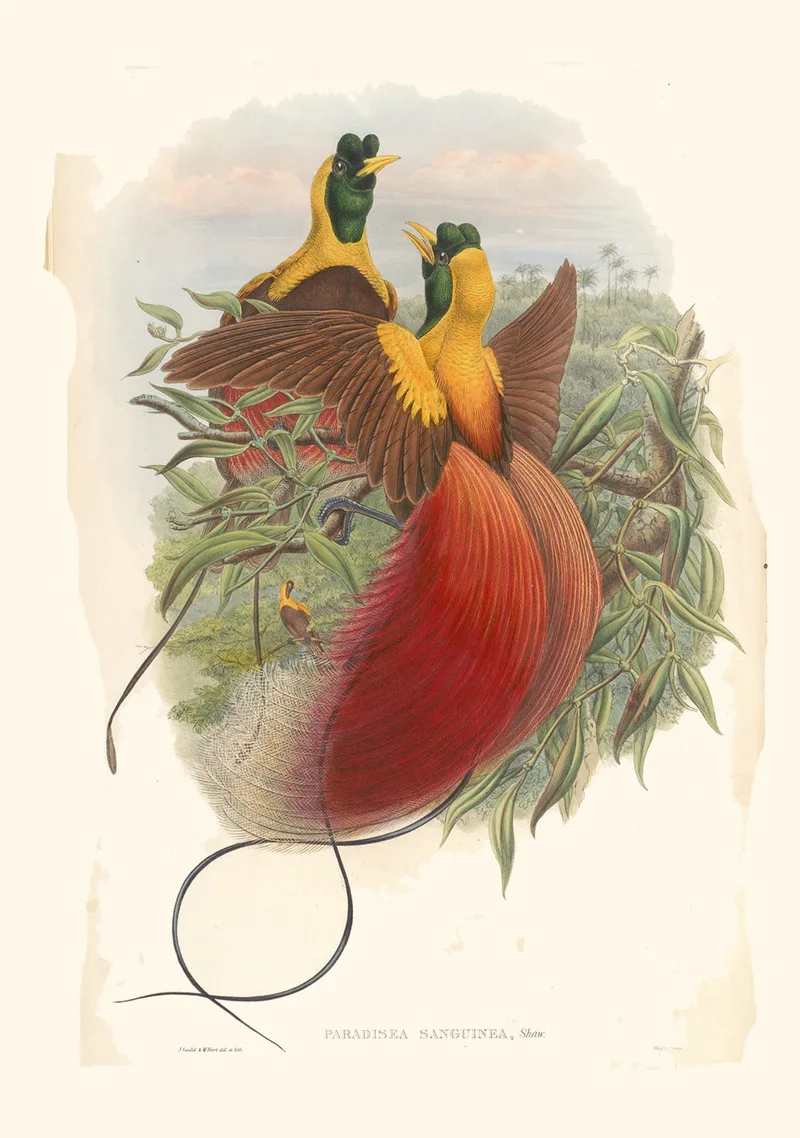
Conceived as a companion to The Birds of Asia and left unfinished at Gould's death. Sharpe, his colleague, assistant and friend, completed it. Birds of paradise, bowerbirds, parrots, cockatoos, kingfishers and hawk-owls, in animated compositions with full backgrounds. The birds of paradise of volume 1 are also sold as a set.
Other works, and where to go next
Gould also published Icones Avium (1837 to 1838), A Monograph of the Odontophorinae, or Partridges of America (1844 to 1850) and The Mammals of Australia (1845 to 1863), and Part 3, Birds, of The Zoology of the Voyage of H.M.S. Beagle (1838 to 1842) carries his name as well. None of these are in our collection.
Every print we make from the books above is a facsimile of an original plate, at the size of the original sheet, about 38 by 56 centimetres, in an edition of 250, numbered in pencil, blind embossed and with a certificate of authenticity. All of them are on John Gould.
Four more plates, four more books
Questions
How many books did John Gould publish?
More than forty volumes between 1830 and 1888, with nearly 3,000 hand-coloured lithographs. The main works are the Himalayan birds, The Birds of Europe, the toucans, The Birds of Australia, the kangaroos, the hummingbirds, The Birds of Asia, The Birds of Great Britain and The Birds of New Guinea.
Which of Gould's books took the longest?
The Birds of Asia: 35 parts over 34 years, from 1849 to 1883, finished by Richard Bowdler Sharpe after Gould died in 1881.
Do you print every plate of each book?
No. The site shows the plates we have made so far, for example 344 of the 530 in The Birds of Asia and 223 of the 367 in The Birds of Great Britain. We hold master files of more; write to us with the book and the plate number.