
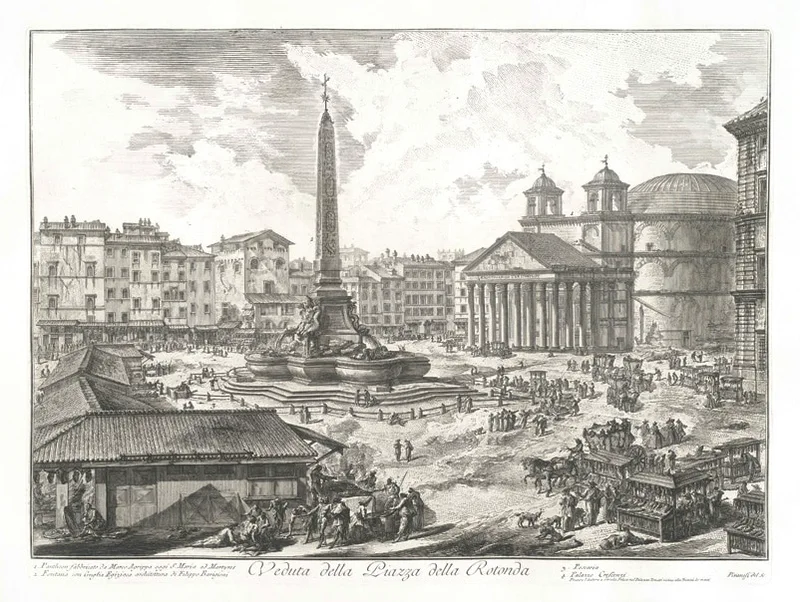
A stonemason’s son arrives in Rome
In 1740 a twenty-year-old draughtsman from the Veneto came to Rome in the suite of Marco Foscarini, the new Venetian ambassador. He was there to draw, and he never really left. Giovanni Battista Piranesi (1720 to 1778) spent the rest of his life in the city, and the city has looked like his prints ever since.
Piranesi was an etcher, architect and student of antiquity, and one of Italy’s most extraordinary artists. He is known for two bodies of work: Le Vedute di Roma, his views of the monuments and ruins of Rome, sold to travellers for thirty years, and the Carceri d’Invenzione, sixteen imaginary prisons that are among the strangest prints of the eighteenth century.
He was born in 1720 at Mogliano Veneto, then in the Republic of Venice, the son of a stonemason. His uncle Matteo Lucchesi, an architect and engineer, taught him to draw and to design buildings, and Piranesi signed his plates “architetto veneziano” for the rest of his life, though he was given almost nothing to build.
Learning to etch at the Palazzo Venezia
In Rome he lived at the Palazzo Venezia, which housed the Venetian embassy, and found a teacher in Giuseppe Vasi, the leading etcher of views of the city. Vasi taught him to etch: to draw with a needle through a waxed ground on a copper plate, bite the lines with acid, and print them in black ink. Piranesi learned fast and, by his own account, was soon impatient with his master.
He went back to Venice in 1744, hoping to work as an architect. When that came to nothing he returned to Rome in 1747 and opened a workshop on the Via del Corso, the street where the visitors on the Grand Tour lodged. They wanted souvenirs of ancient and Baroque Rome, and Piranesi supplied them, as etcher and as his own publisher.
The Vedute di Roma: the views that sold Rome
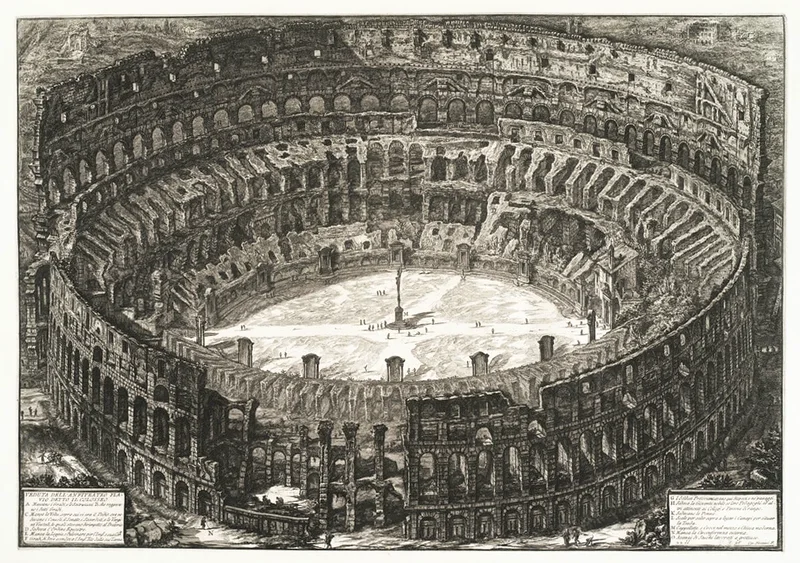
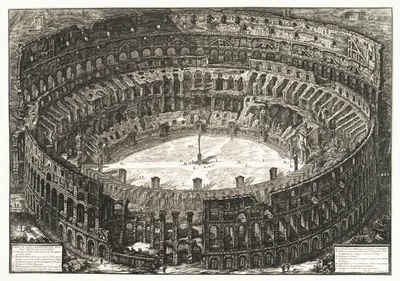
From about 1748 until his death Piranesi etched the Vedute di Roma, around 135 large views of the city: the Colosseum and the Forum, St Peter’s and the Pantheon, the fountains, the squares, the ruins of Hadrian’s Villa at Tivoli. His buildings are immense, his figures tiny, his skies full of cloud and his shadows black. Trained as an architect, he used perspective and vanishing points to give the plates a depth no earlier view-maker had managed.
The views shaped how Europe imagined Rome. Some travellers who arrived with the prints in mind were said to be disappointed that the real city was smaller. What are the Vedute di Roma? tells the story of the series; the plates are on Le Vedute di Roma.
The Carceri: prisons he invented
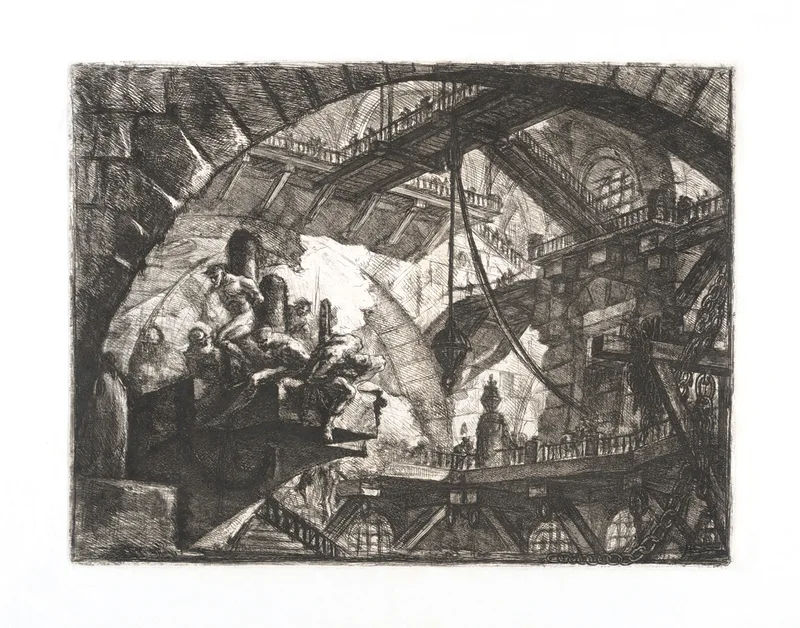
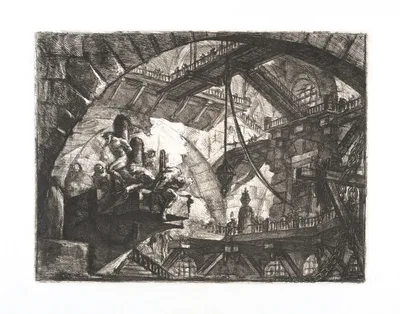
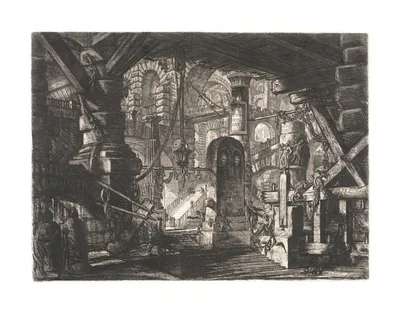
Around 1750, while the first Vedute were selling, Piranesi issued a set of prison interiors that exist nowhere but on paper: vaults without end, stairs that lead to further stairs, ropes, wheels, chains and bridges, with a few small prisoners lost in the dark. In 1761 he took the plates up again, bit them deeper and reissued them under his own name as the Carceri d’Invenzione, sixteen plates in all. What are the Carceri d’Invenzione? looks at them one by one.
Architect of one church, author of many books
Piranesi published far more than views. His four volumes on the antiquities of Rome, the Antichità Romane of 1756, measured and reconstructed the ruins and made his name across Europe, and he argued in print, and at length, that Roman architecture owed nothing to the Greeks. His one real building was the remodelling of Santa Maria del Priorato on the Aventine hill for the Knights of Malta, finished in 1766.
He died in Rome in 1778 after a long illness and was buried in that same church. His tomb bears a statue of him by the sculptor Giuseppe Angelini. His son Francesco carried on the workshop, and a plate by Francesco belongs to the Vedute series we sell.
Piranesi at Heritage Prints
Our collection holds 155 plates by Piranesi: the 139 prints of our Vedute di Roma series and the 16 Carceri d’Invenzione. Each is a facsimile of an original edition, photographed at the size it is printed and made for us by Re-Art Special Art Productions in Almere on acid-free etching paper of 270 g/m² with archival inks. A Veduta sheet measures 81 by 55 centimetres (31.9 by 21.7 inches), a Carceri sheet 51 by 65 centimetres (20.1 by 25.6 inches).
Every print is numbered in pencil, embossed with our blind stamp and comes with a certificate, in an edition of 250. The plates are black and white, as Piranesi made them; if you would like one coloured by hand, see Custom coloring. All of his work is on Giovanni Battista Piranesi.
Four plates to start with
Questions
What is Piranesi famous for?
For two series of etchings: Le Vedute di Roma, about 135 views of the monuments and ruins of Rome made from about 1748 until his death in 1778, and the Carceri d’Invenzione, sixteen imaginary prisons first issued around 1750 and reworked in 1761.
Was Piranesi an architect?
He trained as one with his uncle Matteo Lucchesi and signed his plates “architetto veneziano”, but he built only one church, Santa Maria del Priorato in Rome, where he is buried.
Are Piranesi’s prints etchings or engravings?
Etchings. The lines are drawn through wax and bitten into the copper with acid, then printed in black ink, which is why the plates are black and white.