
A hunter crosses a log, then disappears
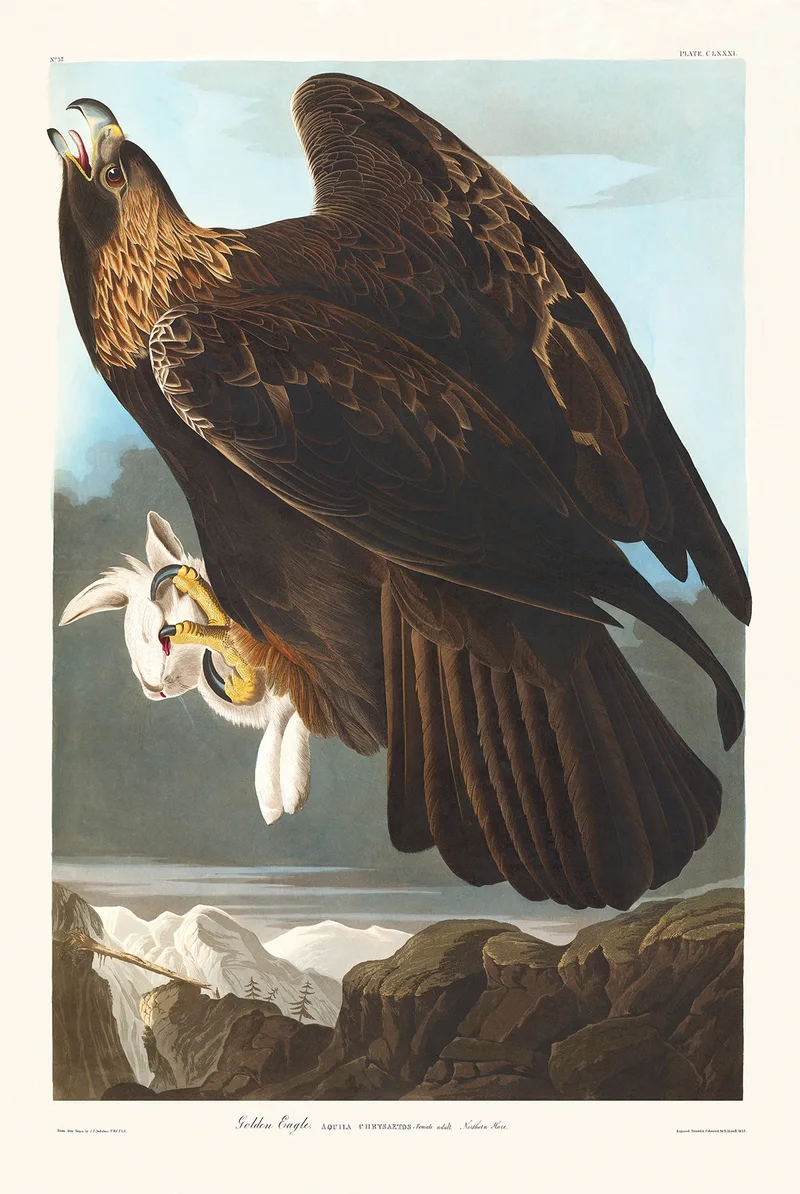
The Golden Eagle is one of the largest birds of prey in North America, and Audubon painted it in full flight over cold, icy peaks, a northern hare pierced by its talons. In the bottom left corner of his watercolour a small figure crosses a log laid over the ravine: a hunter with a rifle, a large bird slung over his shoulder. He is thought to be a self-portrait of the artist.
When Robert Havell engraved the plate in London, the hunter vanished. The log is still there; the man is not. Whether Havell dropped him by mistake or Audubon asked for him to be removed, nobody knows. The plate went out to subscribers without him, and that is how it appears in the copy from which our print is made.
Beyond a few mysteries like this one, we know a great deal about how Audubon worked, thanks to the journals he kept on his travels and the text he wrote to go with the plates.
Every bird at life size, even an eagle
The Birds of America has 435 plates, and Audubon wanted every bird on them at its real size. That decided the paper: double elephant folio, sheets of about 39 by 26 inches. Our facsimiles are printed on sheets of the same size, 67 by 100 centimetres (26½ by 39¼ inches), with the margins and the engraved lettering of the original.
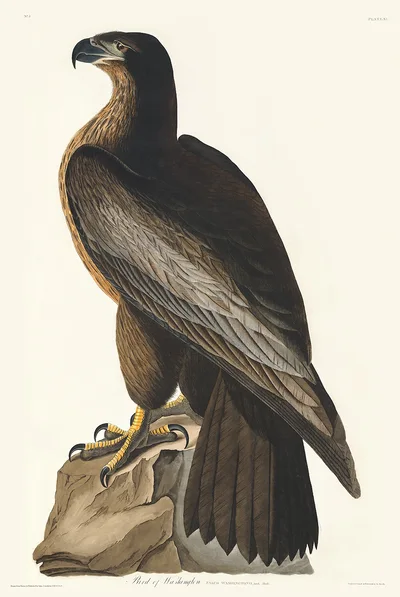
The Bird of Washington shows what that meant for a raptor. The great predator, named after the first president, barely fits on the page. Audubon set it on a rocky outcrop, which adds to its proud bearing, drew the talons in close detail, and turned the head away while keeping the eye on you. There is no escaping it.
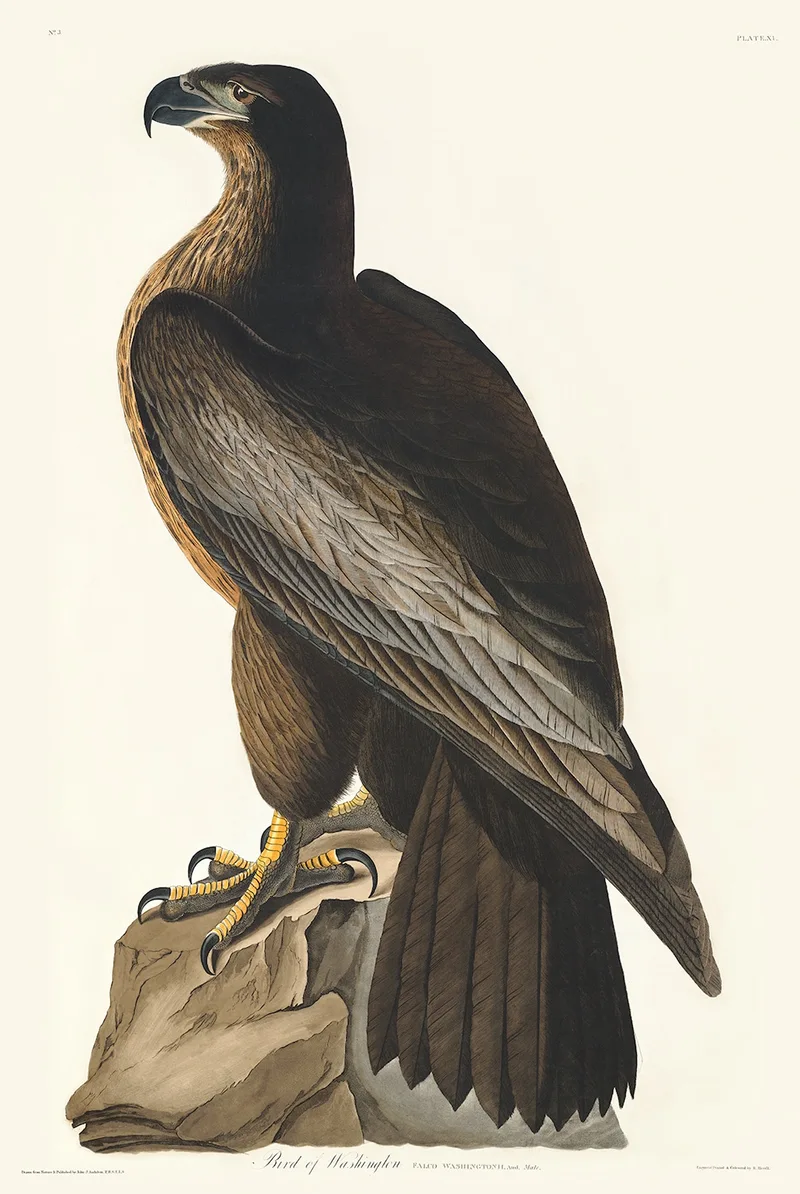
Here too is a mystery. Audubon wrote that he had shot and stuffed the bird, but no specimen has ever been found and the species has never been accepted. The usual explanation is that he drew an immature White-headed Eagle and made it larger; a less kind one is that a new eagle, bigger than any known, helped to sell subscriptions.
How Audubon studied his raptors
Audubon’s technique began in the field. He followed a bird of prey for days on end and filled his journal with what it ate, how it hunted, how it moved through the trees and stood on the ground, the differences between male and female, and how the pair behaved with their young in the breeding season.
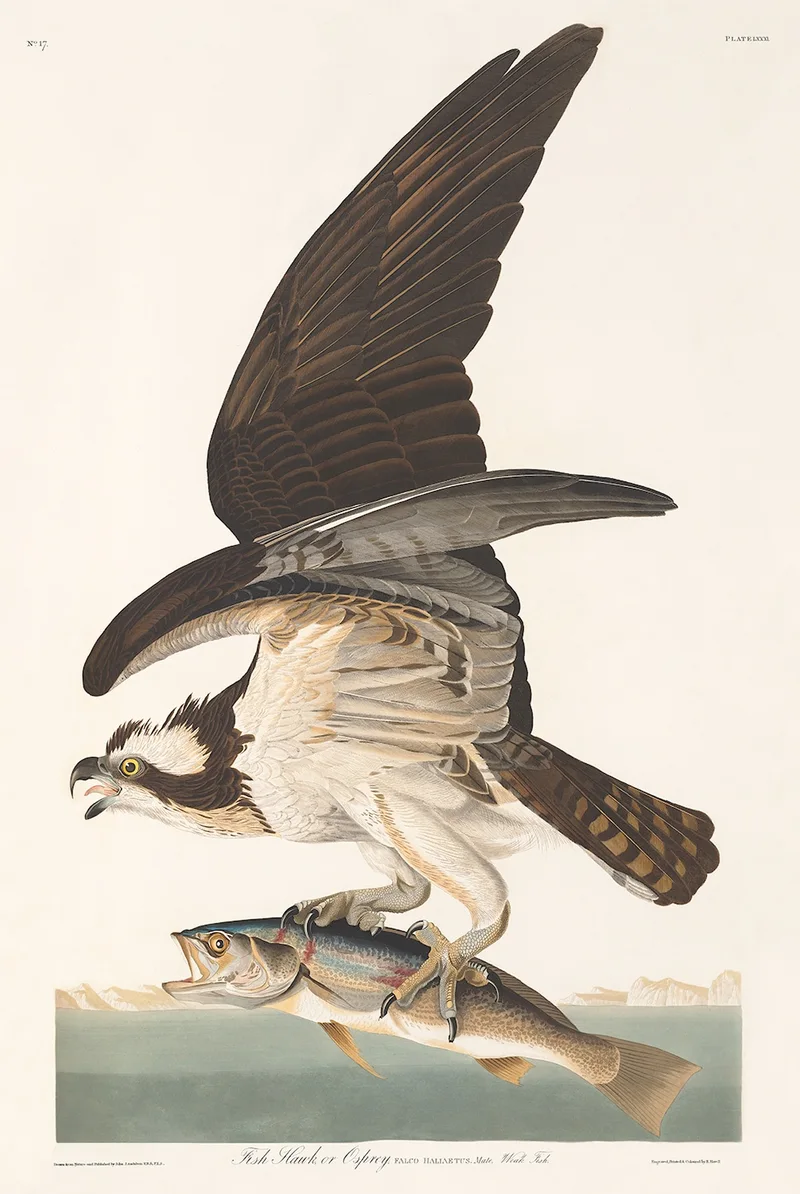
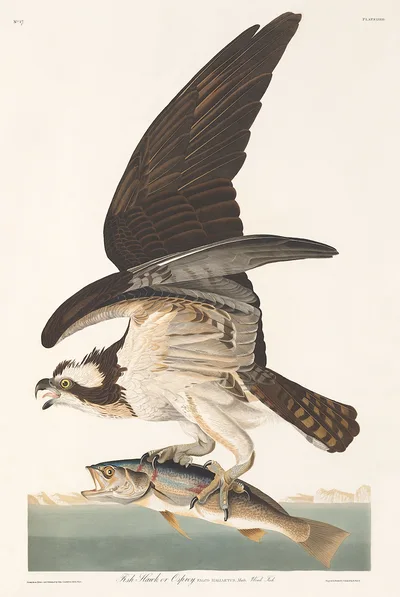
Then he needed the bird itself, to study the plumage, the claws and the beak. Small birds he sometimes caught alive; the large ones he shot, taking care not to spoil the feathers. He was a skilled hunter, and in his day you ate what the woods gave you. Instead of stuffing the specimen in the stiff profile most ornithologists used, he pinned it with wires into the posture he had sketched in the wild, and drew it at once. That is why his Fish Hawk rises from the water with a live fish in its talons, and why his birds look as if they are about to move.
From watercolour to plate: Havell’s workshop
Audubon wanted his watercolours published as a book, and in London he found an engraver willing to take on the work, Robert Havell Jr. Havell transferred each drawing to a copper plate the size of the sheet, in a mixture of engraving and aquatint, an etching technique that gives soft tone rather than line. The plates were printed in black, and the printed sheets were coloured by hand by a team of colourists, working from Audubon’s originals so that the colours matched.
The plate is the thing we reproduce. Audubon’s watercolours are in a museum in New York; what subscribers received, and what the Teylers Museum holds, is Havell’s engraved, printed and hand-coloured version of them. Our facsimile shows the plate as it is, hunter and all, or in this case without him.
The copy in Haarlem
Audubon’s son Victor Gifford Audubon travelled through Europe to find subscribers, and on 26 August 1833, while the book was still being issued, he sold a set to the Teylers Museum in Haarlem. Most sets were bound into volumes; over the years many have been broken up and sold plate by plate, which is why only about 120 complete copies are thought to survive. The Teylers copy is one of them, and one of the best preserved.
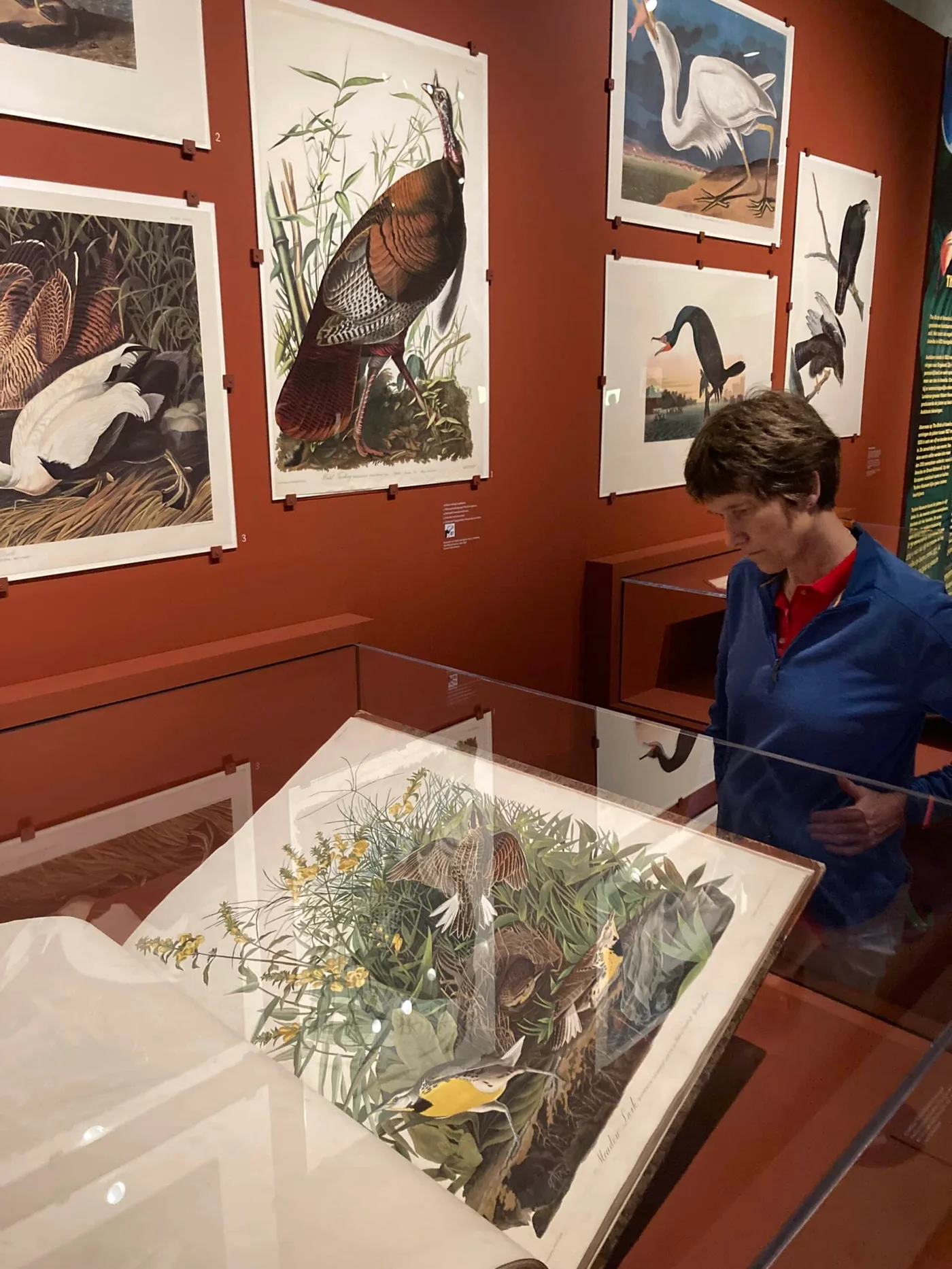
With the museum’s permission, this copy was photographed plate by plate for our facsimiles, which are printed for us by Re-Art Special Art Productions in Almere at the size of the original sheet. What is The Birds of America? tells the whole story of the book; the eagles, hawks, owls and vultures are on The Birds of America, by plate number.
Audubon’s birds of prey
Questions
Is there a hunter in Audubon’s Golden Eagle?
In the original watercolour, yes: a small hunter with a rifle and a bird on his back crosses a log in the lower left corner, thought to be Audubon himself. Havell left him out of the engraved plate, so he does not appear in the printed book or in our facsimile.
Was the Bird of Washington a real bird?
Probably not. Audubon said he shot and stuffed one, but no specimen exists and the species has never been accepted. It is usually explained as an immature White-headed Eagle drawn too large.
How big is the Golden Eagle print?
The sheet is 67 by 100 centimetres (26½ by 39¼ inches), the size of the original double elephant folio plate, and the eagle is shown at life size.