
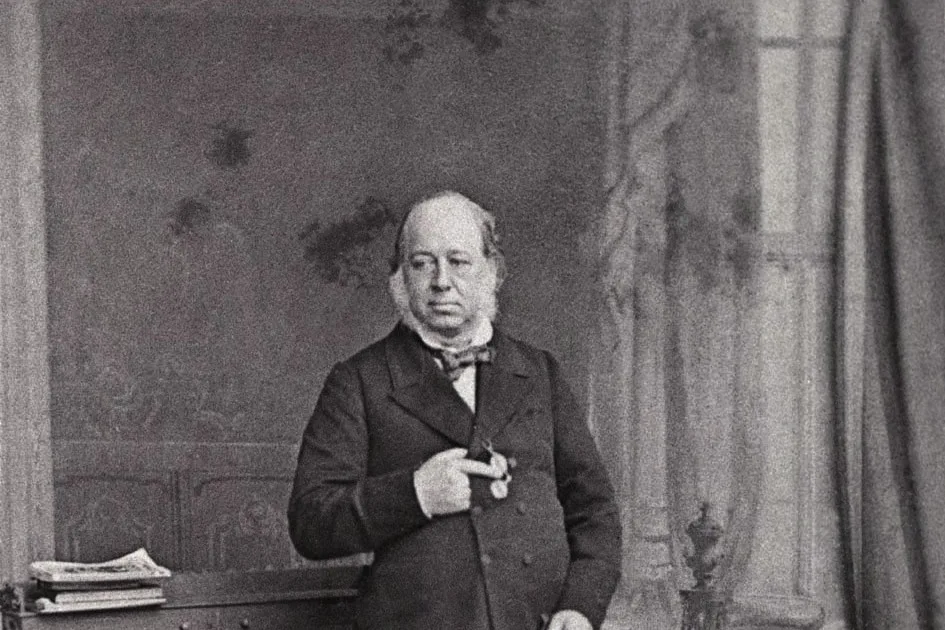
A gardener's son with a taxidermy shop
In the late 1820s a young taxidermist in London was handed a giraffe. The animal had been a present to King George IV, and when it died the job of stuffing it went to John Gould, a gardener's son from Dorset who had set up a taxidermy business in the capital. It was the kind of commission that makes a name, and it says something about Gould: seldom the best artist in the room, usually the one who got the work.
John Gould (1804 to 1881) is the name on nearly 3,000 hand-coloured plates in more than forty volumes, from the Himalaya to Australia, Asia, Great Britain and New Guinea. He was not the artist of those plates. He was the observer, the sketcher, the publisher and the manager of the artists who were, and that is what this entry is about.
Gould was born in Lyme Regis in 1804, the son of a gardener. When his father found work in the Royal Gardens at Windsor, John followed him there at the age of fourteen as an apprentice gardener. He trained at Windsor from 1818 to 1824 and then worked as a gardener at Ripley Castle in Yorkshire.
Gardening was not what interested him. Birds were, and he taught himself to stuff them. By the mid-1820s he had a taxidermy business in London, and it was taxidermy, not drawing, that brought him the giraffe and, more important, the attention of the naturalists who were founding the Zoological Society of London.
Curator at the Zoological Society
In 1827 the Society made him the first curator and preserver of its museum. The post put him at the centre of the new science: every collection of exotic skins that reached London passed through his hands, and he was often the first to describe what was in it, in a long series of scientific papers.
In 1830 a parcel of bird skins arrived from the Himalaya. Gould saw a book in it. No publisher would take the risk, so he published it himself, in monthly parts, with his wife drawing the plates: A Century of Birds from the Himalaya Mountains (1830 to 1833). It sold, and it set the pattern for everything that followed.
Seven years later the Society handed him another parcel to identify: the birds Charles Darwin had brought back from the voyage of the Beagle. Gould's verdict, that the small birds of the Galápagos were twelve species of one new group of ground finches, became one of the famous moments of nineteenth-century science. John Gould and Darwin's finches tells that story.
Elizabeth Gould and the team: Lear, Richter, Hart and Wolf
Gould could see a bird and describe it in exact detail, and he could set its pose down in a few quick lines. What he could not do was finish a plate. His wife Elizabeth Gould (1804 to 1841) could. For the Himalayan book she took his pencil and watercolour sketches, with their notes on colour and attitude, worked them up into finished drawings and drew them on the lithographic stone herself, a technique she learned with help from Edward Lear. She also did the first hand colouring.
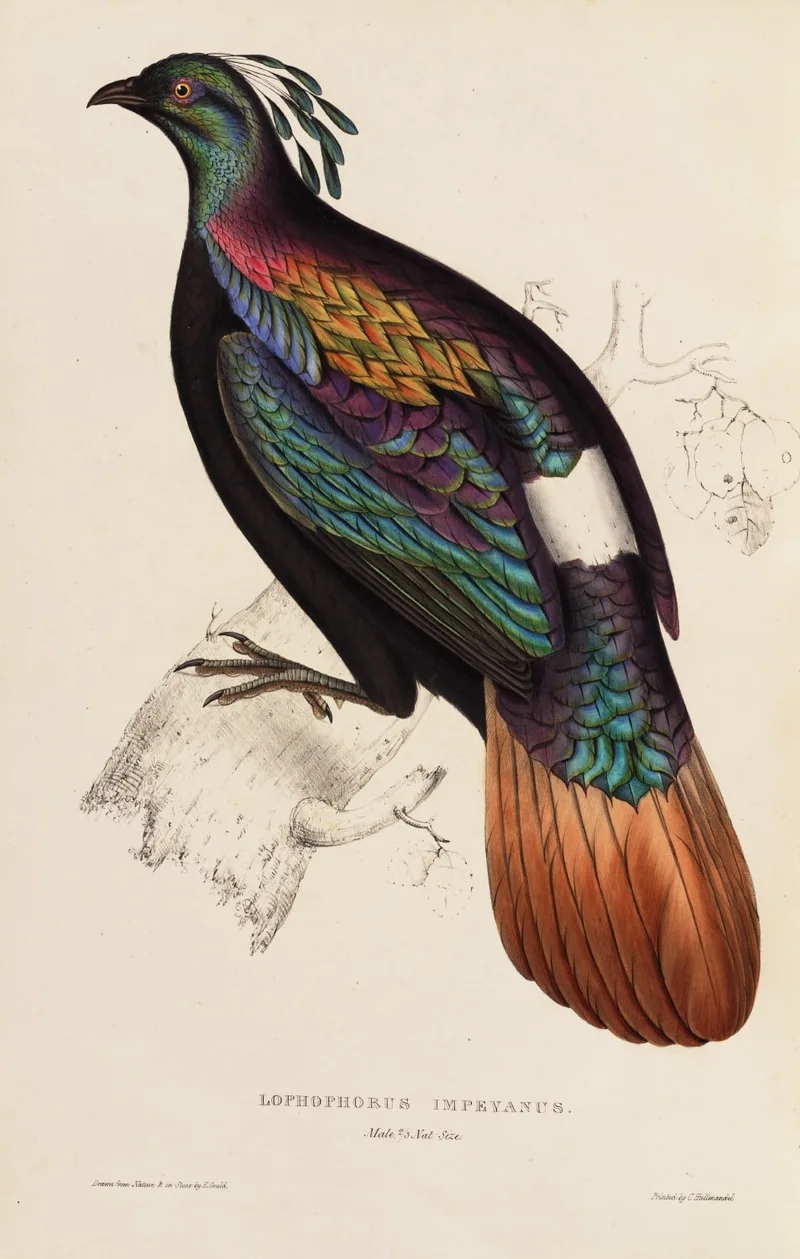
In 1838 the Goulds sailed to Australia and spent almost two years collecting for The Birds of Australia. Elizabeth drew 84 of its plates. She died in 1841, at 37, soon after their return, leaving Gould with young children and a book half done. The Birds of Australia was the first comprehensive survey of the continent's birds, and it made him what he is still called: the father of bird study in Australia.
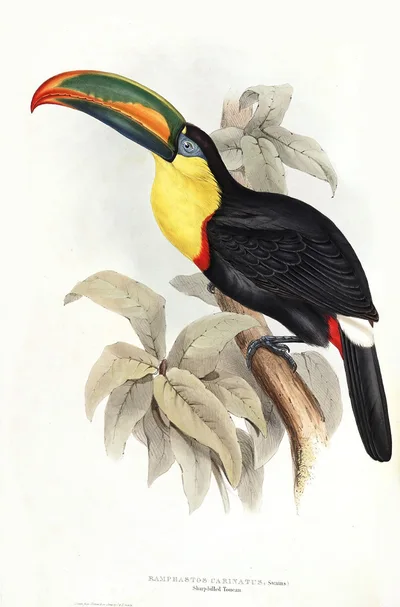
Gould's real talent was for organisation. After Elizabeth's death he hired Henry Constantine Richter (1821 to 1902), who worked her Australian drawings up into plates and stayed with Gould for forty years, until Gould's death. William Matthew Hart (1830 to 1908) joined in 1851 as artist and lithographer and was his chief artist by 1870. Joseph Wolf (1820 to 1899), the German-born animal painter, drew for him as a freelance and never joined the staff; Wolf found Gould shrewd and uncouth, and said he added too much colour, insisting that birds in the wild were brighter. Edward Lear (1812 to 1888), long before his nonsense verse, drew toucans and other plates for the early books and taught Elizabeth lithography.
The method stayed the same for fifty years. Gould made a rough sketch, usually from a freshly killed bird, in pencil, ink, chalk or a broad colour wash: quick, bold and never more than a sketch, but with the character of the bird in it. An artist worked it up into a finished watercolour. Gould approved it, or did not. Then it was drawn on a lithographic stone, printed, and coloured by hand by a team of colourists.
What makes a Gould plate a Gould plate
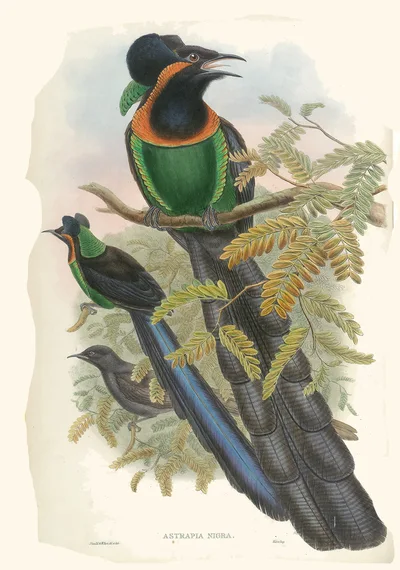
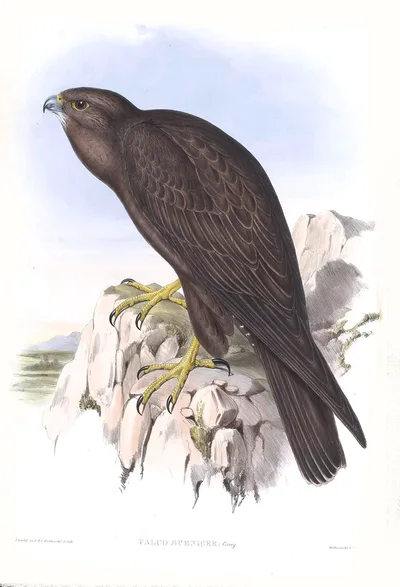
Look at a Gould plate and three things stand out. The birds are lifelike, often a male and a female together, and for the larger species on facing plates; where he knew it, a nest with eggs or young is there too. The colour of the birds in the foreground is rich and full. And the background, especially in the early books, is a faint wash that leaves the bird to do the work. Later, in The Birds of Asia and The Birds of Great Britain, the settings grew lusher and more exact, with the plants and insects of the bird's own country.
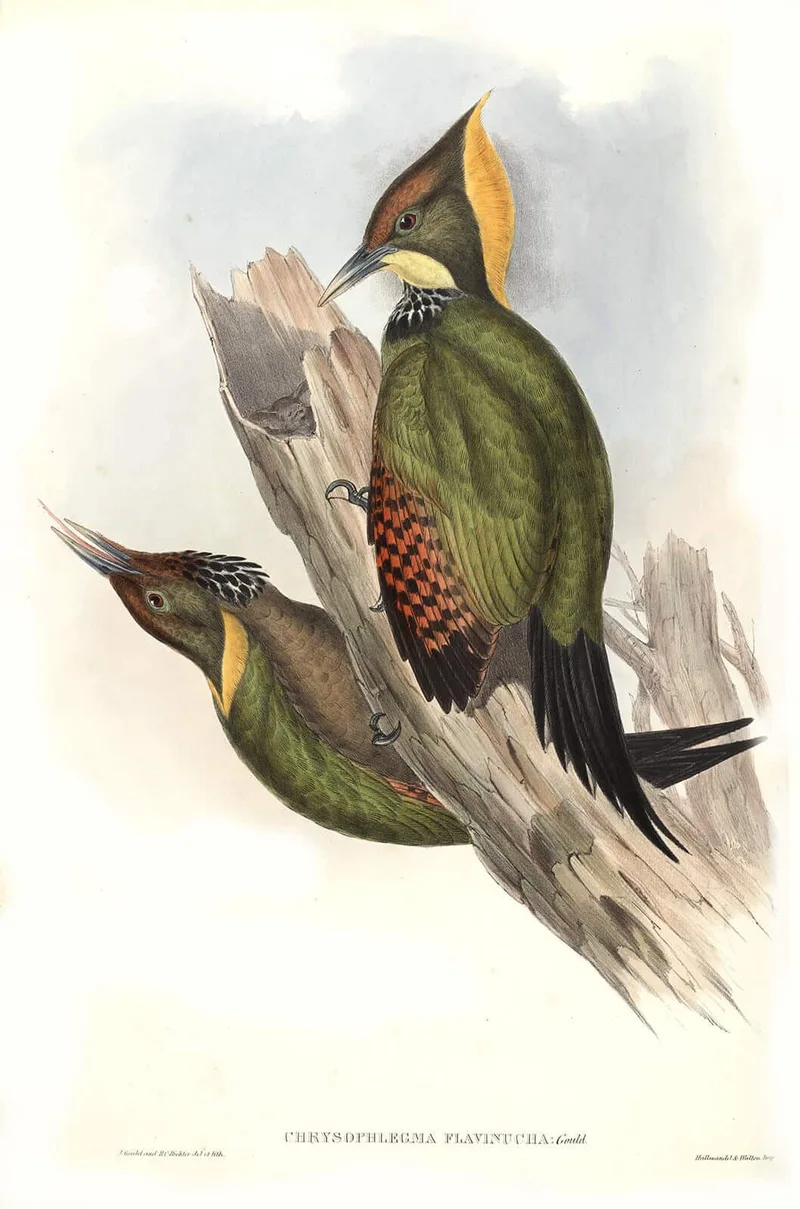
Those faint washes are the hardest part of a facsimile to get right: they either disappear or come out too strong. How a facsimile is made shows how Re-Art proofs every plate against the original until the two match.
Gould's books and his prints today
Between 1830 and his death in 1881 Gould published, among others, A Century of Birds from the Himalaya Mountains, The Birds of Europe, A Monograph of the Ramphastidae, or Family of Toucans, The Birds of Australia, A Monograph of the Macropodidae, or Family of Kangaroos, A Monograph of the Trochilidae, or Family of Hummingbirds, The Birds of Great Britain, The Birds of Asia and The Birds of New Guinea. The last two were still unfinished when he died; his assistant Richard Bowdler Sharpe completed them. What books did John Gould publish? lists each one with its years, its plates and what we offer from it.
Our Gould prints are facsimiles of original plates: the Himalayan book, The Birds of Asia and The Birds of Great Britain from the copies in the library of the Teylers Museum in Haarlem, photographed plate by plate by Re-Art Special Art Productions in Almere, who make every print for us. Each is printed at the size of the original sheet, about 38 by 56 centimetres, on acid-free etching paper of 270 g/m² with archival inks, in an edition of 250, numbered in pencil, blind embossed and with a certificate of authenticity. We hold master files of more plates than the site shows; if the one you want is missing, write to us. All of his works are on John Gould.
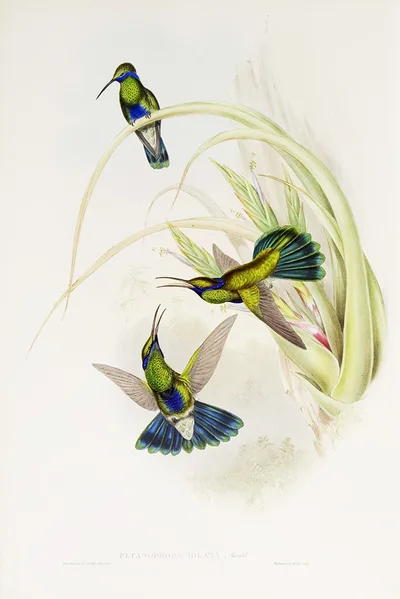
Four plates from four books
Questions
What is John Gould famous for?
For his illustrated bird books: nearly 3,000 hand-coloured lithographs in more than forty volumes, among them The Birds of Australia, The Birds of Asia and The Birds of Great Britain, and for identifying Darwin's finches in 1837.
Did John Gould draw his own plates?
No. He made quick sketches from the birds; his wife Elizabeth Gould, and later Richter, Hart, Wolf and Lear, worked them up into finished drawings and lithographs, which were coloured by hand.
Why is Gould called the father of bird study in Australia?
He and Elizabeth collected in Australia from 1838 to 1840, and The Birds of Australia (1840-1848) was the first comprehensive survey of the continent's birds, with many species described for the first time.