
Why your print arrives in a tube
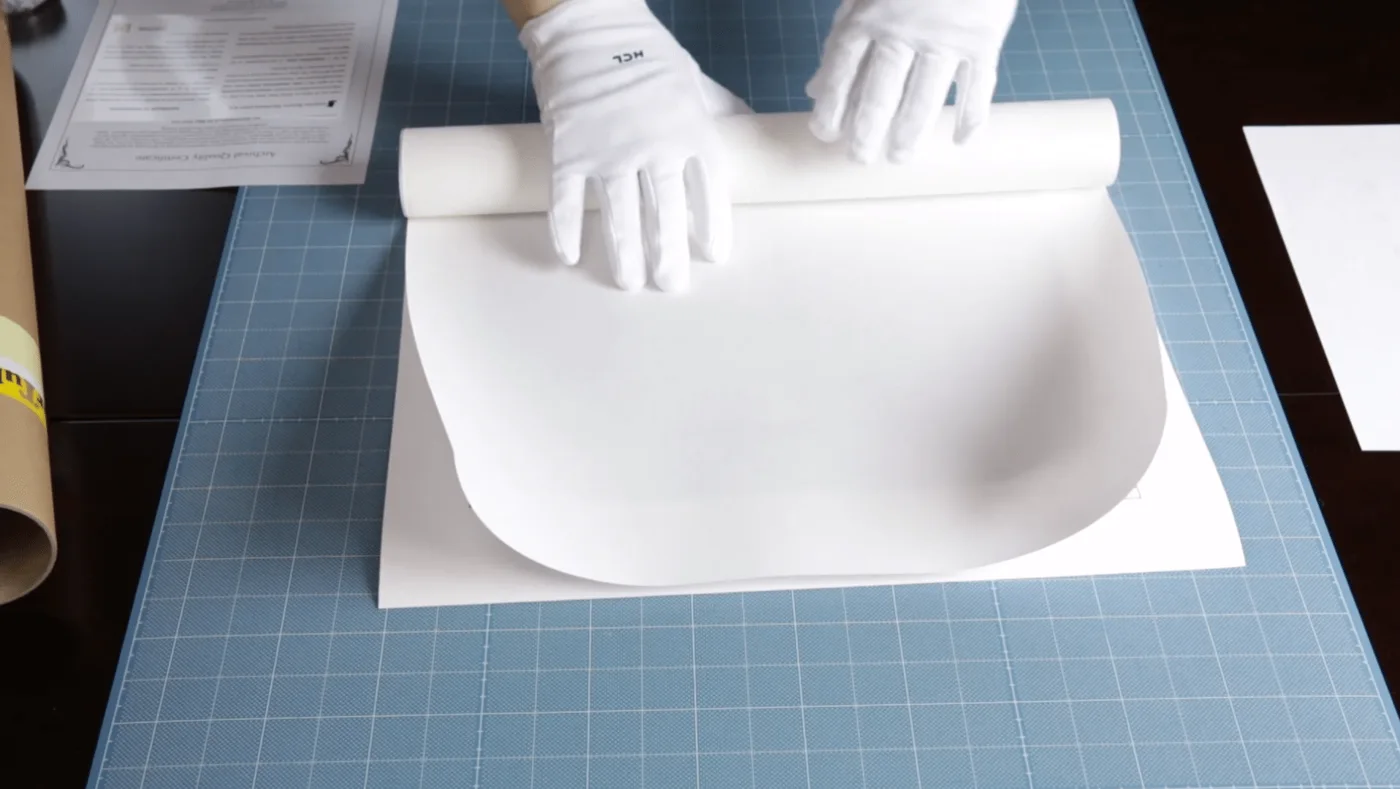
A frame can cost more than the print inside it, and it will be on your wall for as long as the print is, which with ours is more than 100 years under good conditions. That is one reason we do not sell prints framed. The others are simpler: a framed sheet a metre tall is fragile and expensive to ship, and no two rooms want the same frame. So every print leaves Almere rolled in a sturdy tube, and the choices below are yours.
I would prefer to buy an unframed print, so I could choose the frame myself. The main thing is the print.
1. Choose a framer who works with paper
Ask friends, read reviews, then ask the framer one question: how do they mount works on paper? The answer you want includes the words acid-free and hinge. A good framer will also want to see the print before quoting, because a sheet of 67 by 100 centimetres needs a sturdier frame than a small plate.
2. Ask for an acid-free mount and backing
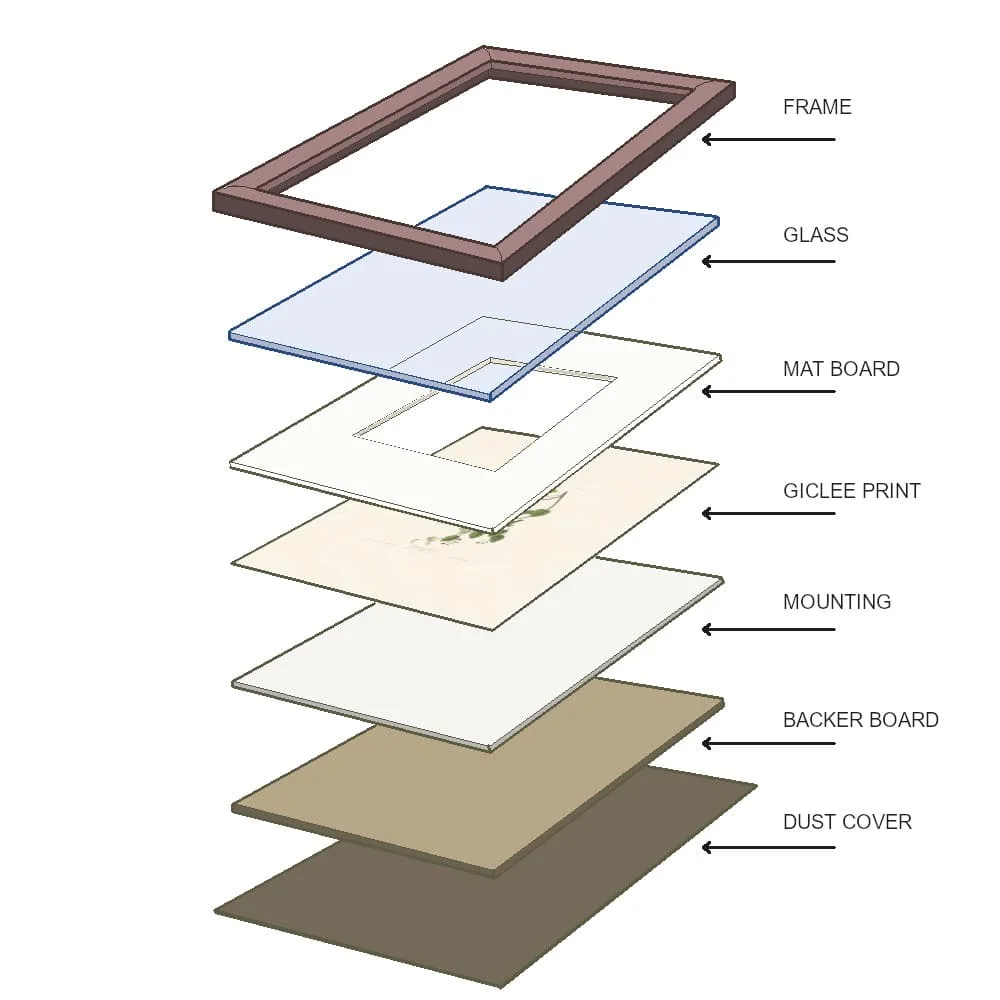
The sheet should never touch the glass, and nothing acidic should touch the sheet. Ask for an acid-free window mount, an acid-free backing board, and hinges of acid-free tape along the top edge only, so the paper can move a little with the seasons. Never let the print be glued down or dry-mounted: it cannot be undone. Our paper is acid-free etching paper of 270 g/m²; the frame should be built to the same standard.
3. Show the whole sheet
Every Heritage print is a facsimile of the whole sheet: the margins, the plate number and the engraved lettering are part of it. Ask for a window that shows the full sheet with a little mount around it, rather than one that crops to the image. On the page of each print you can see the sheet in three frames with a narrow mount of about 2.5 centimetres, which is a good starting point for the conversation.
4. Choose glazing that protects
Glass or acrylic with UV protection slows the one thing that can harm a print over the decades, which is light. A low-reflection finish lets you see the print instead of the window behind you. For a large sheet, acrylic is lighter and does not shatter, which matters a metre above a sofa.
5. Choose the frame for the room, not the trend
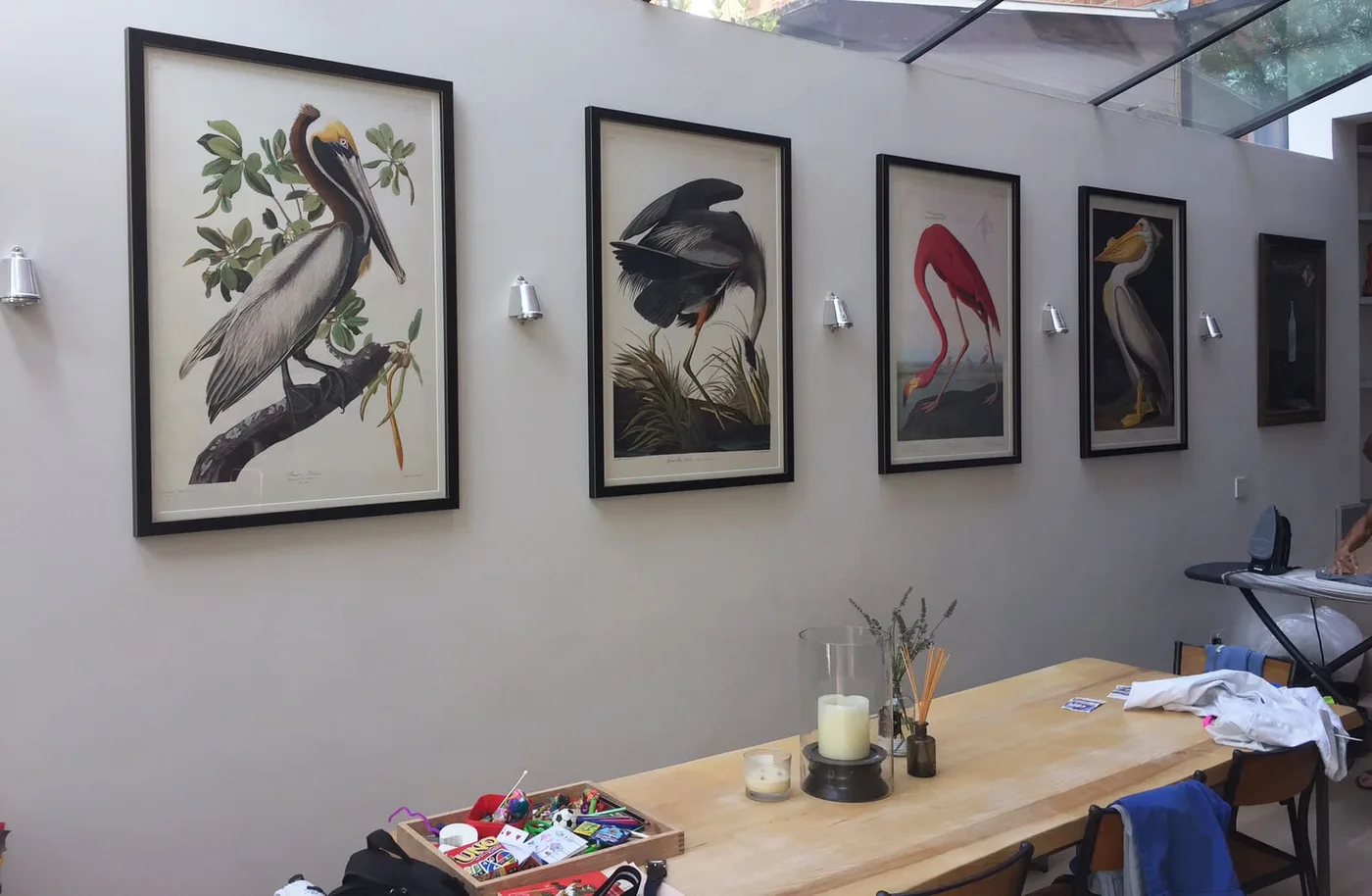
A frame is a decision about the wall. Look at the width of the moulding against the size of the sheet: a narrow light-wood frame makes a small plate feel like a drawing, while a wider black frame with a gold slip gives a large Audubon the weight of a painting. On the page of every print, See it in a room shows the sheet at approximate scale in three frames (black and gold, dark wood and light wood), so you can compare before you visit the framer. Take the room with you in your mind: the colour of the wall, the wood of the furniture, what hangs nearby.
6. Hang it at eye level: about 150 cm to the centre
Measure from the floor to the centre of the frame and aim for about 150 centimetres (60 inches): the height most museums use, and the one that feels natural to someone standing. Above a sofa or a sideboard, go lower, so the frame sits a hand’s width or two above the furniture rather than floating.
7. Use fixings that carry the weight
A framed Audubon sheet behind glass is heavy. Use hooks and wall plugs rated for the weight, two of them for a wide frame so it hangs level and cannot swing. A picture rail along the top of the wall with perlon cords is the most convenient of all: you can move or swap prints without a new hole.
8. Keep it out of direct sunlight and away from damp
This is the condition that matters most. The inks are archival and the paper is acid-free, so a print lasts more than 100 years under good conditions. Good conditions means out of direct sunlight, away from damp, and framed with acid-free materials. Avoid the wall that faces a south-facing window all afternoon, the bathroom, and the wall above a radiator. The frame and the mount are less robust than the print, so protect those too.
9. Light it softly
Soft, diffused light shows a print best and keeps glare and shadows off the glass. A picture light or a spot from the ceiling, angled so that you do not see the bulb in the glazing, is enough. Daylight from the side is lovely; daylight straight onto the sheet is not.
10. Compose the wall
Step back and look at the whole wall. Keep the same distance between frames, line up the centres rather than the tops when the frames differ in size, and ask someone else to look before you drill. A row of plates from one book hangs well at the same height in the same frame; a single large bird wants space around it.
Looking after a framed print
- Dust the frame and the glass with a soft brush or a lightly damp cloth. Do not use cleaning agents, and never spray anything onto the glass: it can run under the edge and reach the mount.
- Once a year, check that the hooks still hold and the frame hangs level.
- If the print ever needs to come out of the frame, let a framer do it. The hinges are meant to be released, not pulled.
Questions about a particular print or wall? Write to us, or see the framing answers in our FAQ.
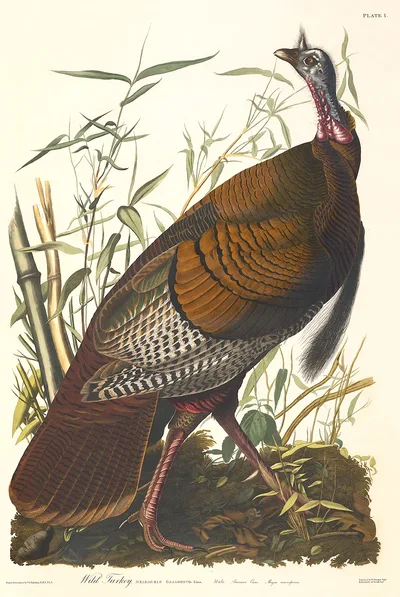
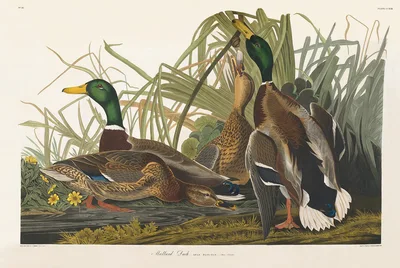
Four plates that frame well


Questions
Do you sell framed prints?
No. Every print ships unframed, rolled in a sturdy tube, so you can choose a frame that suits your room and shipping stays safe. On the page of each print you can see it in three frames, as an example; the frame is not included.
How high should I hang a print?
About 150 cm (60 inches) from the floor to the centre of the print, the height museums use. Above a sofa or a sideboard, hang it a little lower.
Does a giclée print need UV-protective glass?
We recommend it. The inks are archival and the paper is acid-free, but light is the one thing that works on a print over decades. UV-protective, low-reflection glazing and a spot out of direct sunlight keep it as it was made.
How do I clean a framed print?
Dust the frame and the glass with a soft brush or a lightly damp cloth. Do not use cleaning agents, and do not spray anything onto the glass.