
A flower at midnight
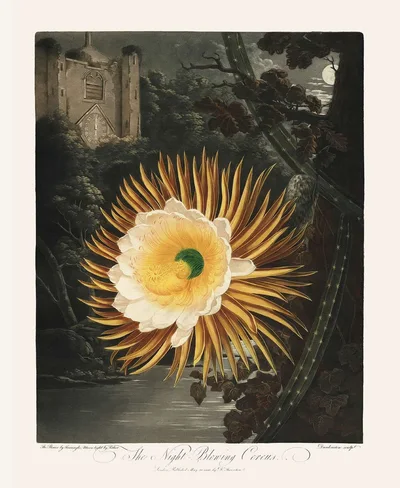
A white cactus flower, wider than a hand, opens in the dark. Behind it a church tower stands against a moonlit sky, and the clock says it is past midnight: the hour the flower opens. That is The Night Blowing Cereus, and no flower book before it had thought to paint a plant at the hour it bloomed.
The Temple of Flora is the third and last part of New Illustration of the Sexual System of Carolus von Linnaeus, published in London by the physician Robert John Thornton (1768 to 1837) between 1799 and 1807. It is a book of large colour plates in which each flower is set in a landscape meant to evoke the country it came from: tulips beside a river with a mill, a lotus before the pyramids, a snowdrop in snow. The plates mix mezzotint, aquatint, stipple and line engraving, were printed in colour and finished by hand, and they ruined their publisher.
Who painted the plates
Thornton was not a painter, so he hired the best British artists he could find: Philip Reinagle, Peter Henderson and Sydenham Edwards among them, with Abraham Pether, a painter of moonlight, called in for the night sky of the cereus. Thornton composed the pictures himself and told his artists to put the plants not against the plain white page of the botanical tradition but into their own settings, so that the viewer would see where the flower grew.
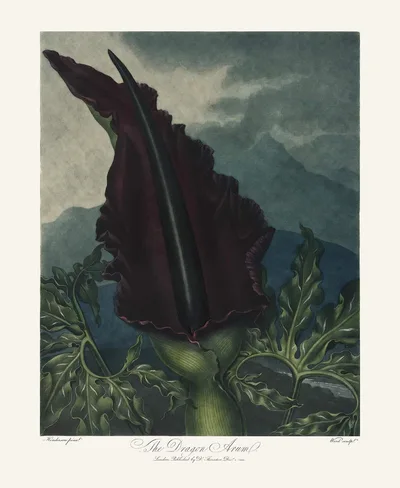
The settings are more theatre than geography: the Snowdrop stands in snow, the Dragon Arum under a stormy sky, and Thornton’s own text keeps pace with the pictures.
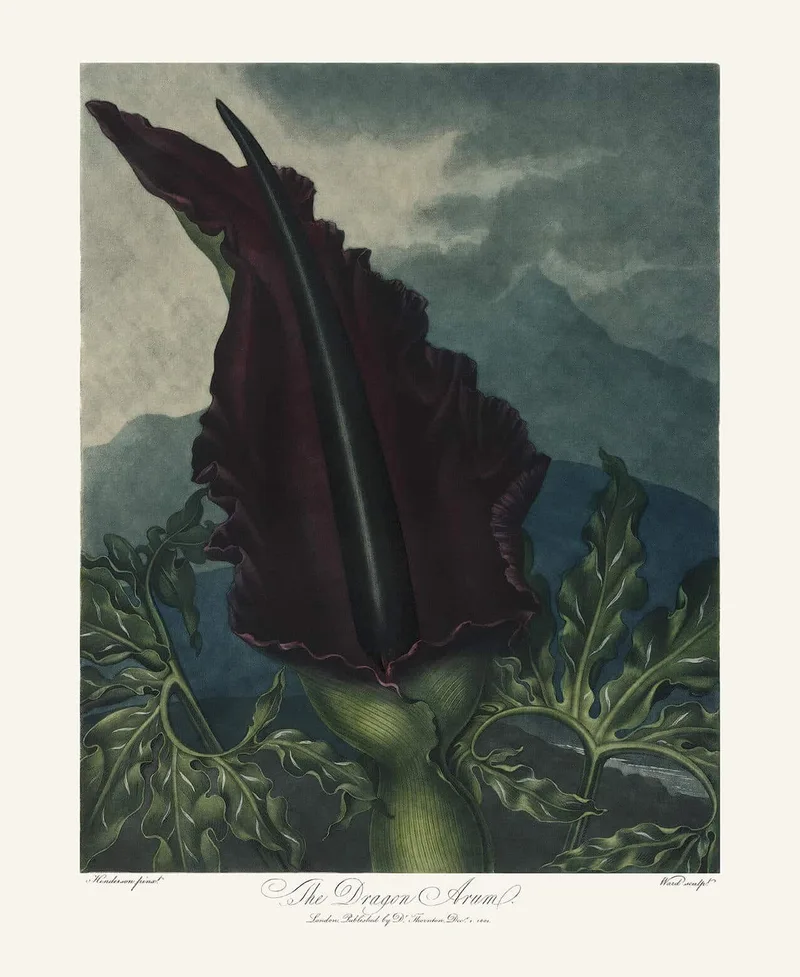
She comes peeping from her purple crest with mischief fraught: from her green covert projects a horrid spear of darkest jet, which she brandishes aloft: issuing from her nostrils flies a noisome vapour, infecting the ambient air.
How the plates were printed: mezzotint, aquatint and stipple
The paintings were turned into prints by several techniques at once, which is why the plates look like no others. Mezzotint gave the deep velvety darks of the backgrounds, aquatint the even tones of sky and water, stipple the soft flesh of petals, and line engraving the outlines. The plates were inked in several colours and printed, and each impression was then finished by hand in watercolour.
Because Thornton paid for the plates himself and ran short of money, they appeared at irregular intervals, and copies of the book differ in what they contain. He had planned seventy; around thirty were made.
The plates people ask for most
There is no agreed favourite, but five plates come up again and again.
- Roses: a bank of roses in yellow, white and red, with two birds and a nest of eggs among the flowers and a classical temple in the distance.
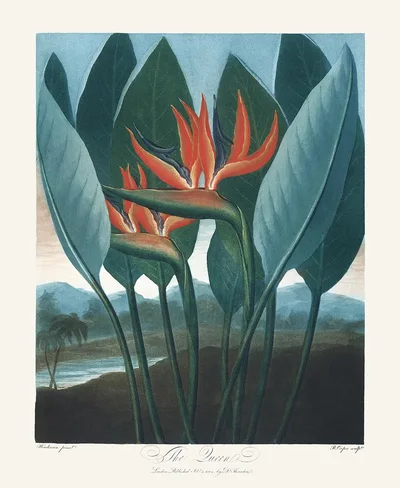
- The Queen: the bird of paradise flower, Strelitzia reginae, named for Queen Charlotte, its orange flowers rising from a red-edged bract against hills, water and palms.
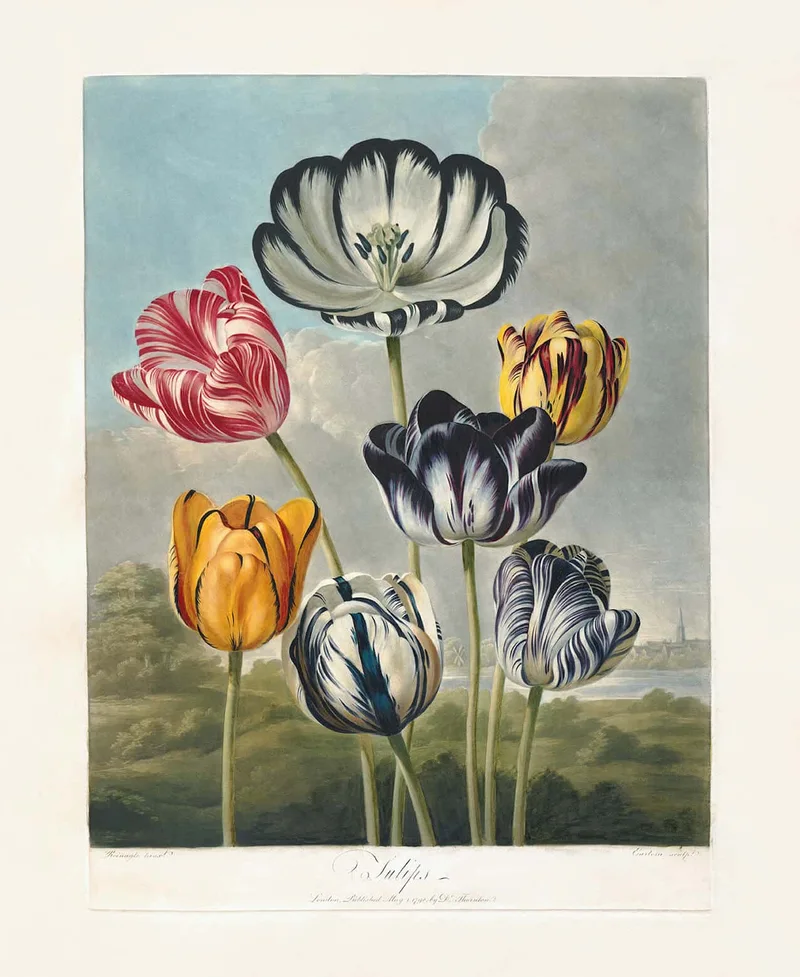
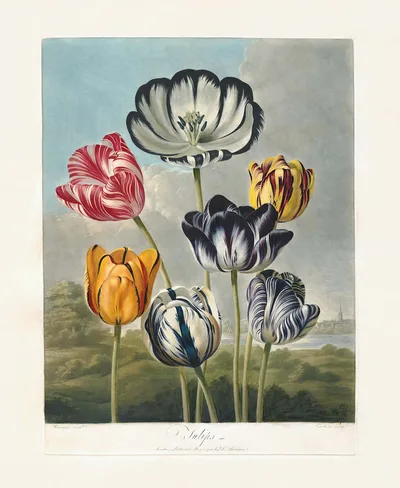
- Tulips: seven named tulips, Louis XVI rising ‘with princely majesty’, a General Washington, La Majestieuse, a carnation tulip and two new varieties named for the Duchess of Devonshire and Earl Spencer, with a river, a mill and a church spire behind.
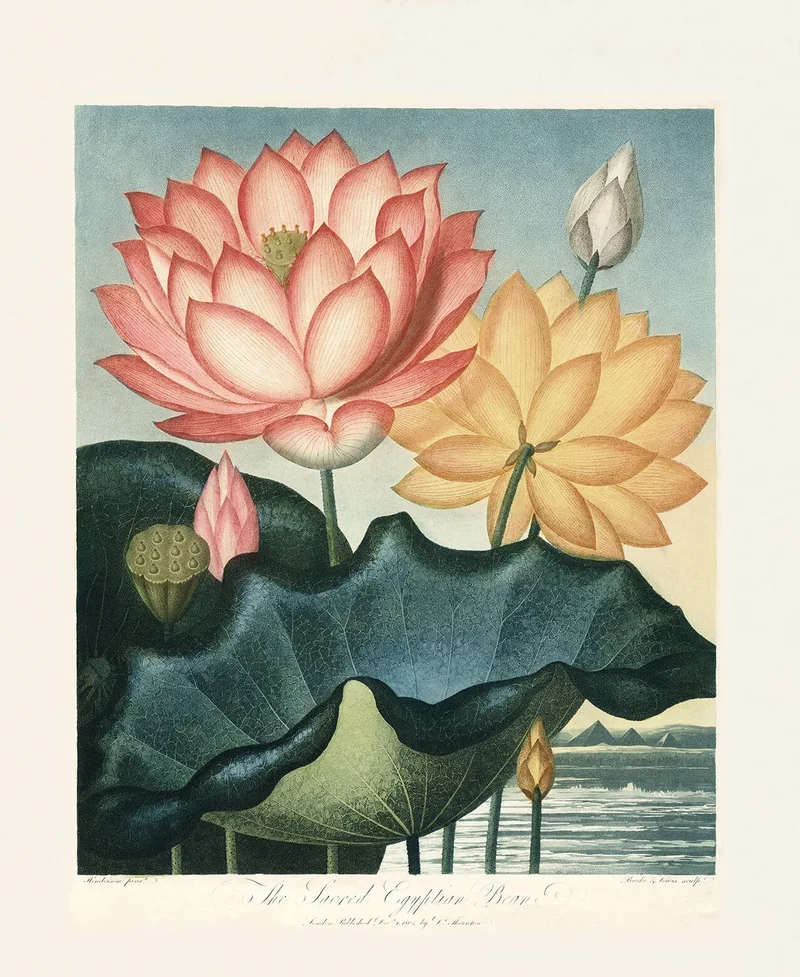
- The Sacred Egyptian Bean: the sacred lotus, Nelumbo nucifera (Thornton’s Nelumbium speciosum), two open flowers and their round leaves on the water, with the pyramids and the Nile behind. It is not the same plant as the Blue Egyptian Water Lily, Nymphaea caerulea, which has a plate of its own.
- Large Flowering Sensitive Plant: a shrub of the East and West Indies, introduced to British gardens in 1769, with its purple, feathery flowers, a hummingbird feeding from them and a man standing beside a full-grown plant to show its height.
Add The Night Blowing Cereus, The Dragon Arum and Cupid Inspiring the Plants with Love, and you have most of the plates that hang in people’s houses.
Why the book nearly did not happen
Thornton began the New Illustration in 1797 with an inheritance and no patron. Subscriptions were slow, the fashion for botany faded, and a lottery in 1811 with the original paintings as first prize failed. He died poor in 1837. Who was Robert John Thornton? tells that story.
The Temple of Flora at Heritage Prints
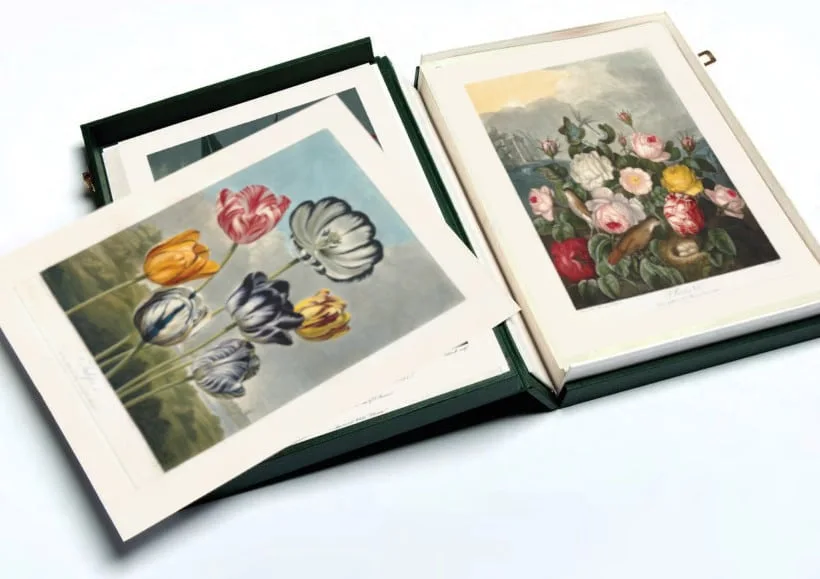
Our thirty plates are facsimiles of the copy of The Temple of Flora in the library of the Teylers Museum in Haarlem. Each is photographed at the size it is printed, retouched only where two centuries have left a mark, proofed against the original and printed for us by Re-Art Special Art Productions in Almere on acid-free etching paper of 270 g/m² with archival inks. The sheets measure 45 by 55 centimetres (17.7 by 21.7 inches). How a facsimile is made.
Every print is numbered in pencil, embossed with our blind stamp and comes with a certificate, in an edition of 250, and lasts more than 100 years under good conditions. The plates are on The Temple of Flora. All thirty together, with a title page, a contents page and a certificate in a Solander box with gold lettering made by hand by a bookbinder, are the complete set, limited to 50 sets and made on request.
Four plates to start with
Questions
How many plates are in The Temple of Flora?
Thornton planned seventy and made around thirty, issued irregularly between 1799 and 1807, so copies differ. Heritage Prints offers thirty of them as facsimiles, from the copy in the Teylers Museum in Haarlem.
How were the plates of The Temple of Flora made?
By a mixture of mezzotint, aquatint, stipple and line engraving on copper, printed in colour and finished by hand in watercolour. That is why the backgrounds are so dark and the petals so soft.
What is the Sacred Egyptian Bean?
The sacred lotus, Nelumbo nucifera, which Thornton called Nelumbium speciosum. It is a different plant from the Blue Egyptian Water Lily, Nymphaea caerulea, which has its own plate in the book.