
Nearly 280,000 pictures coloured by hand
Multiply 367 plates by 750 copies and you get 275,250 sheets, each one coloured by hand with a brush: every sky, every feather. Gould did the sum himself in the introduction, and could not quite believe it.
[…] every sky with its varied tints and every feather of each bird were coloured by hand; and when it is considered that nearly two hundred and eighty thousand illustrations in the present work have been so treated, it will most likely cause some astonishment to those who give the subject a thought.
The Birds of Great Britain (1862 to 1873) is Gould's book on the birds of his own country. He published it himself, in 25 parts, in an edition of 750 copies, and it was bound into five volumes. By then he was nearly sixty, with the Himalaya, Europe, Australia, the hummingbirds and most of Asia behind him, and this is the book in which his plates reached their fullest form.
Nests, eggs and young
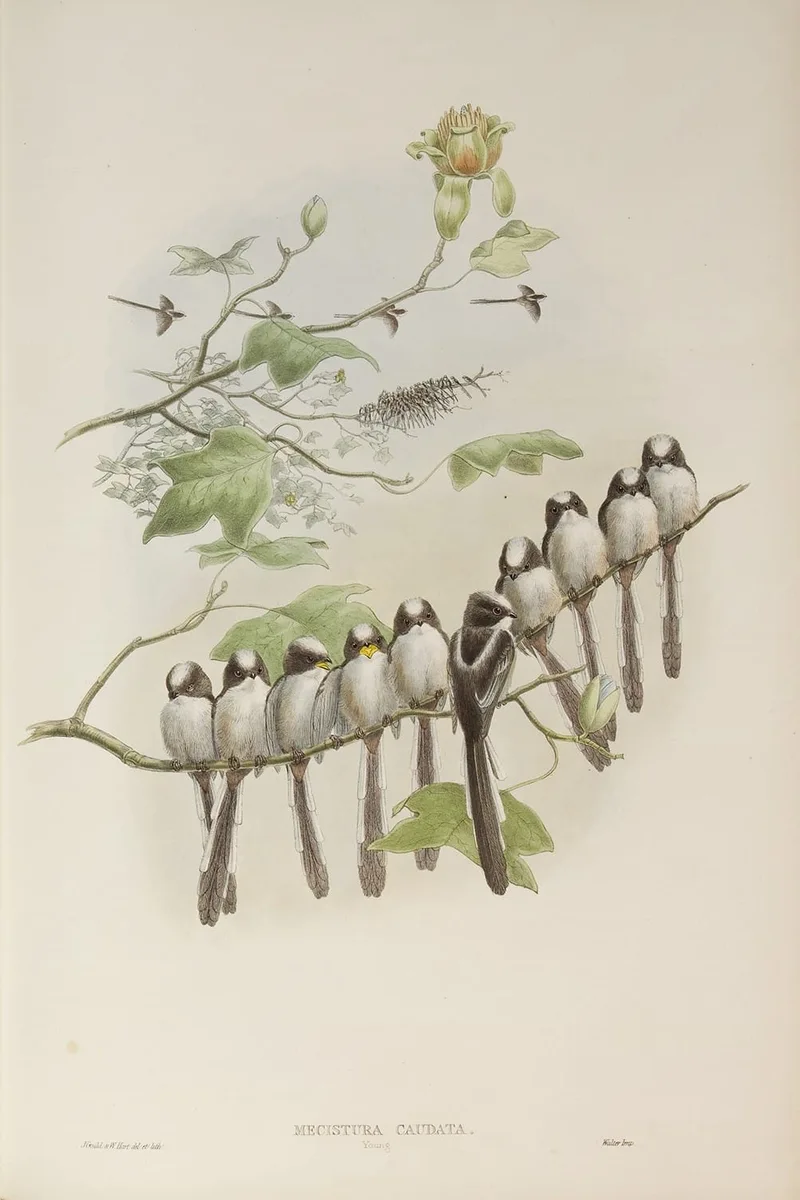
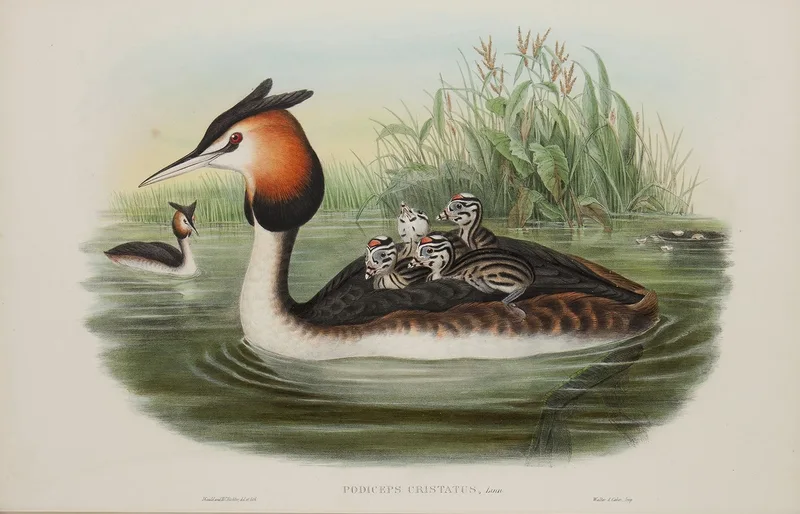
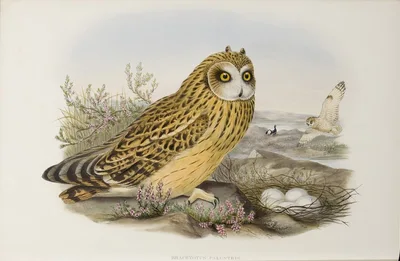
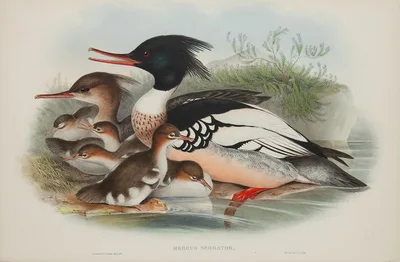
What set the book apart was not the adults but the chicks. Most bird artists of the day drew the adult male in profile and stopped. Gould, who had spent thirty years with skins and nests, decided to show the young as well: in the nest or just out of it, with the eggs, the parent birds and the plant they nested in.
I also felt that there was an opportunity of greatly enriching the work by giving figures of the young of many of the species of various genera.
The result is a book of family scenes, the Long-tailed Tit at its domed nest with a row of fledglings among them. Nothing in Gould's earlier books, or in anyone else's, had done this on such a scale.
Gould's sketch, Wolf's drawing, Hart's stone
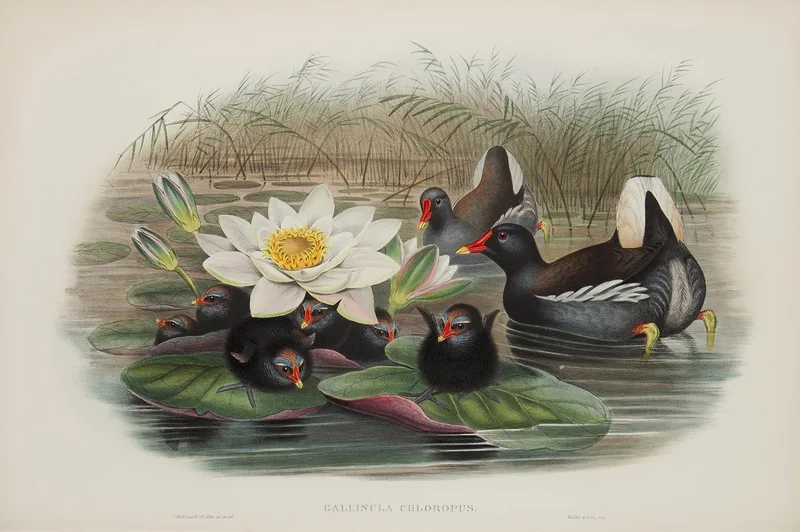
Gould's method had not changed since 1830. He made a rough sketch, usually from a freshly killed bird, to fix the pose and the composition; his artists worked it up into a finished watercolour; once he had approved it, it was drawn on the lithographic stone, printed and coloured by hand. For the Moorhen of volume 4 the first step survives: a hasty sketch on the back of an old board, attributed to Gould, which Joseph Wolf turned into the finished plate.
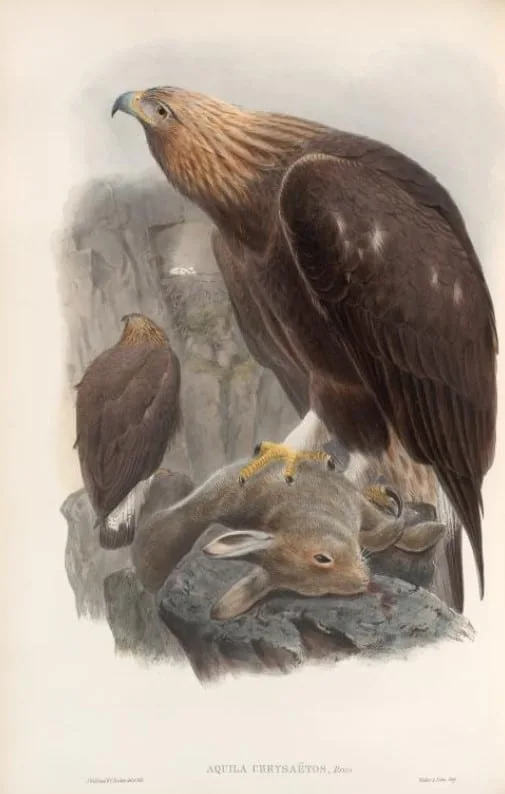
Three artists did most of the work. Joseph Wolf (1820 to 1899), German-born and the most admired of them, drew for Gould as a freelance and never joined his staff; the Golden Eagle of volume 1 is his. Henry Constantine Richter (1821 to 1902) had been with Gould since Elizabeth Gould's death in 1841 and stayed until Gould's own. William Matthew Hart (1830 to 1908), with Gould from 1851, was chief artist and lithographer by 1870; he and Richter also drew the plates on the stone. Wolf admired little about his employer: he found Gould shrewd and uncouth, thought he knew nothing of composition, and said he added too much colour, claiming that birds in the wild were brighter.
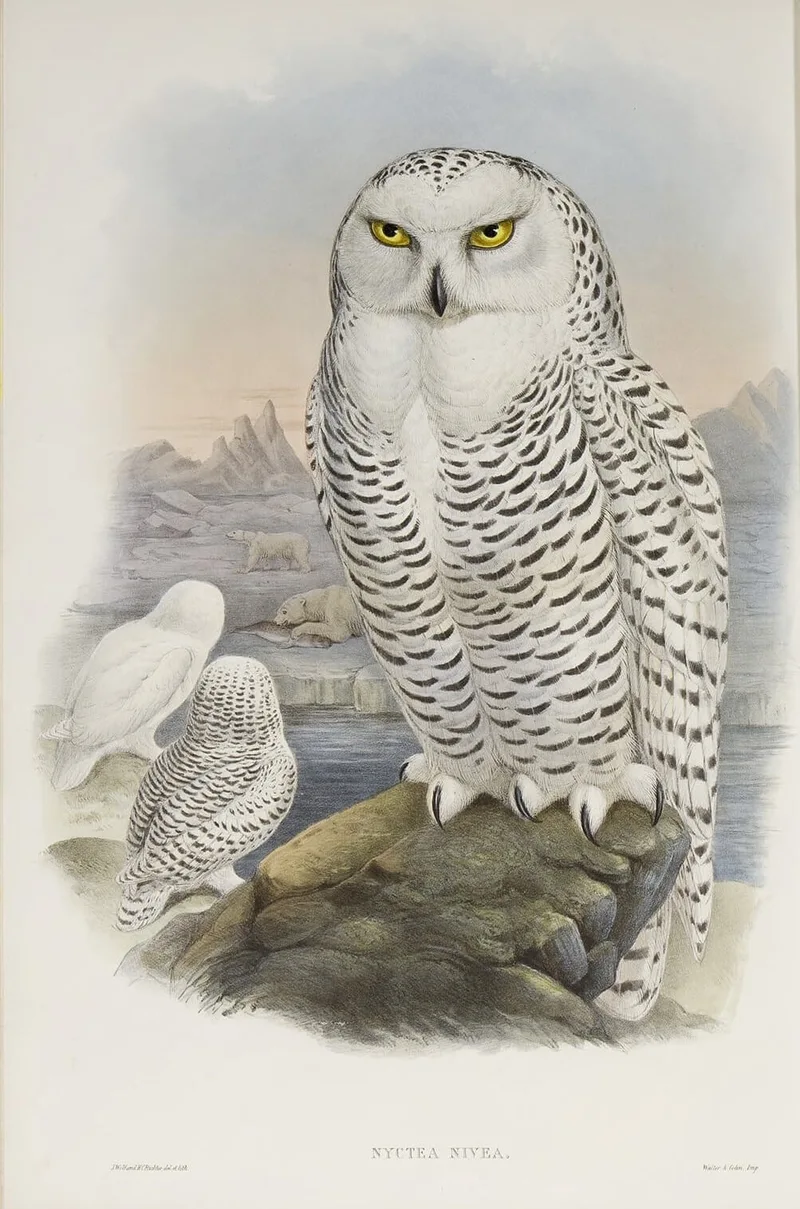
The broken stone of the Snowy Owl
Lithographic stones are heavy and brittle, and early in the printing the stone of the Snowy Owl was dropped and broke. Later impressions show the damage, which is why early impressions of this plate, printed before the accident, are the ones collectors look for.
The five volumes
Gould arranged the birds, as he wrote in the introduction, 'after the plan proposed by Mr. Vigors', the classification of his old colleague at the Zoological Society. Five volumes, five groups. For each we give the prints we offer.
- Volume 1, the Raptores: eagles, vultures, falcons, harriers and owls, Gould's 'large tyrants of the air'. We offer 37 plates.
- Volumes 2 and 3, the Insessores, the perching birds: nightjars, swifts and swallows, the Kingfisher and the Hoopoe, shrikes, tits, thrushes, warblers, wagtails and pipits. We offer 78 plates from volume 2 and 9 from volume 3.
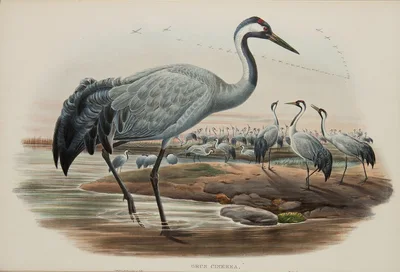
- Volume 4, the Rasores and Grallatores, birds of the ground and the water's edge: pigeons, grouse, partridges, bustards, cranes, herons, plovers and crakes. We offer 13 plates.
- Volume 5, the Natatores, the swimming birds: geese, swans, ducks, grebes, divers, auks, cormorants, gulls, terns and petrels. We offer 86 plates.
Browse the plates by volume on The Birds of Great Britain.
The Teylers copy and our prints
The copy we work from is in the library of the Teylers Museum in Haarlem. Re-Art Special Art Productions in Almere photographed its plates one by one for us, at the size they are printed, retouched them only where time had left a mark, and proofed each against the original under daylight. We offer 223 of the 367 plates, each at the size of the original sheet, about 38 by 56 centimetres, on acid-free etching paper of 270 g/m² with archival inks, in an edition of 250, numbered in pencil, blind embossed and with a certificate of authenticity. Prints ship unframed, rolled in a tube; each volume is also available as a complete set, starting with volume 1.
For Gould's other books, see What books did John Gould publish?; for the man, Who was John Gould?
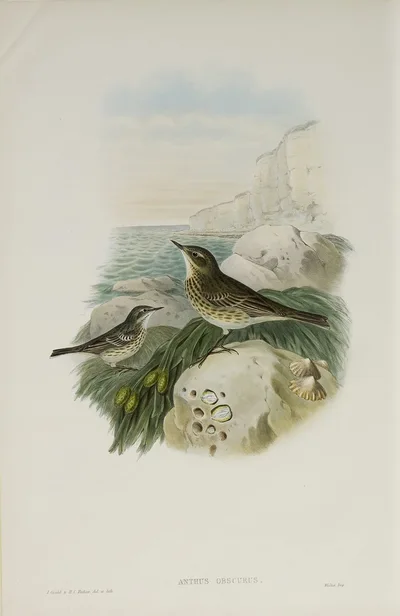
Four plates to start with
Questions
How many plates are in The Birds of Great Britain?
367 hand-coloured lithographs in five volumes, issued in 25 parts between 1862 and 1873 in an edition of 750 copies. We offer 223 of them.
Who drew the plates of The Birds of Great Britain?
Joseph Wolf, Henry Constantine Richter and William Matthew Hart, working from John Gould's rough sketches. Richter and Hart also drew the plates on the lithographic stone, and every impression was coloured by hand.
Why are early impressions of the Snowy Owl worth more?
The lithographic stone of the Snowy Owl was dropped and broken early in the printing. Impressions made before the accident are undamaged and are the ones collectors look for.