
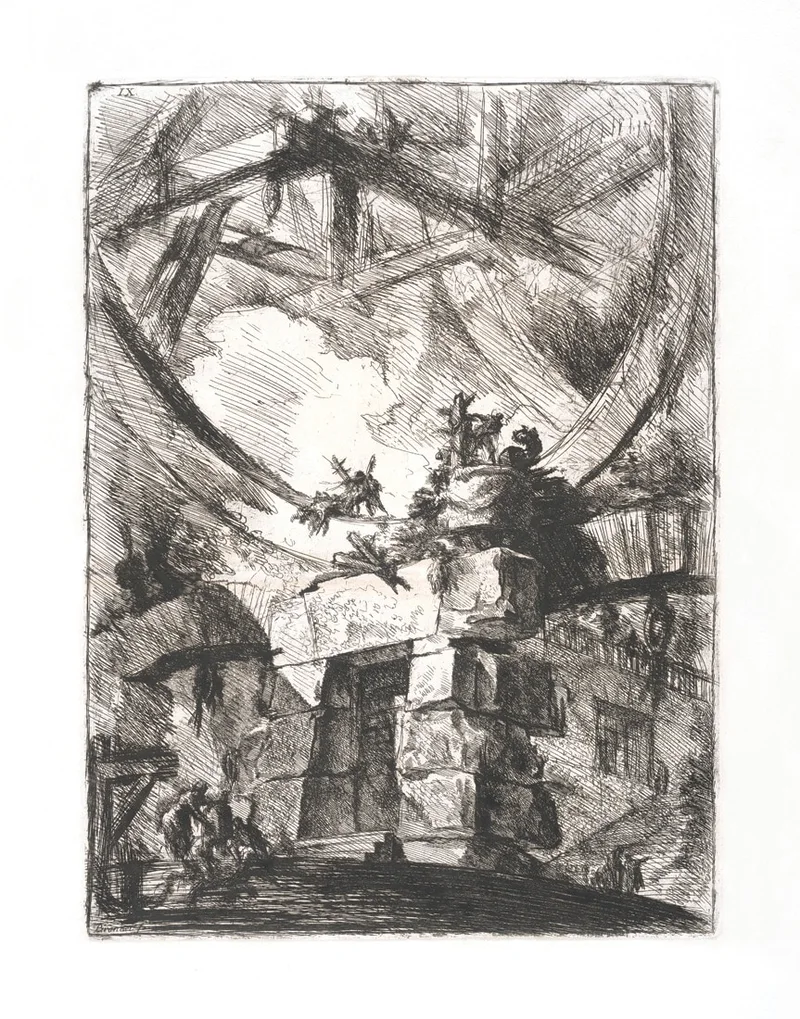
A staircase that leads to another staircase
Look at The Giant Wheel for a minute and try to find the way out. A staircase climbs to a gallery, the gallery ends at a bridge, the bridge leads to a further vault, and there the light gives up. Ropes hang from nowhere. A wheel with spokes the length of a man stands in the foreground, and the men beside it are the size of a thumbnail. Nothing is being built and nobody is going anywhere.
The Carceri d’Invenzione, the Imaginary Prisons, are a series of sixteen etchings by Giovanni Battista Piranesi (1720 to 1778), the Venetian architect and etcher who worked in Rome. He first issued them around 1750, without his name on the title plate, and reissued them in 1761 under his own name, reworked and bitten much more deeply, so that the second version is darker and more crowded than the first. They show vast underground vaults with stairs, bridges and great machines, and they have unsettled people for 270 years.
Two versions: around 1750 and 1761
The first edition appeared in Rome around 1750 as a set of fourteen plates, sold by a print dealer and bearing no artist’s name on its title. The lines are light and sketchy, the spaces airy, almost playful: architectural fantasies by a young man who had just learned to etch.
In 1761 Piranesi went back to the copper. He added two plates, bringing the set to sixteen, reworked every one, bit the lines deeper and laid in heavy cross-hatching until the vaults went black. He added chains, racks, spikes and more figures, and put his name on the title. This is the version most people know, and the one our prints follow. Both versions are his: the plates, like the prisons, were never finished.
What the plates show
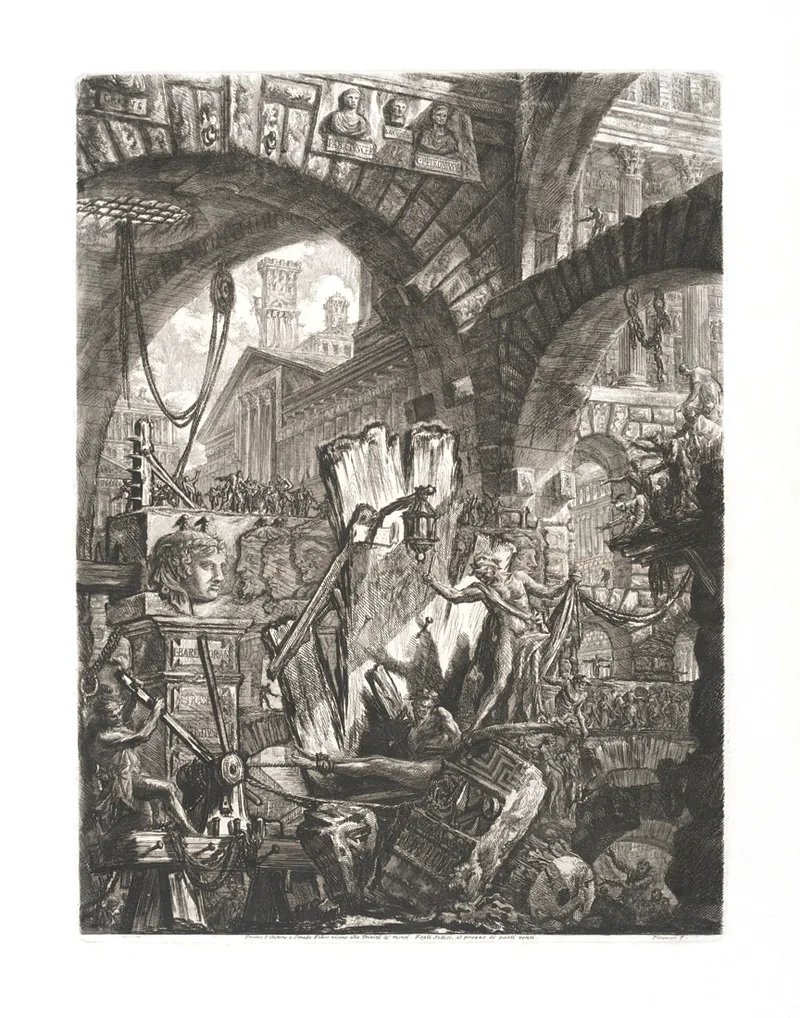
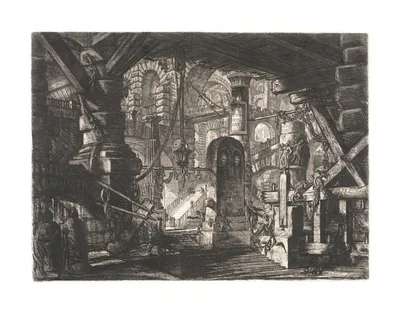
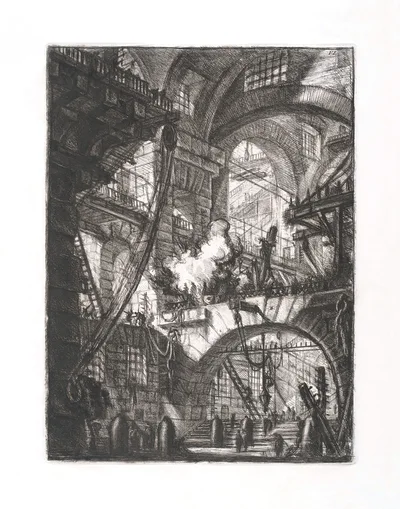
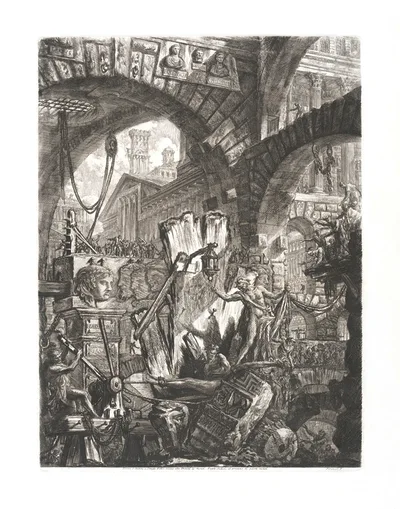
The titles the plates have acquired are plain and a little chilling: The Round Tower, The Smoking Fire, The Drawbridge, The Staircase with Trophies, The Well, The Gothic Arch, The Pier with Chains. Each shows an interior too large to be a building: arches on top of arches, galleries hung from ropes, stairs cut into piers, and here and there a lamp, a beam, a pulley or a wheel whose purpose is never explained.
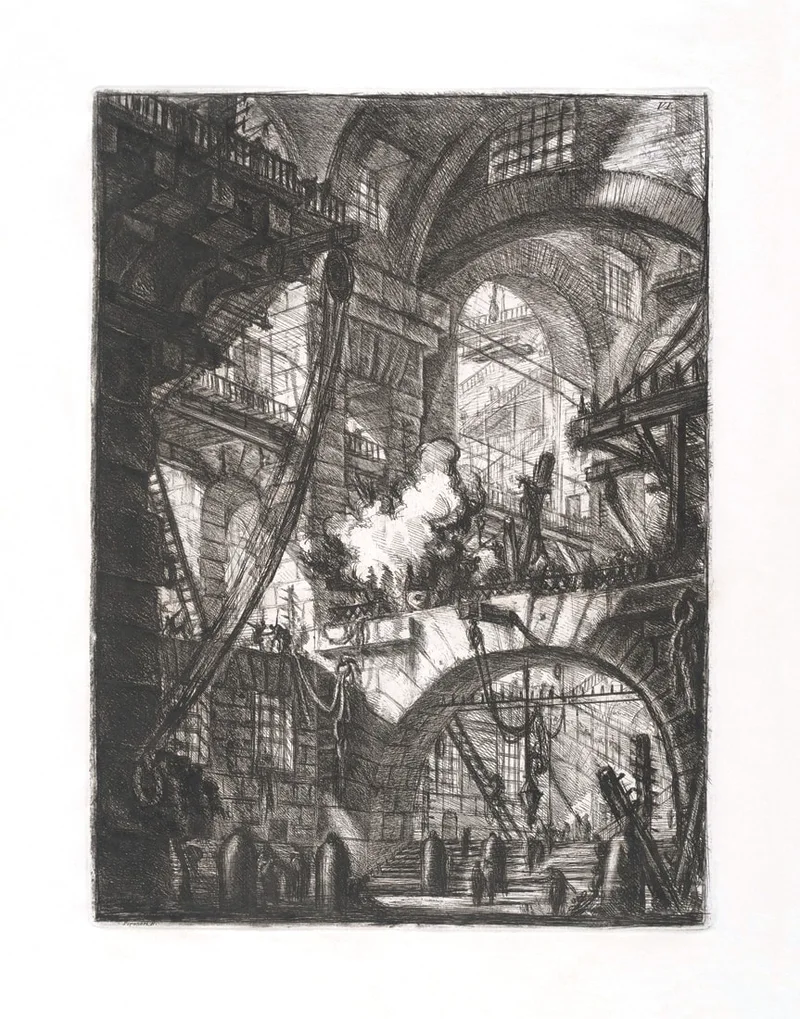
As in his views of Rome, Piranesi’s obsession is architecture and the fall of light on it. But in the prisons nothing had to exist, so he bent the rules. Vanishing points shift between the upper and lower halves of a plate; a stair that starts in the foreground ends in the far distance; a bridge crosses a space that cannot be there. The people are reduced to small dark marks, and the more you look the less sense the building makes. That is the point.
Why they still unsettle
No prison was ever built like this, and the plates were not meant as a protest. They are capricci, flights of invention in the Venetian tradition, made by an architect who was not being asked to build. Yet the Romantics read them as pictures of the mind: Thomas De Quincey, who knew them from Coleridge’s description, wrote in his Confessions of an English Opium-Eater of Piranesi climbing his own staircases for ever. Later architects, stage designers and film-makers have borrowed the vaults, the chains and the scale.
The Carceri at Heritage Prints
We sell all sixteen plates, including the title plate, as facsimiles of an original edition. Each is photographed at the size it is printed, retouched by hand only where the paper has suffered, and printed for us by Re-Art Special Art Productions in Almere on acid-free etching paper of 270 g/m² with archival inks. The sheets measure 51 by 65 centimetres (20.1 by 25.6 inches), upright or landscape as Piranesi made them, and keep their full margins. How a facsimile is made.
Every print is numbered in pencil, embossed with our blind stamp and comes with a certificate, in an edition of 250. They last more than 100 years under good conditions. The whole series is on Carceri d’Invenzione; all sixteen in a Solander box are the complete set. The plates are black and white; a hand-coloured version is possible through Custom coloring.
Four prisons to start with
Questions
How many plates are in the Carceri d’Invenzione?
Sixteen in the edition of 1761, including the title plate. The first issue of around 1750 had fourteen; Piranesi added two when he reworked the series.
Why are there two versions of Piranesi’s prisons?
Piranesi first issued the plates around 1750, lightly etched and without his name. In 1761 he reworked them, bit them much deeper, added figures and chains, and reissued them under his own name as the Carceri d’Invenzione.
Were the Carceri real prisons?
No. They are inventions, as the title says: imaginary interiors of impossible size, with stairs, bridges and machines that lead nowhere.