
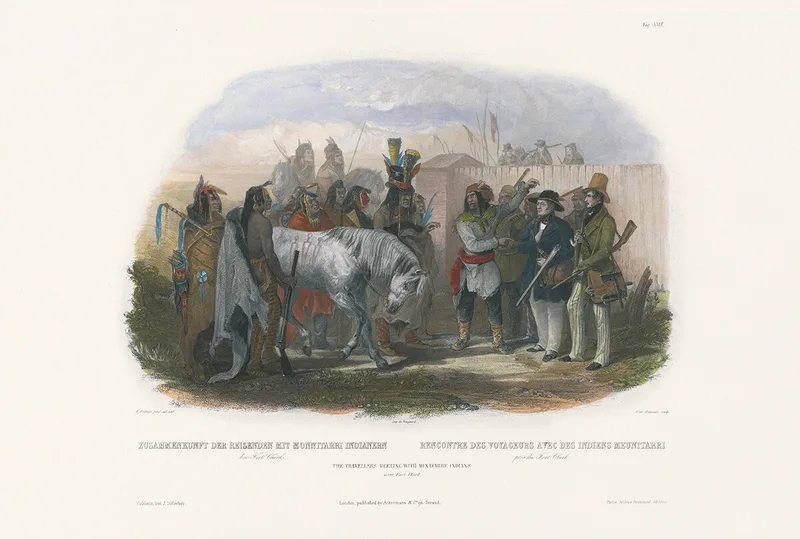
A prince, a painter and a hunter
Three Europeans on foot meet a party of mounted Hidatsa on the prairie near Fort Clark. The small figure in the middle, in a dark coat, is Maximilian, Prince of Wied-Neuwied; beside him stand his hunter David Dreidoppel and the painter Karl Bodmer, who drew the scene. It is one of the few plates in which the travellers appear, and it says what the whole book is: a meeting, recorded with care by the people on one side of it.
Travels in the Interior of North America is Maximilian's account of that journey, from Boston in 1832 to the Blackfoot country of the Upper Missouri and back in 1834. The text fills two volumes; the atlas holds 81 aquatint plates after Bodmer, 48 large tableaux and 33 smaller vignettes, with a map of the route. The German edition, Reise in das innere Nord-America in den Jahren 1832 bis 1834, was published in Koblenz from 1839; French and English editions followed, the English in London in 1843 and 1844.
Why Maximilian went
Maximilian (1782 to 1867) was a naturalist who had already explored Brazil. He went to North America to study its animals, plants and peoples before they changed, and he took Bodmer because a written description, however careful, could not show what a face or a painted robe looked like. Who Bodmer was is told separately.
The route ran from St. Louis up the Missouri by the steamer Yellow Stone to Fort Pierre, by the steamer Assiniboine to Fort Union and by keelboat to Fort McKenzie, deep in Blackfoot country, then back downriver for a winter at Fort Clark among the Mandan and Hidatsa. Along the way the travellers met the Sioux, the Assiniboine, the Plains Cree, the Gros Ventres and the Blackfoot, and Maximilian filled his journals with vocabularies, customs, counts of lodges and the names of every man who sat for Bodmer.
What the plates show
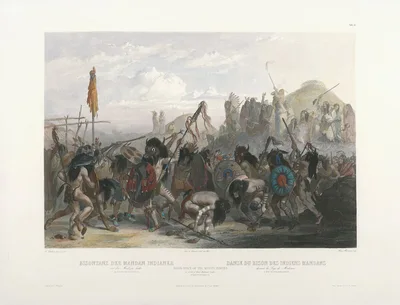
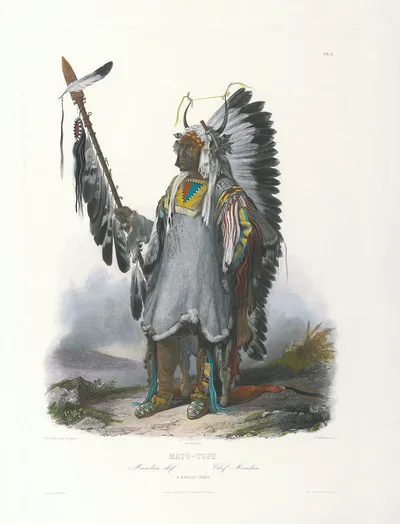
The tableaux are the large plates: portraits of chiefs and warriors in full dress, dances, the interior of a Mandan lodge, a bison herd, the forts, the strange eroded cliffs of the Upper Missouri. The vignettes are smaller and often quieter: a skin lodge, dog sledges on the ice, a view of a river bend, the travellers themselves.
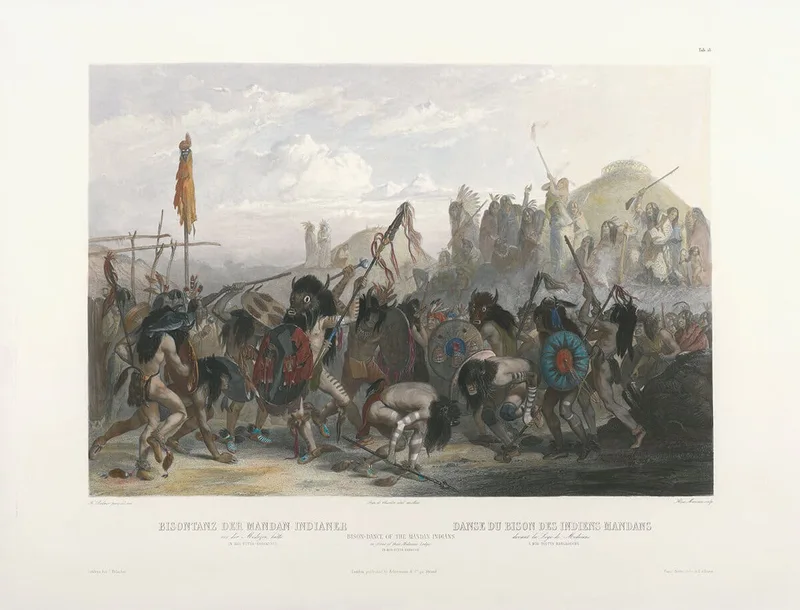
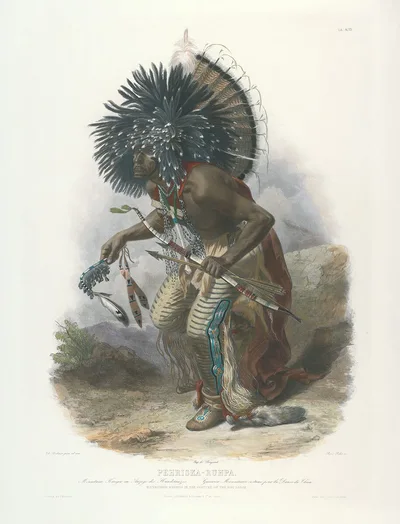
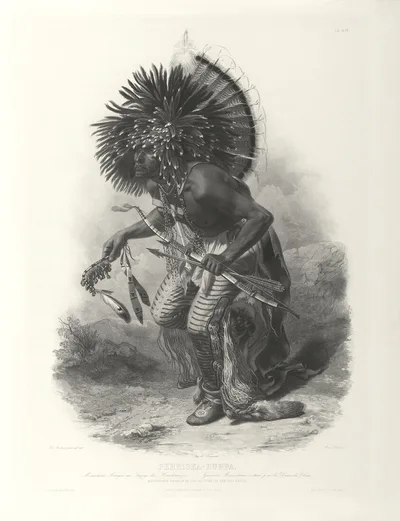
Bodmer's gift was exactness without stiffness. The feathers, quillwork and face paint of Pehriska-Ruhpa in the costume of the Dog Dance can be checked against surviving objects; the Bison Dance moves. Three years after the expedition left, smallpox killed most of the Mandan, and for their life in the villages the plates are now a primary source.
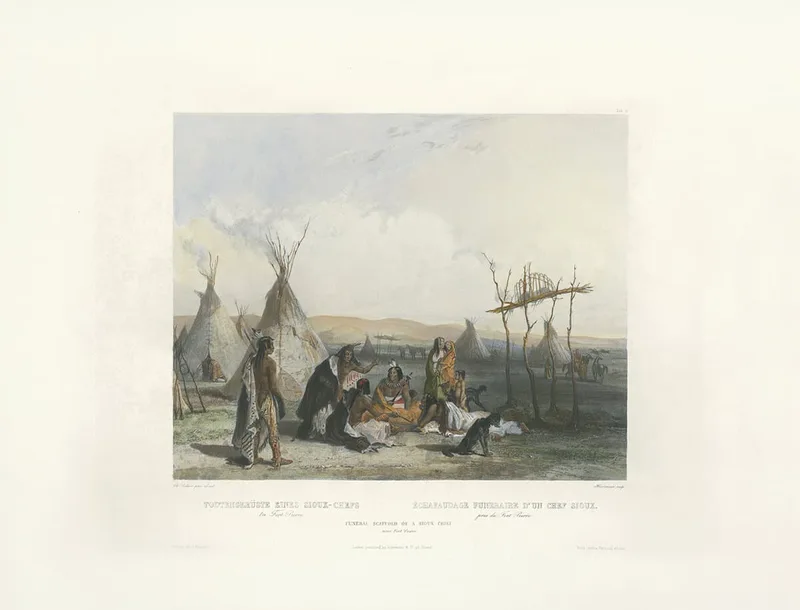
Black and white, or coloured by hand
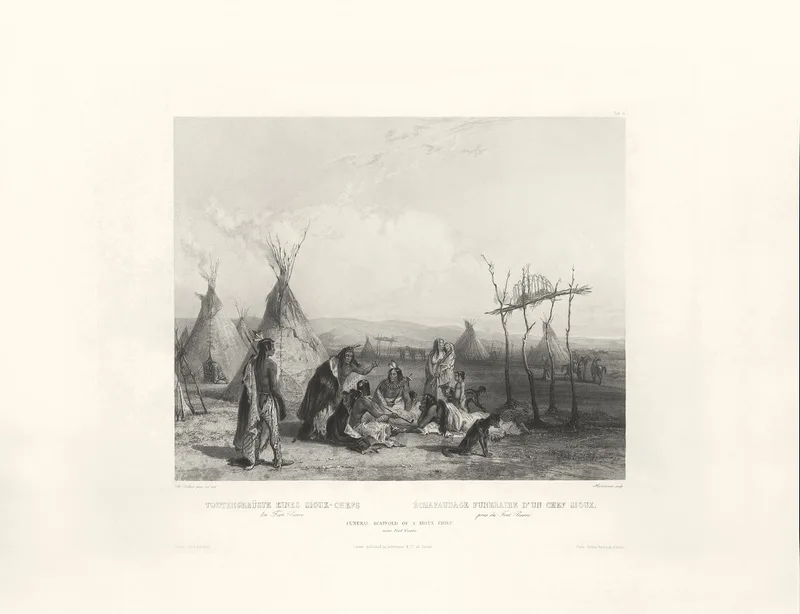
The plates were engraved in Paris as aquatints, under Bodmer's supervision, and printed in black and white; the publishers also sold copies coloured by hand, at a higher price. Both exist in museums and libraries today.
Our prints come in both forms. The black and white series shows the aquatints as they were first printed. The colour series is made differently: these are giclées printed from copies that a colourist in America coloured by hand, in the manner of the coloured copies of the 1840s. They are not reproductions of the original coloured edition. If you would rather have one particular plate coloured by hand for you, our Custom coloring service does that on request, with a quote for the price and delivery time.
The prints today
Each print is made for us by Re-Art Special Art Productions in Almere, at the size of the original plate, in an edition of 250, numbered in pencil, embossed with our blind stamp and with a certificate of authenticity. Prints ship unframed, rolled in a tube, and last more than 100 years under good conditions. Both series can also be ordered as a complete set in a Solander box: black and white or in colour.
Four plates to start with
Questions
How many plates are in Travels in the Interior of North America?
81 aquatints after Karl Bodmer, 48 tableaux and 33 vignettes, plus a map of the route. Heritage Prints offers all of them, in black and white and in colour.
When was Travels in the Interior of North America published?
The German edition appeared in Koblenz from 1839; French and English editions followed, the English in London in 1843 and 1844.
Are the Heritage Prints colour versions the original coloured plates?
No. The original aquatints were printed in black and white and some copies were coloured by hand. Our colour prints are giclées printed from copies that a colourist in America coloured by hand in that manner. The black and white series shows the plates as first printed.