
Drawn from the living bird
In the 1850s a visitor to the Amsterdam zoo Natura Artis Magistra could stand in front of a living turaco: an African bird the size of a crow, with a crest, a short bright bill and, when it flew, a flash of crimson in the wings. Hermann Schlegel, director of the natural history museum in Leiden, drew the birds there. Where the zoo had no living bird, he worked from skins.
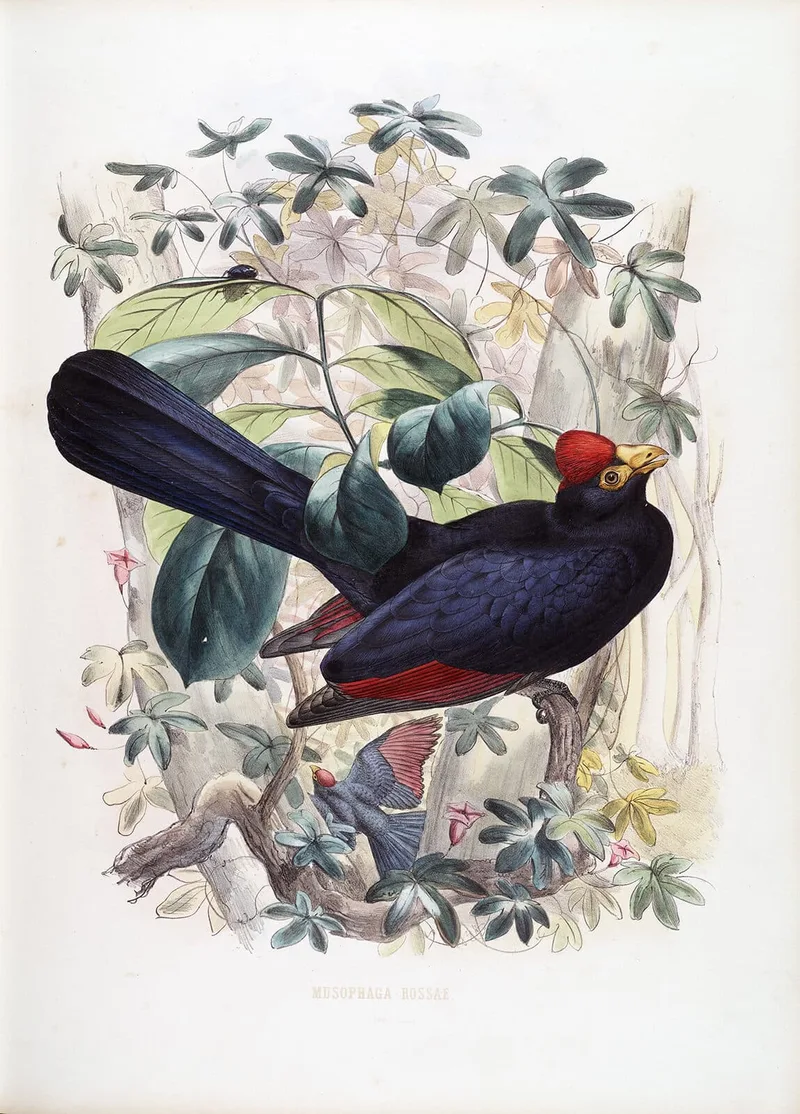
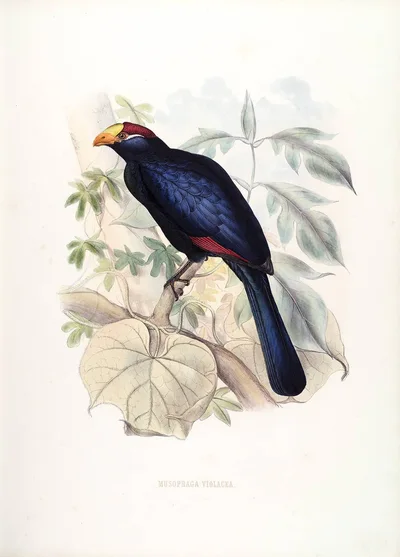
De Toerako's is the book that came of it: published in Leiden in 1860 by the Royal Zoological Society Natura Artis Magistra, written in Dutch by Schlegel with Gerardus Frederik Westerman (1807-1890), one of the founders of the zoo, and illustrated with 17 hand-coloured lithographs after Schlegel's drawings. It shows every turaco species known at the time, each at life size. Our 17 prints are made from the copy in the Teylers Museum in Haarlem.
A book that was never for sale
Artis, founded in 1838, is the oldest zoo in the Netherlands, and the society that ran it had scientific ambitions. It commissioned the book and dedicated it to its patron, King Willem III. The edition was very small and the copies were not sold: the society presented them to its members and to zoologists it wished to honour. That is why De Toerako's is so rare today, and why it is often called the finest Dutch colour-plate book on birds.
The text gives a description of each species, with its distribution and synonymy, and a synopsis with the Latin diagnoses. But as the bibliographer Anker wrote, 'the essential part of the work consists of the beautiful plates'. The birds are figured life-size, 'which accounts for the large format'.
What is a turaco?
Turacos live only in Africa south of the Sahara, in forest and wooded savanna. They are also called plantain-eaters and, for their loud call, go-away-birds. Schlegel's generation put them close to the cuckoos; today they have an order of their own, Musophagiformes, with a single family, Musophagidae. The name means banana eater.
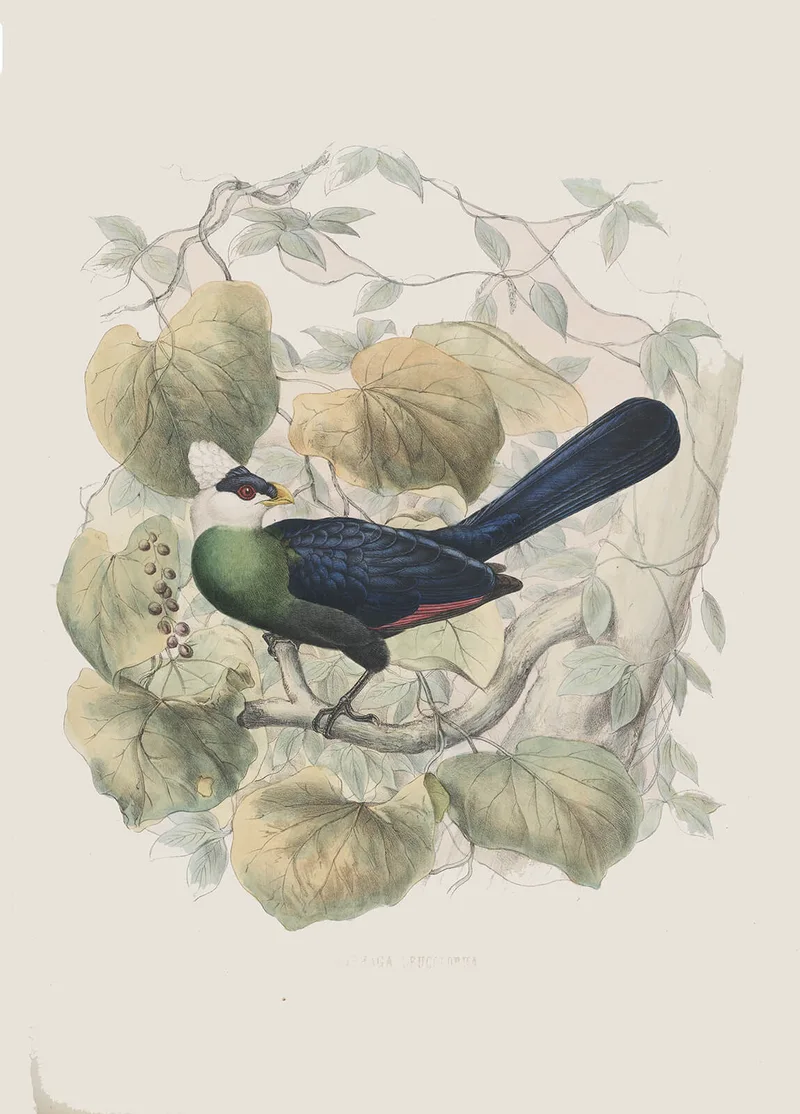
What makes them worth a book is the colour. The green and the crimson of turaco feathers are true pigments, turacoverdin and turacin, which hardly any other bird has: most green in birds is a trick of light on the structure of the feather, and turacin even washes out in water. Schlegel could not know the chemistry, but his plates show the colours as the living birds wore them.
The plates, and the shadow of Wolf
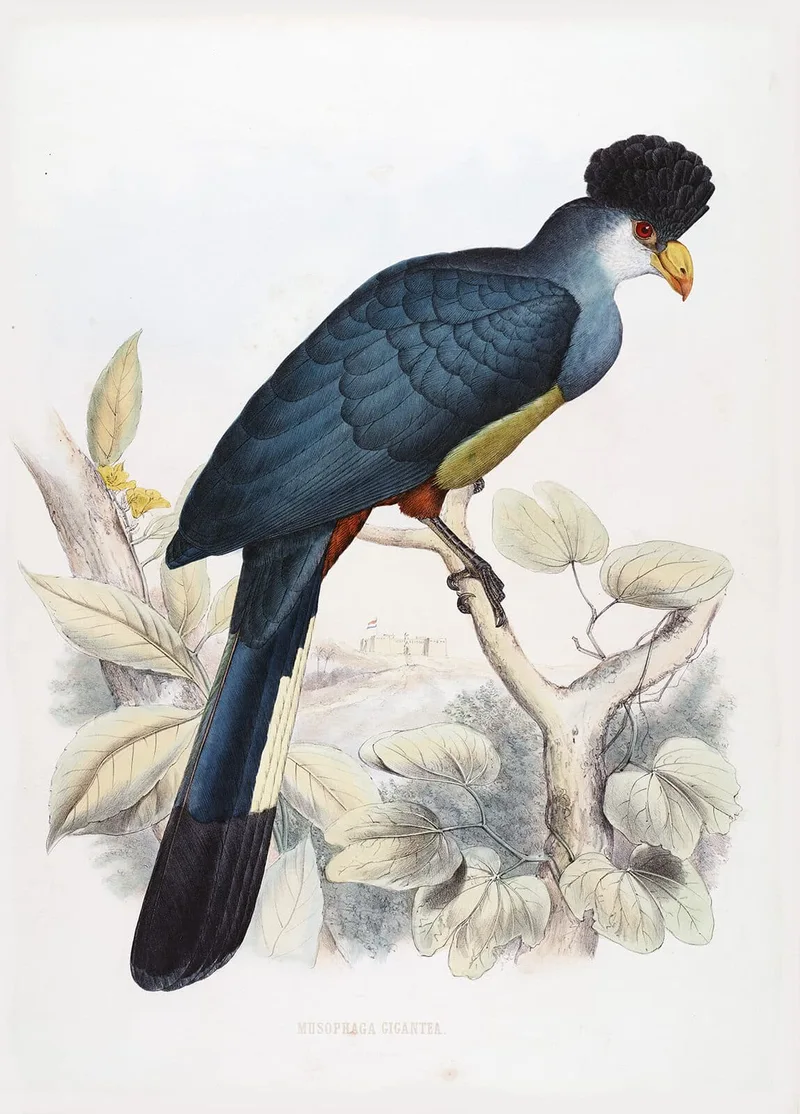
Schlegel drew and lithographed much of his own work, and these plates are his, printed by P.W.M. Trap in Leiden and coloured by hand. Bibliographers have noticed something else in them. 'The plates are excellent and suggest the work of Wolf', wrote Zimmer. Joseph Wolf had drawn the hawks of Schlegel's earlier Traité de fauconnerie, and the lively poses of the turacos carry something of his manner.
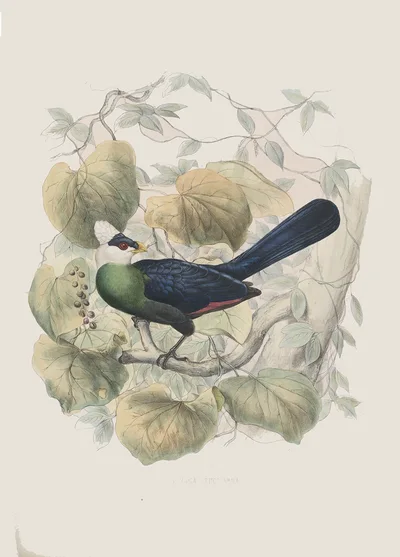
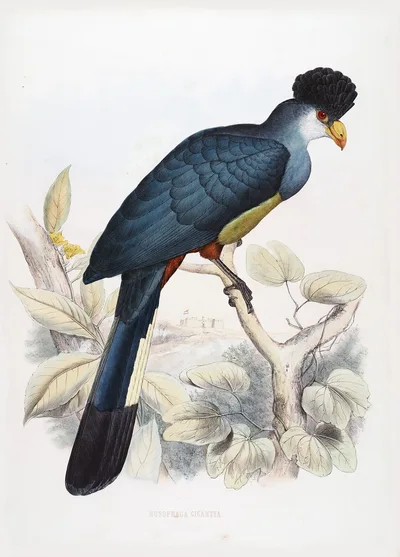
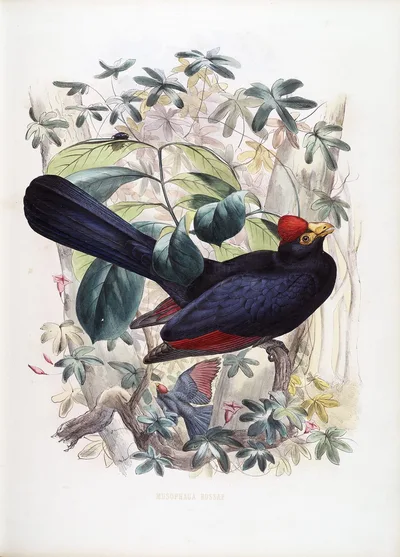
Each bird sits on a branch among the foliage of its own habitat, and each is life-size, so the great blue turaco fills its sheet. The titles are the Latin names of 1860: Musophaga Rossae for Ross's turaco, Musophaga Leucolopha for the white-crested, Musophaga Gigantea for the great blue.
De Toerako's at Heritage Prints
Our series holds all 17 plates, photographed from the copy in the library of the Teylers Museum in Haarlem by Re-Art Special Art Productions in Almere and printed at the size of the original sheets, 57 by 72 cm, on acid-free etching paper. Each is in an edition of 250, numbered in pencil, blind embossed and with a certificate of authenticity.
See De Toerako's and the complete set, or read Who was Hermann Schlegel? and What is the Traité de fauconnerie?.
Four turacos from the book
Questions
Who made De Toerako's?
Hermann Schlegel (1804-1884), director of the natural history museum in Leiden, drew the plates and wrote the text with Gerardus Frederik Westerman (1807-1890), one of the founders of the Amsterdam zoo Artis. The society published it in 1860.
How many plates does De Toerako's have?
Seventeen: one for each turaco species known in 1860, each at life size, in hand-coloured lithography. All 17 are in our series.
Was De Toerako's ever sold?
No. The society Natura Artis Magistra presented the copies to its members and to zoologists it wished to honour, which is why the book is so rare.