
An eclipse at noon
In the autumn of 1813 John James Audubon left his house at Henderson, on the banks of the Ohio, and rode towards Louisville. A few miles beyond Hardinsburg he noticed pigeons passing overhead, more than he had ever seen. He stopped to watch.
The air was literally filled with Pigeons; the light of noon-day was obscured as by an eclipse, the dung fell in spots, not unlike melting flakes of snow; and the continued buzz of wings had a tendency to lull my senses to repose.
A hundred and one years later, in 1914, the last Passenger Pigeon on earth died in a cage at Cincinnati Zoo. Her name was Martha.
Audubon painted 435 plates for The Birds of America. For a handful of them, his sheet is now one of the few places the bird can still be seen. This is the story of four of those birds, told where possible in his own words.
The Passenger Pigeon: the most numerous bird on earth
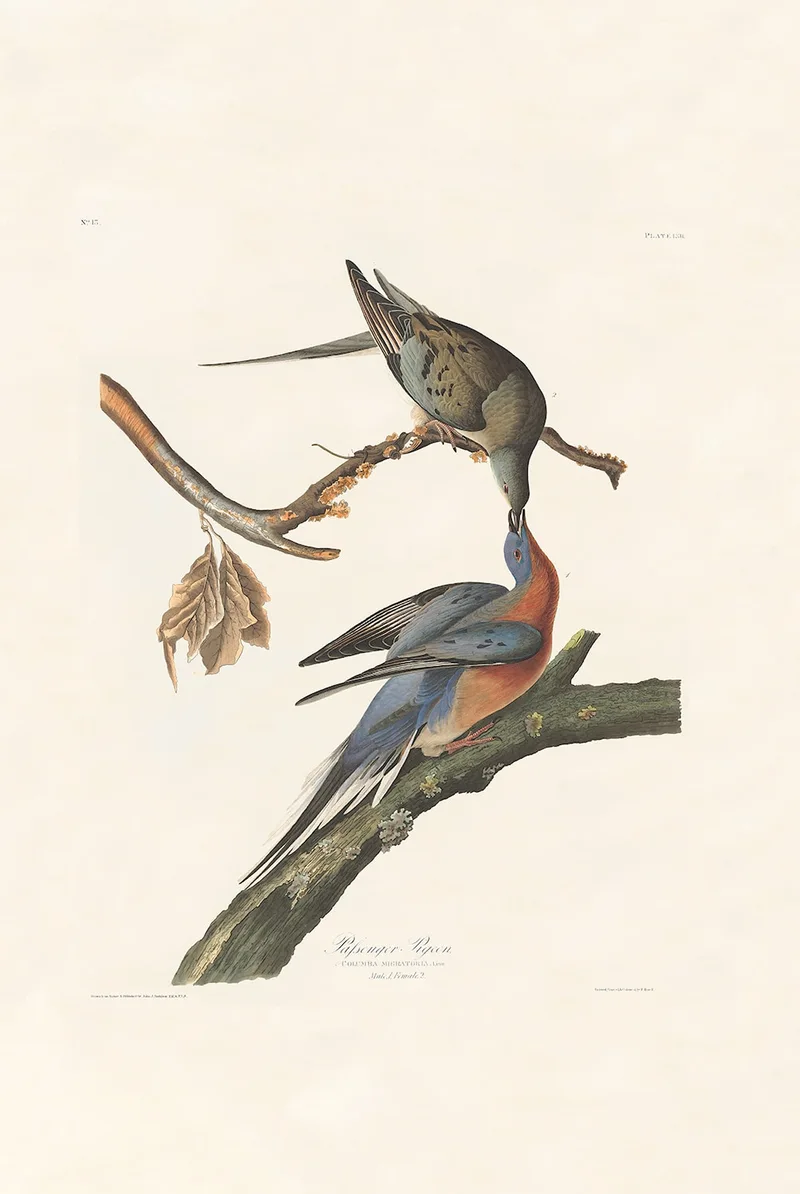
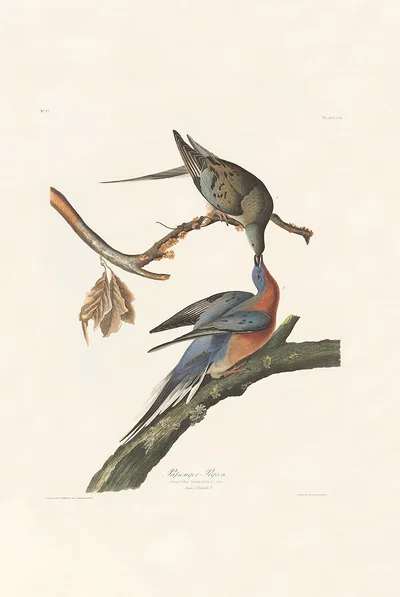
In 1800 there were perhaps five billion Passenger Pigeons in North America, possibly more than any other bird in the world. They moved in flocks of hundreds of millions that could take days to pass. A slate-blue back, a red breast on the male, a long pointed tail: a handsome bird, but it was the numbers that made it. The pigeons bred in colonies that covered whole forests and relied on those numbers for safety.
Plate 62 shows two birds billing, one above the other, and has been criticised ever since: the pair would have sat side by side, the male would have passed the food, and his tail would not have been spread. Audubon was a better observer of flocks than of courtship.
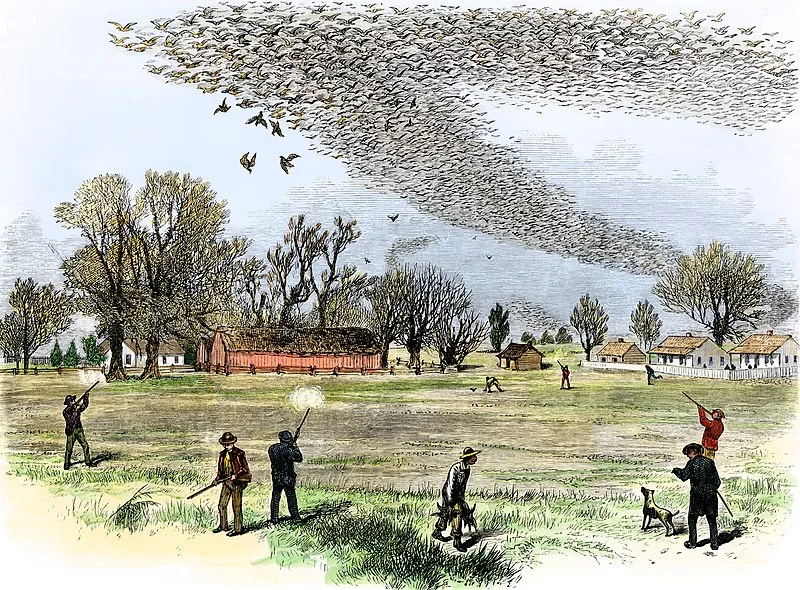
He watched a roost in Kentucky where people had camped to wait for the birds. When the pigeons came in at dusk, men with poles knocked them down by the thousand, fires were lit, branches gave way under the weight of birds, and the noise carried three miles. At sunrise the survivors flew off and hogs were turned loose on what was left.
Here again, the tyrant of the creation, man, interferes, disturbing the harmony of this peaceful scene.
Yet Audubon did not think the pigeons could be shot out. He saw them sold for a cent apiece in New York and still thriving, and concluded that only the clearing of the forests could reduce them. He was half right. The forests were cleared, and the great nestings were hunted straight through the breeding season. In 1878 one nesting was worked for nearly five months, with up to 50,000 birds killed a day and about 7.5 million in all; when the surviving adults tried to nest again, they were killed too.
A bird that needed a crowd to breed could not survive in small numbers. The last wild bird was shot in 1901.
The Pinnated Grouse: from pest to rarity in twenty-five years
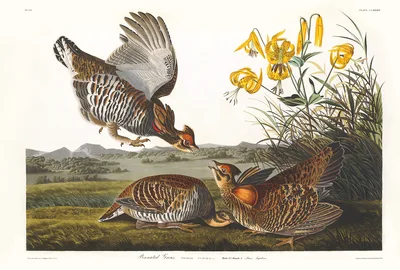
When Audubon moved to Kentucky in 1808, the prairie chicken was a nuisance. The birds were, he wrote, “so abundant, that they were held in no higher estimation as food than the most common flesh, and no ‘hunter of Kentucky’ deigned to shoot them.” They ate the buds off the orchard trees in winter and the seed out of the fields in spring, and farmers’ children drove them off with rattles from morning to night. In winter the grouse walked into farmyards and fed with the poultry; Audubon caught several in a stable at Henderson, where they had followed some Wild Turkeys. A friend shot upwards of forty in a morning and left them where they fell.
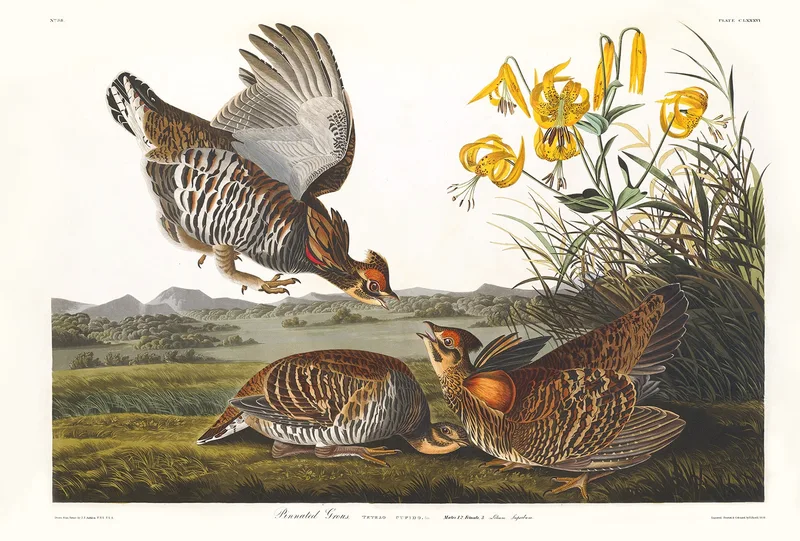
Twenty-five years later, writing the text to go with this plate, he could hardly believe his own account.
Such an account may appear strange to you, reader; but what will you think when I tell you, that, in that same country, where, twenty-five years ago they could not have been sold at more than one cent apiece, scarcely one is now to be found?
In the markets of Philadelphia, New York and Boston the birds now fetched five to ten dollars the pair, and sportsmen travelled a hundred miles to shoot a dozen brace in a fortnight. The grouse, Audubon wrote, “have abandoned the State of Kentucky, and removed (like the Indians) every season farther to the westward, to escape from the murderous white man.”
The species survives, but only just. It was shot as a pest and its prairie was ploughed. One of its three subspecies, the Heath Hen of the eastern seaboard, has been extinct since the early 1930s. The Greater Prairie Chicken and Attwater’s Prairie Chicken are protected and bred in captivity; in 2019 Illinois had about 200 birds left and Missouri about 500.
The Great Auk: painted from a bird he never saw alive
Audubon went looking for this one. In 1833 he sailed to Labrador, where the fishermen told him about the bird they called the Penguin.
When I was in Labrador, many of the fishermen assured me that the “Penguin,” as they name this bird, breeds on a low rocky island to the south-east of Newfoundland, where they destroy great numbers of the young for bait, but as this intelligence came to me when the season was too far advanced, I had no opportunity of ascertaining its accuracy.
He never found one. The Great Auk was a flightless seabird 75 centimetres tall, a powerful swimmer and clumsy on land, which bred on a few bare islands in the North Atlantic. It had never learned to fear people, and for sailors and settlers it was food that walked up to the boat; its eggs were taken and its chicks used as bait for cod. Protection was attempted as early as 1553, but rarity only raised the price: collectors paid for a skin or an egg what a skilled worker earned in a year.
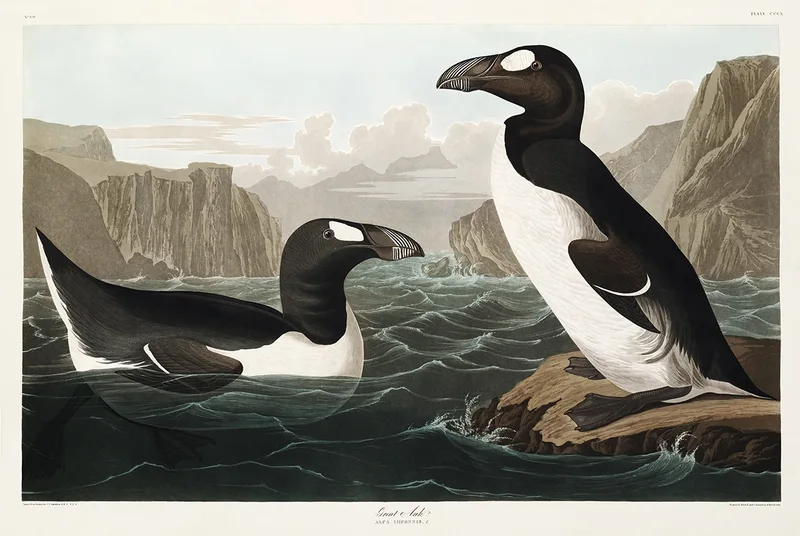
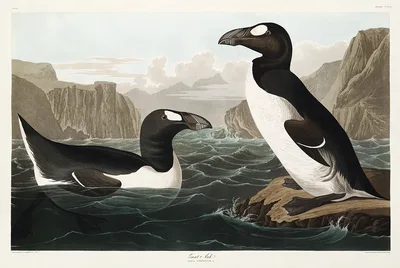
Audubon bought a stuffed specimen in London in 1836 and painted it as if alive, in the water and on the rock. The background, as often, he left to his engraver Robert Havell Jr., who painted the cliffs and the gale without ever having been north of London. On 3 June 1844, within a decade of the plate, the last known breeding pair was killed on Eldey, off Iceland.
The scene as a whole has a fantastical quality, removed from any reality we might want to associate with it: the waves arrested in timelessness as in Japanese prints, the rocks bathed in a light that seems to come from nowhere in particular, a perfect stage for birds that exist no longer in nature, but only in the naturalist’s mind and on the pages of his big book.
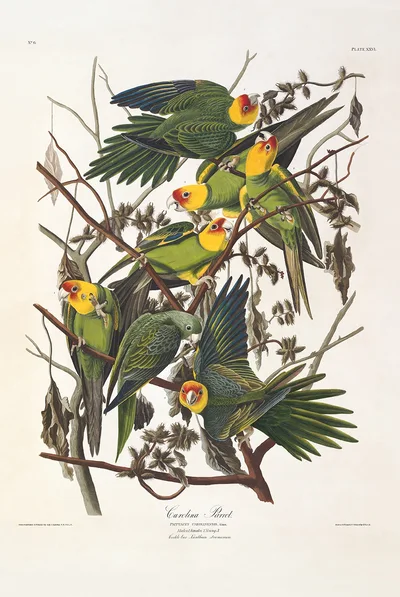
The Carolina Parrot: too bright for its own good
Our Parakeets are very rapidly diminishing in number; and in some districts, where twenty-five years ago they were plentiful, scarcely any are now to be seen.
The only parrot native to the eastern United States was green and yellow, and it flew in loud flocks through orchards and river forests. Farmers shot it for what it did to the fruit. Milliners wanted its feathers for hats; a brooch made of Carolina Parakeet tails and heads survives, pinned to a walking dress of the 1880s. And the old hollow trees it nested in were felled for timber. Plate 26 shows a flock feeding together, the way Audubon saw them.
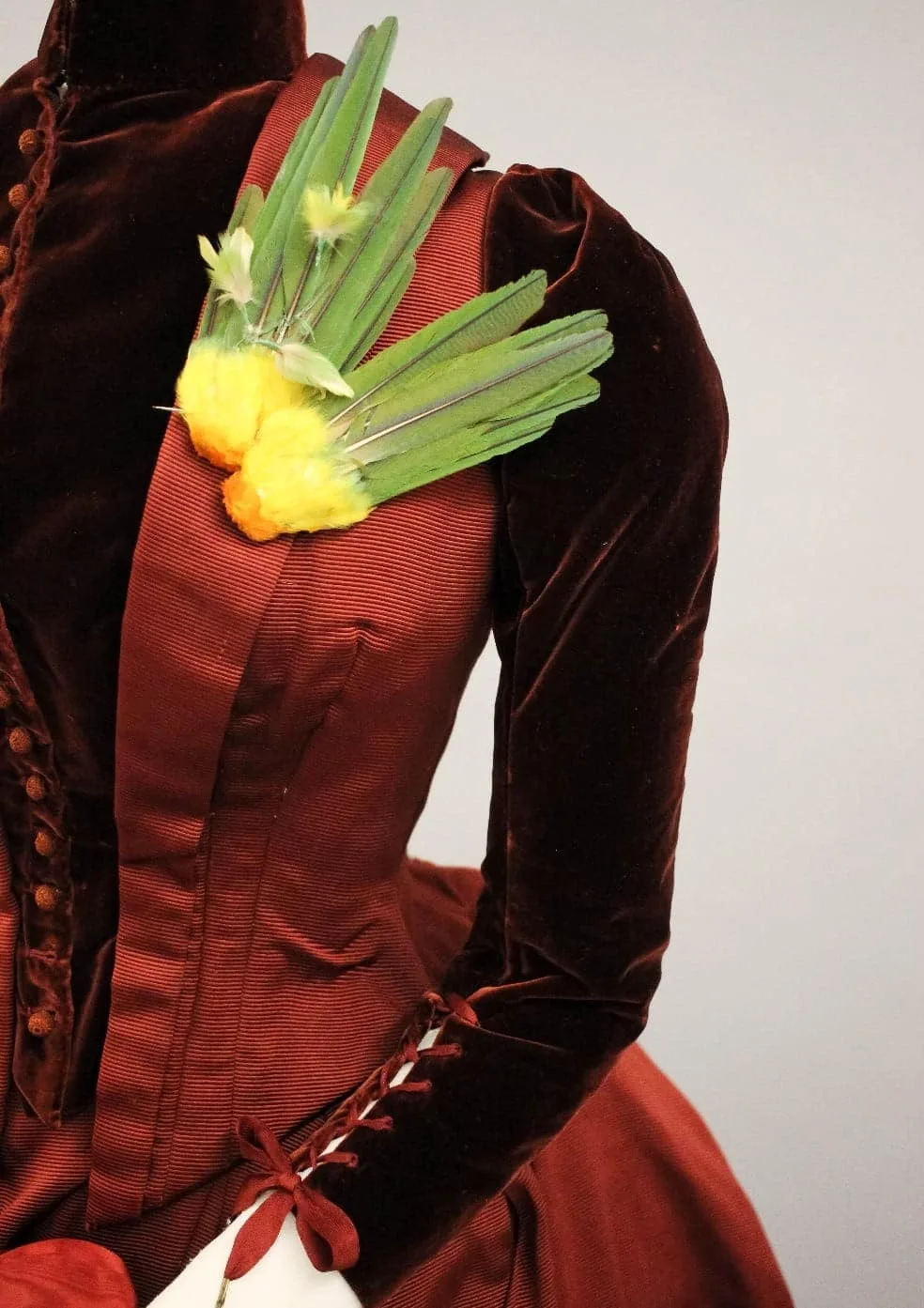
The last captive bird died in 1918, in the same Cincinnati zoo as Martha.
And the others
The Pied Duck of plate 332, now called the Labrador Duck, went in the 1870s. The Ivory-billed Woodpecker of plate 66 has not been confirmed alive for decades. Both lost their habitat first; both were drawn while they were still ordinary birds.
What the plates are now
Audubon shot birds to paint them, and he did not expect the pigeons to run out. But he wrote down what he saw with a precision nobody else bothered with: the prices in the market, the farmers’ rattles, the cent apiece. Read next to the plates, his journals are the clearest record we have of how quickly abundance can end.
The copy of The Birds of America that the Teylers Museum in Haarlem bought from Audubon’s son in 1833 still holds all of these birds, at their real size and in their own colours. Our facsimiles are made from that copy, and the extinct birds stay in the collection on purpose. A Passenger Pigeon on a wall is a quiet argument for the birds that are left.
The birds in this story
Questions
Which birds in The Birds of America are extinct?
The Passenger Pigeon (plate 62), the Carolina Parrot (plate 26), the Great Auk (plate 341) and the Pied or Labrador Duck (plate 332). The Ivory-billed Woodpecker (plate 66) has not been confirmed alive for decades, and the Heath Hen, a subspecies of the Pinnated Grouse (plate 186), is also gone.
Why did the Passenger Pigeon become extinct?
Hunting on an industrial scale, straight through the breeding season, combined with the clearing of the forests it nested in. A bird that bred in colonies of millions could not keep going once the colonies were broken up. The last wild bird was shot in 1901 and the last captive bird, Martha, died in 1914.
Did Audubon ever see a living Great Auk?
No. He searched for it off Labrador and Newfoundland in 1833 and found none. He painted plate 341 from a stuffed specimen he bought in London in 1836; the last known pair was killed in 1844.
Is the Pinnated Grouse extinct?
The species survives under protection, though in small numbers. One subspecies, the Heath Hen, has been extinct since the early 1930s.